

16 Marks – Sweden
Sweden
Context
Year: 1624
Issuer: Sweden 
Ruler: Gustavus II Adolphus
Currency:
(1598—1665)
Subdivision: 16 Marks = 1 Carolin
Demonetized: Yes
Material
References
KM: #Click to copy to clipboard105
Numista: #142307
Value
Bullion value: $824.31
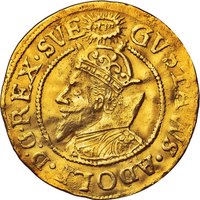
Obverse
Description:
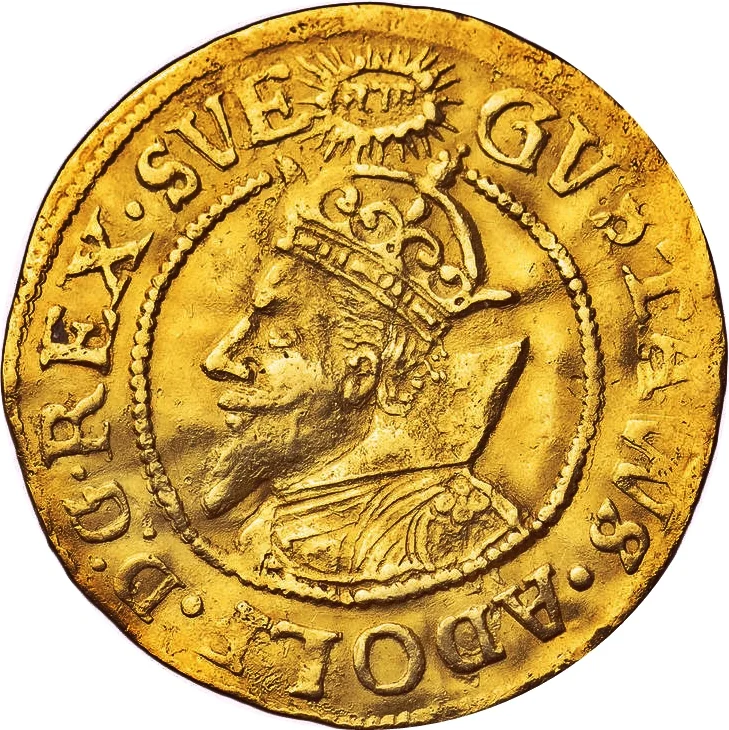
King Gustav II Adolf facing right within a beaded circle. The Hebrew name of Jehovah appears radiantly above his head, inside the surrounding legend.
Inscription:
GVSTAWS · ADOLF · D:G · REX · SVE
( יהוה )
( יהוה )
Script: Latin
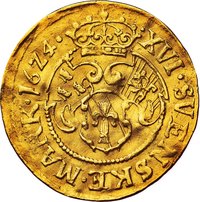
Reverse
Description:
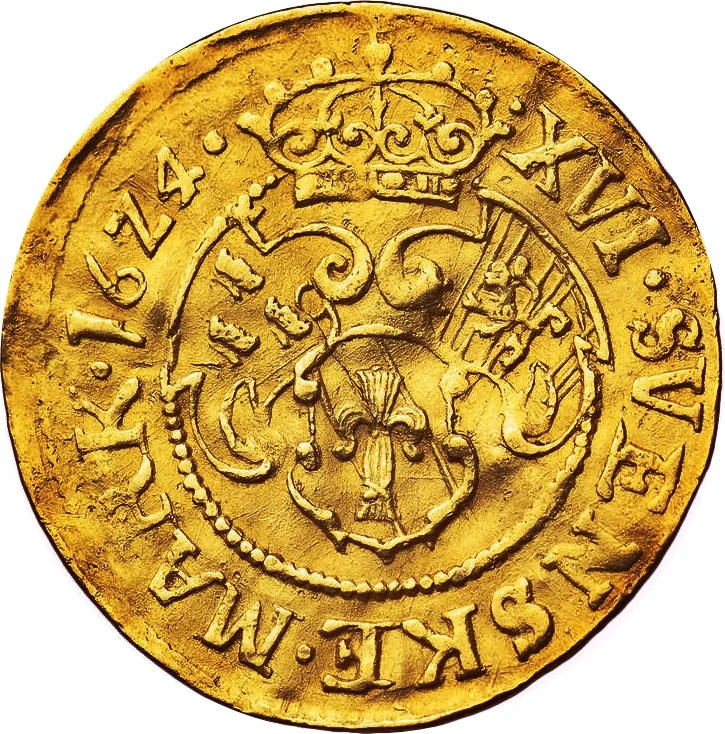
Crown above three shields in a triangular frame: the top two (Sweden's Three Crowns and the Folkungs Lion) bend inward, above a shield with the Vasa Arms. This central motif is encircled by beads, with the value and date around the outside.
Inscription:
· XVI · SVENSKE * MARK · 16Z4 ·
Script: Latin
Edge
Mintings
| Year | Mint Mark | Mintage | Quality | Collection |
|---|---|---|---|---|
| 1624 | — | — |
Historical background
In 1624, Sweden was grappling with a severe monetary crisis rooted in the preceding decades of aggressive foreign policy under King Gustavus Adolphus. To finance near-constant warfare in the Baltic, the crown had repeatedly debased the national currency, the mark. By reducing the silver content in coins while maintaining their face value, the state created short-term revenue but triggered rampant inflation, a loss of public trust, and economic instability. The domestic economy suffered as "good" full-weight coins were hoarded or exported, leaving circulation to the inferior, debased currency—a classic example of Gresham's Law.
Recognizing that the chaotic currency was undermining both the economy and the war effort itself, Gustavus Adolphus enacted a sweeping reform in 1624. This involved a complete recall and re-minting of the circulating coinage. The old, debased mark system was abolished and replaced with a new, standardized silver-based currency. The foundational unit became the riksdaler (rixdollar), a large silver coin inspired by German and Dutch models, which was valued in a fixed relationship to smaller subsidiary coins like öre and mark to create a clear decimal system.
This reform was a landmark success. It restored confidence in Sweden's money by guaranteeing its silver content and stable value, which facilitated trade and state finance. The new system provided the solid fiscal foundation necessary for Sweden’s continued military campaigns during the Thirty Years' War and established a monetary framework that would endure for centuries, marking a pivotal step in the nation's rise as a European great power.
Recognizing that the chaotic currency was undermining both the economy and the war effort itself, Gustavus Adolphus enacted a sweeping reform in 1624. This involved a complete recall and re-minting of the circulating coinage. The old, debased mark system was abolished and replaced with a new, standardized silver-based currency. The foundational unit became the riksdaler (rixdollar), a large silver coin inspired by German and Dutch models, which was valued in a fixed relationship to smaller subsidiary coins like öre and mark to create a clear decimal system.
This reform was a landmark success. It restored confidence in Sweden's money by guaranteeing its silver content and stable value, which facilitated trade and state finance. The new system provided the solid fiscal foundation necessary for Sweden’s continued military campaigns during the Thirty Years' War and established a monetary framework that would endure for centuries, marking a pivotal step in the nation's rise as a European great power.

✨ Legendary