

2½ Kreuzer – Teutonic Order
Germany
Obverse
Description:
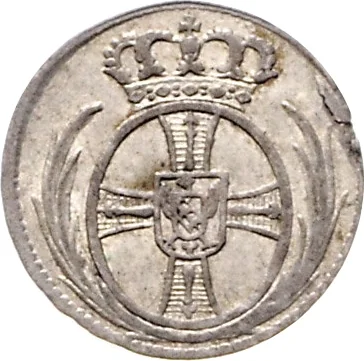
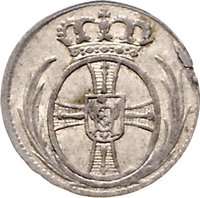
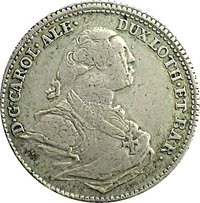
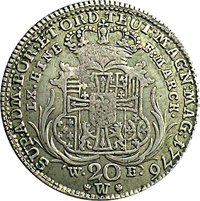
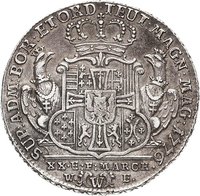
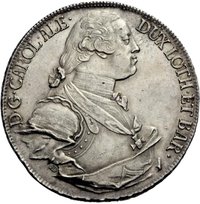
Crowned oval arms flanked by palm fronds.
Reverse
Description:
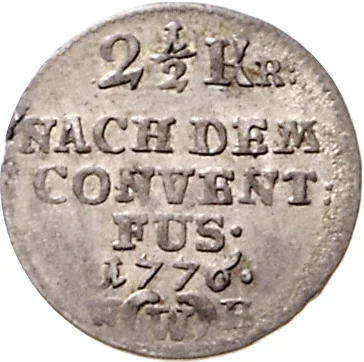
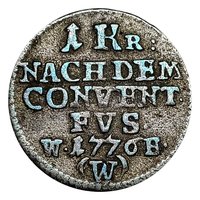
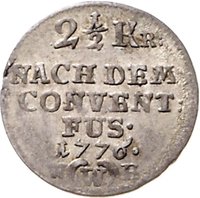
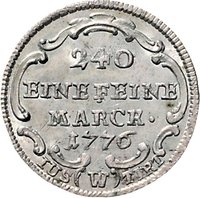
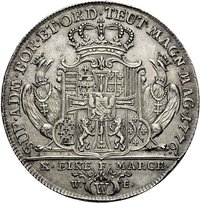
Dated 6-line inscription with mint officials' initials.
Inscription:
2-1/2 Kr: / NACH DEM / CONVENS: / FUS. / 1776 / W(W)E
Script: Latin
Edge
Mints
| Name | Mark |
|---|---|
| Wertheim | — |
Mintings
| Year | Mint Mark | Mintage | Quality | Collection |
|---|---|---|---|---|
| 1776 | W | — |
Historical background
In 1776, the currency situation within the lands of the Teutonic Order was complex and fragmented, reflecting the Order's diminished and anomalous political status. The monastic state had been secularized in 1525, transforming into the Duchy of Prussia, and the remaining holdings of the Teutonic Order were limited to small, scattered territories within the Holy Roman Empire, most notably around Mergentheim, where the Grand Master resided. As such, the Order no longer functioned as a sovereign minting authority for a unified realm. Its economic transactions were conducted using a multitude of circulating coins from the various German states and empires that surrounded its enclaves.
The primary circulating media would have been a mixture of regional and imperial currencies. The Holy Roman Empire's monetary system was notoriously decentralized, with numerous states (like Austria, Bavaria, and Saxony) issuing their own silver Taler and smaller fractional coins (Kreuzer, Groschen). The Order's territories would have been integrated into the economic spheres of their specific regions, likely using the coinage of neighboring princes or ecclesiastical states. Furthermore, the widespread use of account money, like the Reichsthaler as a unit of account for bookkeeping and contracts, was essential for navigating this chaotic physical coinage.
Therefore, the "currency situation" for the Teutonic Order in 1776 was one of dependency and adaptation. The Order administered its estates and collected revenues not in its own currency, but in a patchwork of external coins, which then had to be managed, exchanged, and assayed for their varying silver content. This monetary fragmentation was a practical symbol of the Order's loss of temporal power, existing as a minor territorial lord within the intricate and outdated financial architecture of the pre-Napoleonic Holy Roman Empire.
The primary circulating media would have been a mixture of regional and imperial currencies. The Holy Roman Empire's monetary system was notoriously decentralized, with numerous states (like Austria, Bavaria, and Saxony) issuing their own silver Taler and smaller fractional coins (Kreuzer, Groschen). The Order's territories would have been integrated into the economic spheres of their specific regions, likely using the coinage of neighboring princes or ecclesiastical states. Furthermore, the widespread use of account money, like the Reichsthaler as a unit of account for bookkeeping and contracts, was essential for navigating this chaotic physical coinage.
Therefore, the "currency situation" for the Teutonic Order in 1776 was one of dependency and adaptation. The Order administered its estates and collected revenues not in its own currency, but in a patchwork of external coins, which then had to be managed, exchanged, and assayed for their varying silver content. This monetary fragmentation was a practical symbol of the Order's loss of temporal power, existing as a minor territorial lord within the intricate and outdated financial architecture of the pre-Napoleonic Holy Roman Empire.
✨ Legendary