

1 Ducat – Teutonic Order
Germany
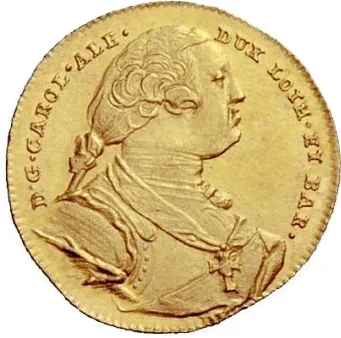
Obverse
Description:
Armored bust facing right.
Inscription:
D. G. CAROL. ALE. - DUX LOTH. ET BAR.
Script: Latin
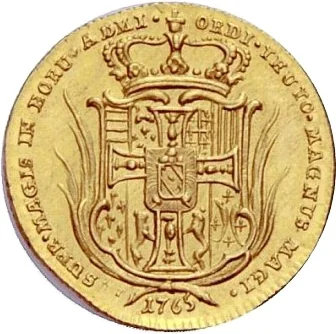
Reverse
Description:
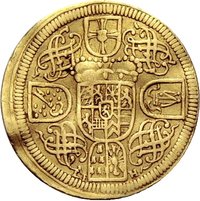
Crowned coat of arms.
Inscription:
SUPR. MAGIS IN BORU. ADMI. - ORDI. TEUTO. MAGNUS MAGI.
Script: Latin
Edge
Mints
| Name | Mark |
|---|---|
| Wertheim | — |
Mintings
| Year | Mint Mark | Mintage | Quality | Collection |
|---|---|---|---|---|
| 1765 | — | — |
Historical background
In 1765, the currency situation within the Teutonic Order State was one of profound complexity and instability, a direct legacy of its fragmented political geography. The Order's territories were not a contiguous bloc but were scattered across the Holy Roman Empire, primarily in the southern German lands (the Deutschmeistertum) and around the Rhine. Consequently, there was no single, unified Teutonic Order currency. Instead, the economy operated under a mosaic of circulating coins, with each regional bailiwick (Ballei) often minting or using its own coinage alongside the myriad of currencies issued by neighboring secular and ecclesiastical states. This created a chaotic environment for trade, requiring constant exchange and valuation tables.
The financial foundation of the Order itself was also under severe strain. By the mid-18th century, the Teutonic Order had long lost its military and economic relevance, its original purpose obsolete. Its income, derived from landed estates and prebends, was increasingly insufficient to cover administrative costs and the lavish lifestyles of its predominantly aristocratic members. This chronic budgetary shortfall led to repeated debasement of the coins the Order did issue—reducing their precious metal content to generate short-term revenue. This practice eroded public trust in Teutonic coinage, further driving reliance on stronger external currencies like Prussian thalers or Austrian gulden.
Ultimately, the monetary disarray of 1765 was a symptomatic reflection of the Order's broader existential crisis. As a medieval relic in an Enlightenment era of centralizing nation-states, it lacked the sovereign power to enforce a monetary monopoly or implement effective fiscal reform. The currency fragmentation mirrored its political weakness, hindering internal economic cohesion. This financial precariousness would persist until the Order's secularization in 1805 by Napoleon Bonaparte, when its remaining territories and their monetary systems were absorbed by emerging German states.
The financial foundation of the Order itself was also under severe strain. By the mid-18th century, the Teutonic Order had long lost its military and economic relevance, its original purpose obsolete. Its income, derived from landed estates and prebends, was increasingly insufficient to cover administrative costs and the lavish lifestyles of its predominantly aristocratic members. This chronic budgetary shortfall led to repeated debasement of the coins the Order did issue—reducing their precious metal content to generate short-term revenue. This practice eroded public trust in Teutonic coinage, further driving reliance on stronger external currencies like Prussian thalers or Austrian gulden.
Ultimately, the monetary disarray of 1765 was a symptomatic reflection of the Order's broader existential crisis. As a medieval relic in an Enlightenment era of centralizing nation-states, it lacked the sovereign power to enforce a monetary monopoly or implement effective fiscal reform. The currency fragmentation mirrored its political weakness, hindering internal economic cohesion. This financial precariousness would persist until the Order's secularization in 1805 by Napoleon Bonaparte, when its remaining territories and their monetary systems were absorbed by emerging German states.
✨ Legendary