

1 Groschen – Teutonic Order
Circulating commemorative coins
Commemoration: Death of Clemens August von Bayern
Germany

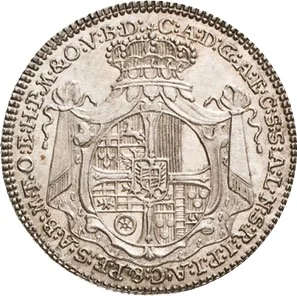
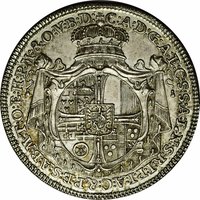
Obverse
Description:
Crowned oval quartered arms with central shield.
Script: Latin
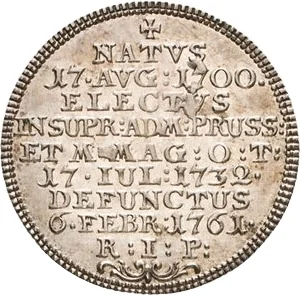
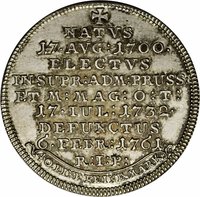
Reverse
Description:
9-line dated inscription.
Inscription:
NATVS // 17. AVG: 1700. // ELECTVS // IN SUPR: ADM: PRUSS. // ET M: MAG: O: T: // 17. IUL: 1732. // DEFUNCTUS // 6. FEBR: 1761. // R: I: P:
Script: Latin
Edge
Mintings
| Year | Mint Mark | Mintage | Quality | Collection |
|---|---|---|---|---|
| 1761 | — | — |
Historical background
In 1761, the currency situation within the Teutonic Order State was one of profound instability and debasement, a direct consequence of its prolonged financial and political decline. The Order, a relic of the medieval crusading era, held territory primarily in the Holy Roman Empire (notably in Protestant-dominated areas) and was financially strained by the costs of maintaining its monastic and military structures, as well as its obligations to the Imperial system. To meet these expenses, the Order's treasury, or Schatzkammer, had resorted to repeatedly reducing the silver content in its coinage, particularly in smaller denominations like kreuzers and groschen. This practice, common among struggling German states, led to a proliferation of lightweight, inferior coins that eroded public trust and sparked inflation within its local economies.
The monetary landscape was further complicated by the wider context of the Seven Years' War (1756-1763). While the Teutonic Order itself was not a primary belligerent, its territories were affected by the economic turmoil and military movements of the conflict. The war caused a surge in demand for specie (coin), disrupted trade, and placed additional fiscal pressures on all German states. Furthermore, the circulation of numerous foreign currencies, especially stronger Prussian and Austrian coins, alongside the Order's own debased issues, created a chaotic exchange environment. Good, full-weight coins were hoarded or exported, leaving the inferior Teutonic currency in common use—a classic example of Gresham's Law, where "bad money drives out good."
Ultimately, this currency crisis was a symptom of the Order's anachronistic and unsustainable position. With its political authority waning and its economic base shrinking, it lacked the power to enforce monetary reform or restore confidence. The debased coinage undermined internal commerce and highlighted the Order's inability to manage its secular territories effectively. This financial weakness contributed to the growing perception of the Order as a dysfunctional entity, paving the way for its eventual secularization and dissolution in the early 19th century following the Napoleonic reorganizations of Germany.
The monetary landscape was further complicated by the wider context of the Seven Years' War (1756-1763). While the Teutonic Order itself was not a primary belligerent, its territories were affected by the economic turmoil and military movements of the conflict. The war caused a surge in demand for specie (coin), disrupted trade, and placed additional fiscal pressures on all German states. Furthermore, the circulation of numerous foreign currencies, especially stronger Prussian and Austrian coins, alongside the Order's own debased issues, created a chaotic exchange environment. Good, full-weight coins were hoarded or exported, leaving the inferior Teutonic currency in common use—a classic example of Gresham's Law, where "bad money drives out good."
Ultimately, this currency crisis was a symptom of the Order's anachronistic and unsustainable position. With its political authority waning and its economic base shrinking, it lacked the power to enforce monetary reform or restore confidence. The debased coinage undermined internal commerce and highlighted the Order's inability to manage its secular territories effectively. This financial weakness contributed to the growing perception of the Order as a dysfunctional entity, paving the way for its eventual secularization and dissolution in the early 19th century following the Napoleonic reorganizations of Germany.
✨ Legendary