

½ Thaler (Clemens August von Bayern) – Teutonic Order
Circulating commemorative coins
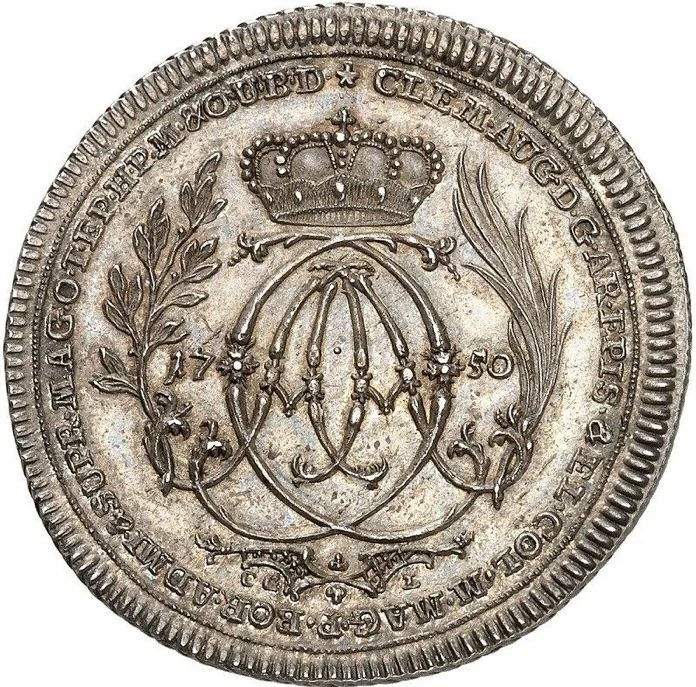
Commemoration: 50th anniversary of Clemens August von Bayern
Germany

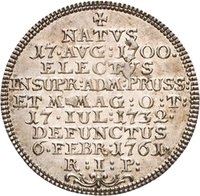
Obverse
Description:
Crowned monogram and date flanked by branches.
Script: Latin
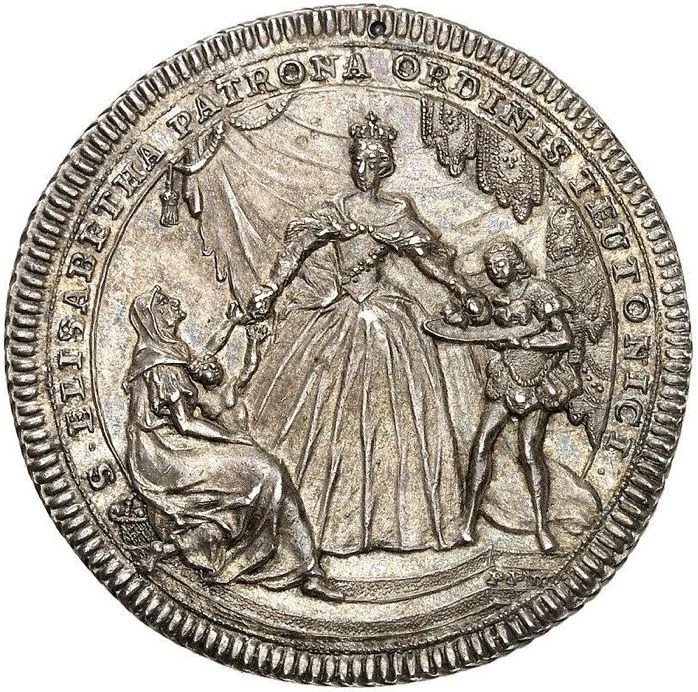
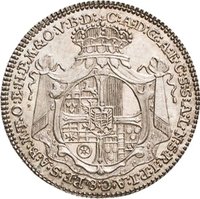
Reverse
Description:
Crowned woman at center.
Script: Latin
Edge
Mints
| Name | Mark |
|---|---|
| Nuremberg | — |
Mintings
| Year | Mint Mark | Mintage | Quality | Collection |
|---|---|---|---|---|
| 1750 | — | — |
Historical background
By 1750, the currency situation within the Teutonic Order State was a complex and declining system, heavily influenced by its political subordination. The Order had lost its secular sovereignty in 1525 when Grand Master Albert of Brandenburg secularized its Prussian territories. What remained was a much-reduced ecclesiastical state, the Hochmeistertum, with its capital at Mergentheim in southwestern Germany, existing as a minor territory within the Holy Roman Empire. Its monetary system was therefore not autonomous but integrated into the wider, fragmented imperial currency landscape, subject to the regulations of the various Imperial Circles.
The Order’s finances and coinage were managed by its Treasury (Schatzkammer) in Mergentheim. It issued limited small-change coinage, primarily Kreuzers and Hellers, for local use within its scattered possessions. These coins were of necessity aligned with the monetary standards of the surrounding powerful states, particularly the Austrian Empire and the various South German principalities. The primary reference was the Reichsthaler, a standard silver coin of the Empire, but in practice, the Order’s currency competed with and was often overshadowed by the more robust and widely circulated coins of its larger neighbors, leading to frequent exchange complications.
This monetary dependency reflected the Order’s diminished political and economic stature. The currency was sufficient for internal administration and local trade but held little regional weight. Its issuance was a symbolic exercise of remaining sovereign rights rather than a tool of economic policy. The situation underscored the Teutonic Order’s transformation from a formidable Baltic power into a minor ecclesiastical landlord, its financial instruments a mere microcosm of the intricate and often chaotic monetary patchwork that characterized the Holy Roman Empire in the mid-18th century.
The Order’s finances and coinage were managed by its Treasury (Schatzkammer) in Mergentheim. It issued limited small-change coinage, primarily Kreuzers and Hellers, for local use within its scattered possessions. These coins were of necessity aligned with the monetary standards of the surrounding powerful states, particularly the Austrian Empire and the various South German principalities. The primary reference was the Reichsthaler, a standard silver coin of the Empire, but in practice, the Order’s currency competed with and was often overshadowed by the more robust and widely circulated coins of its larger neighbors, leading to frequent exchange complications.
This monetary dependency reflected the Order’s diminished political and economic stature. The currency was sufficient for internal administration and local trade but held little regional weight. Its issuance was a symbolic exercise of remaining sovereign rights rather than a tool of economic policy. The situation underscored the Teutonic Order’s transformation from a formidable Baltic power into a minor ecclesiastical landlord, its financial instruments a mere microcosm of the intricate and often chaotic monetary patchwork that characterized the Holy Roman Empire in the mid-18th century.
✨ Legendary