

3 Pfennigs – Teutonic Order
Germany
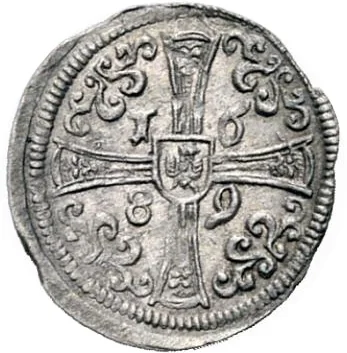
Obverse
Description:
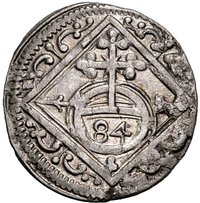
Long cross, central arms, date flanking cross angles.
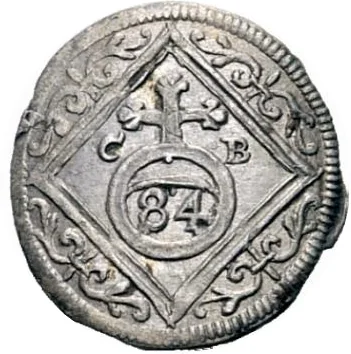
Reverse
Description:
Imperial orb with 84 rhombus ornaments.
Edge
Mintings
| Year | Mint Mark | Mintage | Quality | Collection |
|---|---|---|---|---|
| 1688 | — | — | ||
| 1689 | CB | — |
Historical background
In 1688, the currency situation within the territories of the Teutonic Order was complex and fragmented, reflecting its diminished political and economic power. The Order's state, centered in the Duchy of Prussia (a Polish fief) and its scattered holdings in the Holy Roman Empire, lacked a unified monetary system. Instead, it operated within the broader, chaotic currency landscape of the German Reich, where numerous states, bishoprics, and free cities minted their own coins of varying weight and purity. The Order itself minted coins at its Prussian capital of Königsberg, but these circulated alongside a plethora of foreign currencies, particularly the ubiquitous Reichsthaler and regional Polish and Dutch coins, leading to constant difficulties in exchange and valuation.
This monetary fragmentation was exacerbated by the widespread practice of debasement, where states reduced the precious metal content in coins to finance near-constant warfare, such as the ongoing Great Turkish War. The Teutonic Order, financially strained and no longer the military powerhouse of its medieval past, was not immune to these pressures. While it sought to maintain the reputation of its Königsberg mint, the influx of inferior coins from neighboring territories eroded trust in local currency and complicated both daily trade and the Order's own fiscal administration. Merchants and subjects had to navigate a confusing array of values, with money changers playing a crucial and often profitable role.
Consequently, the economic reality for the Order in 1688 was one of monetary dependency and vulnerability. Its ability to manage its currency was constrained by the policies of larger powers, particularly the Polish Crown, to which its Prussian lands were still subordinated. The lack of a strong, exclusive currency symbolized the Order's transition from a sovereign crusading entity to a territorial state struggling to maintain economic coherence within the decentralized and competitive framework of late 17th-century Central Europe. This unstable monetary environment hindered economic development and reflected the Order's broader struggle for relevance in a changing world.
This monetary fragmentation was exacerbated by the widespread practice of debasement, where states reduced the precious metal content in coins to finance near-constant warfare, such as the ongoing Great Turkish War. The Teutonic Order, financially strained and no longer the military powerhouse of its medieval past, was not immune to these pressures. While it sought to maintain the reputation of its Königsberg mint, the influx of inferior coins from neighboring territories eroded trust in local currency and complicated both daily trade and the Order's own fiscal administration. Merchants and subjects had to navigate a confusing array of values, with money changers playing a crucial and often profitable role.
Consequently, the economic reality for the Order in 1688 was one of monetary dependency and vulnerability. Its ability to manage its currency was constrained by the policies of larger powers, particularly the Polish Crown, to which its Prussian lands were still subordinated. The lack of a strong, exclusive currency symbolized the Order's transition from a sovereign crusading entity to a territorial state struggling to maintain economic coherence within the decentralized and competitive framework of late 17th-century Central Europe. This unstable monetary environment hindered economic development and reflected the Order's broader struggle for relevance in a changing world.
✨ Legendary