

1 Groschen – Teutonic Order
Germany
Context
Years: 1666–1680
Country: Germany 
Issuer: Teutonic Order
Ruler: Leopold I
Currency:
(1525—1809)
Demonetized: Yes
Material
Diameter: 21 mm
Weight: 1.4 g
Silver weight: 1.40 g
Shape: Irregular round
Composition: Silver
Magnetic: No
References
KM: #Click to copy to clipboard86
Numista: #139020
Value
Bullion value: $4.01
Obverse
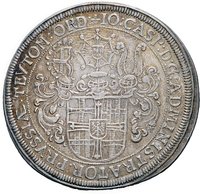
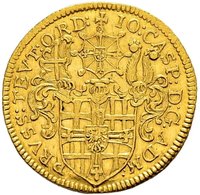
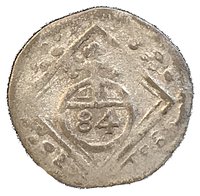
Description:
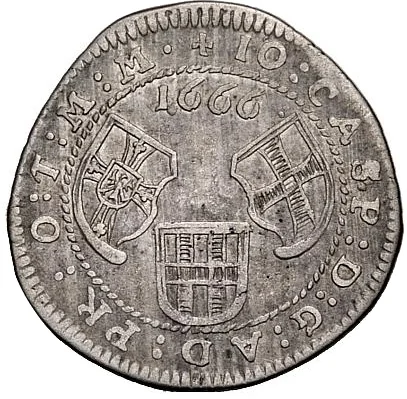
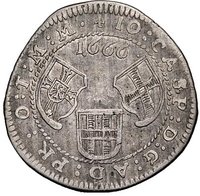
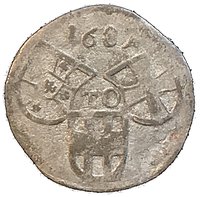
Inner circle with three shields (two above one), date above, surrounded by lettering.
Inscription:
IO : CASP : D : G : AD : PR : O : T : M : M · +
Script: Latin
Reverse
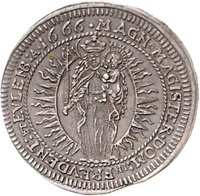
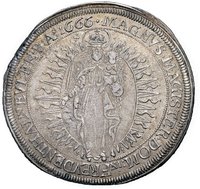
Description:
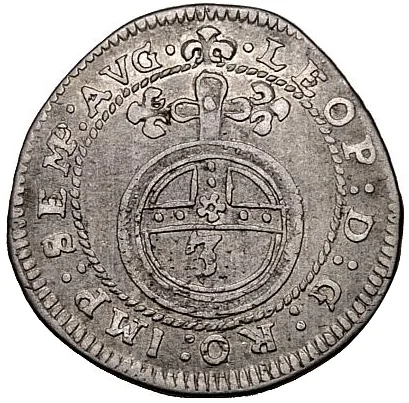
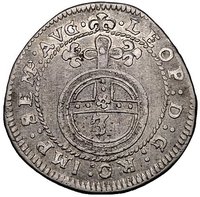
Inner circle: Imperial orb with "3." Outer circle: Titles of Leopold I.
Inscription:
· LEOP : D : G : RO : IMP : SEMP : AVG ·
Script: Latin
Edge
Mintings
| Year | Mint Mark | Mintage | Quality | Collection |
|---|---|---|---|---|
| 1666 | — | — | ||
| 1668 | — | — | ||
| 1670 | — | — | ||
| 1680 | — | — |
Historical background
In 1666, the currency situation within the Teutonic Order State (largely corresponding to the Duchy of Prussia) was complex and strained, reflecting its politically ambiguous status. The territory was a fief of the Polish Crown, yet it was simultaneously under the secular rule of the Hohenzollern Elector of Brandenburg, Frederick William (the "Great Elector"). This dual sovereignty created a contested monetary authority. While the Order's own mint in Königsberg had historically produced coins, the Polish monarchy also asserted the right to issue currency for its fief, leading to a circulation of both Prussian and Polish coins alongside a multitude of foreign currencies from the bustling Baltic trade.
Economically, the period was one of recovery from the devastating Polish-Swedish wars, which had severely disrupted commerce and agriculture. The need to rebuild state finances placed immense pressure on the monetary system. A common practice of the era, currency debasement—reducing the precious metal content in coins to create more money from the same silver stock—was a persistent temptation and problem. This led to inflationary pressures, a loss of public trust in coinage, and the complicating phenomenon of "good" full-weight coins being hoarded or exported while "bad" debased coins remained in circulation, as described by Gresham's Law.
Consequently, the monetary landscape in 1666 was fragmented and unstable. The circulation consisted of a confusing mix of older Teutonic Order issues, Polish grosz and złoty, Swedish money from the recent occupation, and various German thalers. This disorder hindered commerce and state administration. It was within this context that Frederick William, steadily integrating the duchy into his Brandenburgian holdings, was increasingly motivated to reform and unify the currency system as part of his broader project to centralize power and stimulate economic recovery, a process that would culminate in later monetary ordinances.
Economically, the period was one of recovery from the devastating Polish-Swedish wars, which had severely disrupted commerce and agriculture. The need to rebuild state finances placed immense pressure on the monetary system. A common practice of the era, currency debasement—reducing the precious metal content in coins to create more money from the same silver stock—was a persistent temptation and problem. This led to inflationary pressures, a loss of public trust in coinage, and the complicating phenomenon of "good" full-weight coins being hoarded or exported while "bad" debased coins remained in circulation, as described by Gresham's Law.
Consequently, the monetary landscape in 1666 was fragmented and unstable. The circulation consisted of a confusing mix of older Teutonic Order issues, Polish grosz and złoty, Swedish money from the recent occupation, and various German thalers. This disorder hindered commerce and state administration. It was within this context that Frederick William, steadily integrating the duchy into his Brandenburgian holdings, was increasingly motivated to reform and unify the currency system as part of his broader project to centralize power and stimulate economic recovery, a process that would culminate in later monetary ordinances.
💎 Extremely Rare