


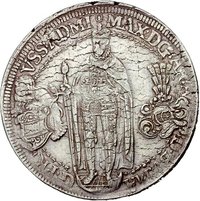
Obverse
Description:
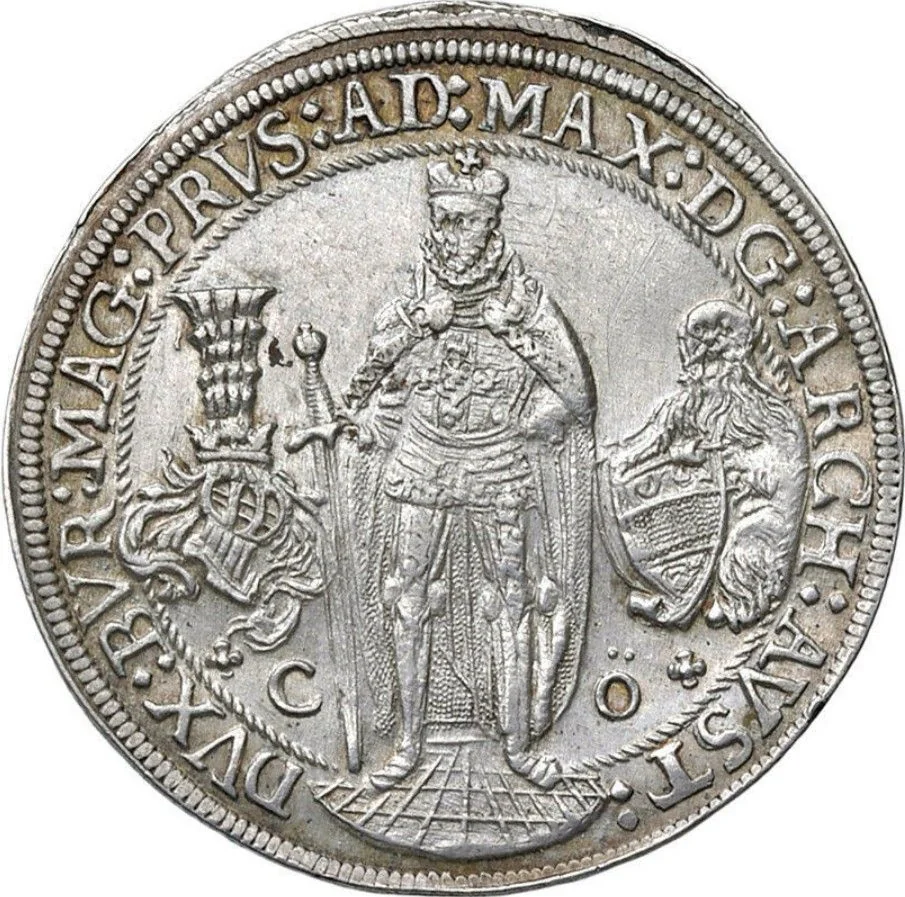
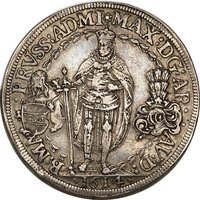
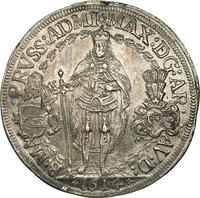
Portrait of Maximilian III in armor, facing slightly left. He wears a mantle and helmet, holds a sword, and displays the Teutonic Order cross. Flanked by a great helm and a lion-held shield of Austria, within a leaved circle. Feet divide the legend and signature "CO."
Inscription:
MAX:DG:ARCH:AVST: DVX:BVR:MAG:PRVS:AD:
Script: Latin
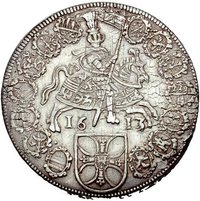
Reverse
Description:
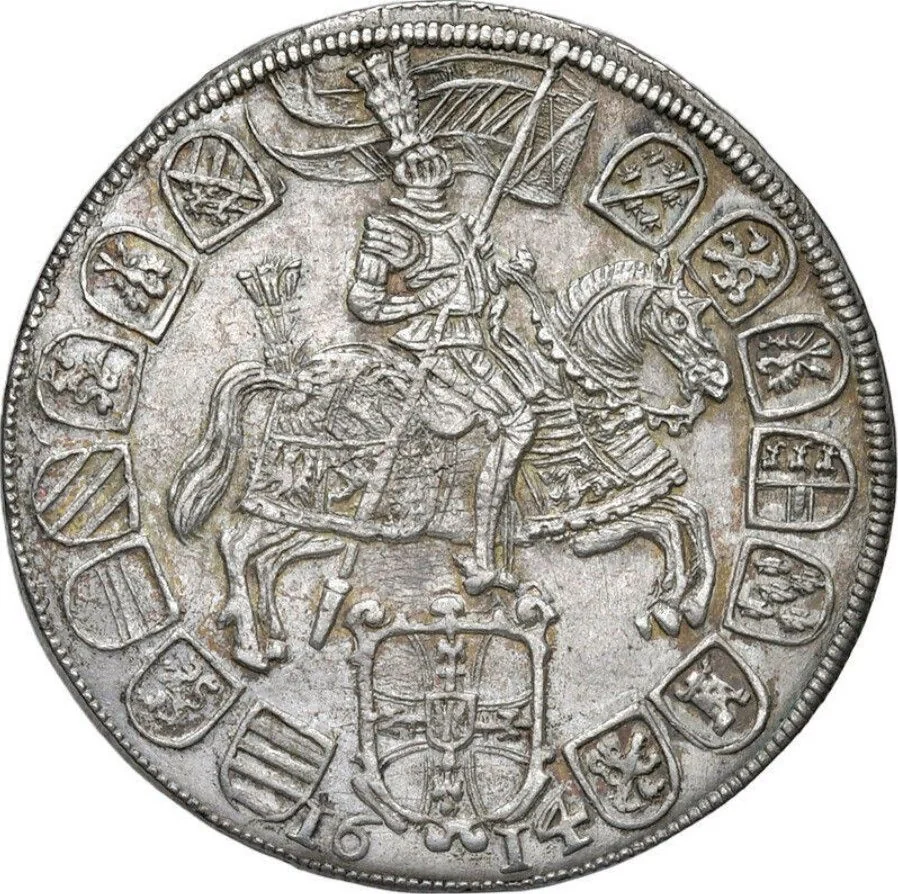
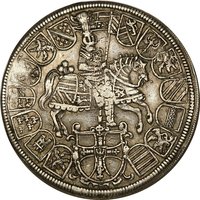
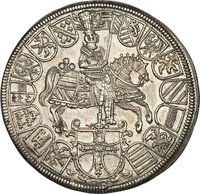
An armored knight on horseback faces right, wearing a great helm and carrying a banner. He is encircled by 14 small shields displaying regional coats of arms. A larger shield at the bottom features the cross of the Teutonic Order with Tyrol at its center, above a divided date.
Inscription:
16 14
Script: Latin
Edge
Categories
| Symbols> Coat of Arms |
| Animal> Feline |
| Animal> Bird> Eagle |
| Animal> Horse |
| Object> Armour |
| Building> Castle or fortification |
Mints
| Name | Mark |
|---|---|
| Hall | — |
Mintings
| Year | Mint Mark | Mintage | Quality | Collection |
|---|---|---|---|---|
| 1614 | CO | — |
Historical background
In 1614, the Teutonic Order, governing the Duchy of Prussia as a fief of the Polish Crown, faced a complex and challenging currency situation. The state’s monetary system was not autonomous but was deeply entangled within the wider Polish-Lithuanian Commonwealth, which exerted significant control over minting rights. The primary circulating coin was the Prussian schilling, but the monetary landscape was dominated by large quantities of foreign coins, particularly Polish groszy and thalers from the German states and the Netherlands. This created a fragmented and unstable system where the value and purity of coins in circulation varied widely, complicating trade and state finances.
The core of the problem lay in the chronic shortage of high-quality, full-weight coinage. Gresham's law was in full effect: "bad money drives out good." Debased coins from neighboring states, along with clipped and worn domestic issues, remained in daily use, while full-weight silver thalers were often hoarded or exported. This scarcity of reliable currency hampered commerce and tax collection for the Order's treasury. Furthermore, the Polish monarchy, wary of a strong and financially independent Prussia, historically restricted the Order's minting activities, limiting its ability to reform the currency and assert economic sovereignty.
Consequently, the monetary policy of Grand Master Johann Sigismund in 1614 was one of cautious management rather than sweeping reform. The state focused on maintaining the stability of its existing coinage as best it could, regulating exchange rates between the myriad coins in circulation, and attempting to curb the worst abuses of debasement and clipping. The situation underscored the Teutonic Order's diminished political power, as its economic fortunes were dictated by its feudal overlord in Kraków and the unpredictable flows of international bullion, leaving its currency system vulnerable and inefficient.
The core of the problem lay in the chronic shortage of high-quality, full-weight coinage. Gresham's law was in full effect: "bad money drives out good." Debased coins from neighboring states, along with clipped and worn domestic issues, remained in daily use, while full-weight silver thalers were often hoarded or exported. This scarcity of reliable currency hampered commerce and tax collection for the Order's treasury. Furthermore, the Polish monarchy, wary of a strong and financially independent Prussia, historically restricted the Order's minting activities, limiting its ability to reform the currency and assert economic sovereignty.
Consequently, the monetary policy of Grand Master Johann Sigismund in 1614 was one of cautious management rather than sweeping reform. The state focused on maintaining the stability of its existing coinage as best it could, regulating exchange rates between the myriad coins in circulation, and attempting to curb the worst abuses of debasement and clipping. The situation underscored the Teutonic Order's diminished political power, as its economic fortunes were dictated by its feudal overlord in Kraków and the unpredictable flows of international bullion, leaving its currency system vulnerable and inefficient.
✨ Legendary