

1 Ducat – Teutonic Order
Germany
Context
Years: 1597–1612
Year: 1597
Country: Germany 
Issuer: Teutonic Order
Currency:
(1525—1809)
Demonetized: Yes
References
KM: #Click to copy to clipboard20
Numista: #138938
Value
Bullion value: $572.10
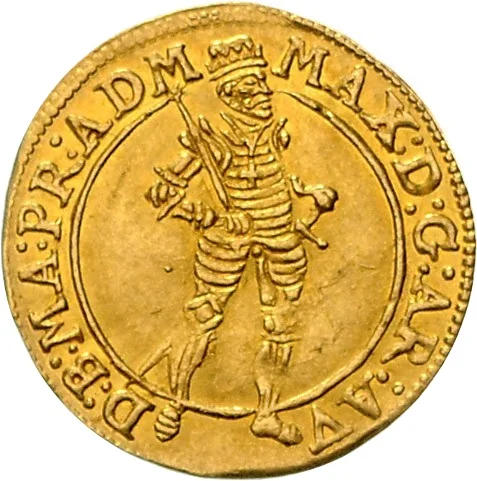
Obverse
Description:
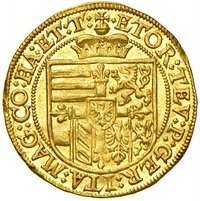
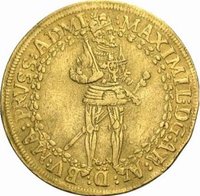
Armored Emperor Maximilian, crowned.
Script: Latin
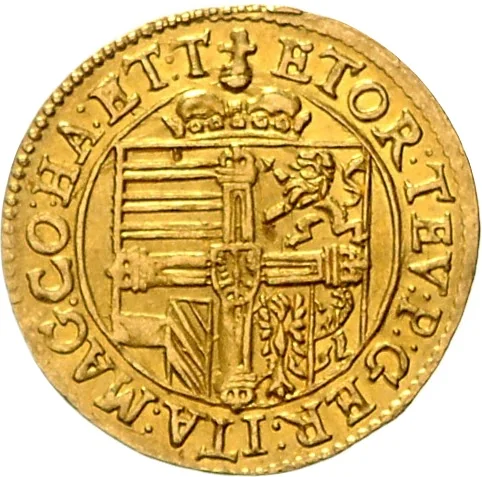
Reverse
Description:
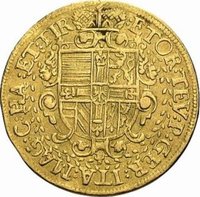
Arms.
Script: Latin
Edge
Mintings
| Year | Mint Mark | Mintage | Quality | Collection |
|---|---|---|---|---|
| 1597 | — | — | ||
| 1612 | — | — |
Historical background
In 1597, the Teutonic Order, governing the Duchy of Prussia as a Polish fief, faced significant monetary instability rooted in its political subordination and regional economic pressures. The state’s currency, the Prussian schilling, was part of a fragmented system where the Order lacked full sovereignty over minting. Crucially, the monetary policy was heavily influenced by the Polish Crown, which sought to control the flow of precious metals and maintain the value of its own currency, the Polish grosz. This often led to tensions, as the Order's need for fiscal independence clashed with Polish economic interests.
The period was marked by the pervasive problem of debasement, where coins were minted with a reduced silver content to increase seigniorage revenue for the state treasury. This practice, common across Europe, was driven by the Order's ongoing financial strains, including the costs of administration, defense, and its feudal obligations to Poland. The circulation of underweight and foreign coins, particularly from neighboring states like the Netherlands and German principalities, further complicated the monetary landscape, eroding public trust in the currency and disrupting local commerce.
Consequently, the monetary situation in 1597 was one of weak confidence and inflationary pressure. Merchants and peasants alike suffered from the uncertainty, as the real value of payments and savings fluctuated. While not in a state of catastrophic collapse, the currency system reflected the broader vulnerabilities of the Teutonic Order—a once-mighty military order now a secondary political entity struggling to manage its economy within the constraints of vassalage and an increasingly integrated regional market.
The period was marked by the pervasive problem of debasement, where coins were minted with a reduced silver content to increase seigniorage revenue for the state treasury. This practice, common across Europe, was driven by the Order's ongoing financial strains, including the costs of administration, defense, and its feudal obligations to Poland. The circulation of underweight and foreign coins, particularly from neighboring states like the Netherlands and German principalities, further complicated the monetary landscape, eroding public trust in the currency and disrupting local commerce.
Consequently, the monetary situation in 1597 was one of weak confidence and inflationary pressure. Merchants and peasants alike suffered from the uncertainty, as the real value of payments and savings fluctuated. While not in a state of catastrophic collapse, the currency system reflected the broader vulnerabilities of the Teutonic Order—a once-mighty military order now a secondary political entity struggling to manage its economy within the constraints of vassalage and an increasingly integrated regional market.
✨ Legendary