

2 Ducats – Teutonic Order
Germany
Context

Material
References
KM: #Click to copy to clipboard21
Numista: #488142
Value
Bullion value: $1143.22
Obverse
Description:
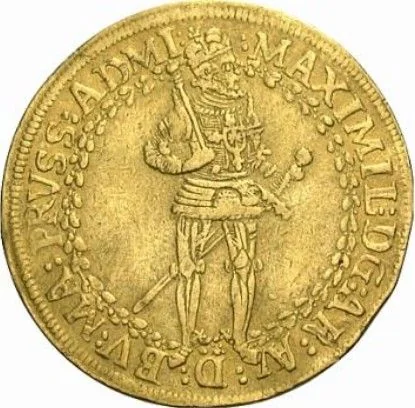
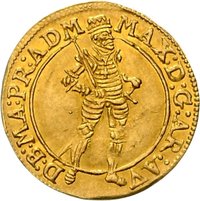
Archduke standing, holding sword and scepter, with Teutonic Order cross on chest, within a leaved circle and legend.
Inscription:
:MAXIMIL:DG:AR:AV:D:BV:MA:PRVSS:ADMI:
Script: Latin
Reverse
Description:
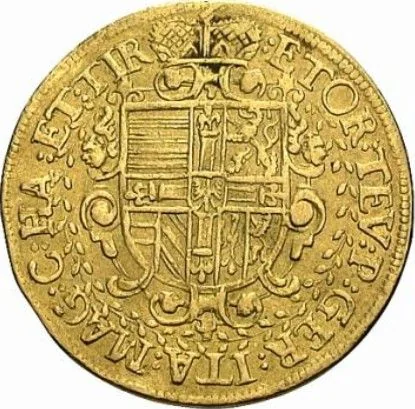
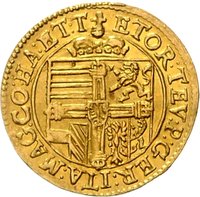
Arms of the Teutonic Order with central Tyrol shield, encircled by quarterings for Hungary, Bohemia, Austria-Burgundy, and Prussia-Habsburg. Side angel heads and ornaments within a leaf wreath. Legend around.
Inscription:
ET OR:TEV:P:GER:ITA:MAG:C:HA:ET:TIR
Script: Latin
Edge
Mints
| Name | Mark |
|---|---|
| Hall | — |
Mintings
| Year | Mint Mark | Mintage | Quality | Collection |
|---|---|---|---|---|
| — | — | — |
Historical background
In 1602, the Teutonic Order's currency situation was one of profound instability and debasement, reflecting the wider economic and political decline of the state. The Order, ruling the Duchy of Prussia as a fief of the Polish Crown since 1525, had long struggled with fiscal solvency. Its primary income from agricultural estates was insufficient to cover the costs of maintaining its administrative structure and the lavish court of its ruler, Margrave and Grand Master Elector Joachim Friedrich of Brandenburg (who also served as Administrator of Prussia). To meet these chronic deficits, the Order's mint in Königsberg had engaged in repeated debasements of its primary silver coin, the schilling, reducing its precious metal content to generate seigniorage profit.
This monetary policy created a classic "bad money drives out good" scenario, where full-weight foreign coins, particularly the robust Polish grosz and thalers from the Holy Roman Empire, were hoarded or exported, leaving the weakened local currency to dominate circulation. The resulting inflation severely harmed local trade and the common population, whose wages and savings were effectively eroded. Furthermore, the situation was complicated by the personal union with Brandenburg; Joachim Friedrich’s priorities often lay with his electoral territories, and the monetary chaos in Prussia was not his most pressing concern.
Consequently, the currency crisis of 1602 was a symptom of a failing state apparatus. It eroded internal economic cohesion, fostered public discontent, and highlighted the Order's inability to manage its core fiscal responsibilities. This instability would persist until the later reforms of the 1620s, which standardized the currency on the Prussian groschen, but the early 17th-century period remained one of significant monetary disorder and declining economic confidence within the Teutonic state.
This monetary policy created a classic "bad money drives out good" scenario, where full-weight foreign coins, particularly the robust Polish grosz and thalers from the Holy Roman Empire, were hoarded or exported, leaving the weakened local currency to dominate circulation. The resulting inflation severely harmed local trade and the common population, whose wages and savings were effectively eroded. Furthermore, the situation was complicated by the personal union with Brandenburg; Joachim Friedrich’s priorities often lay with his electoral territories, and the monetary chaos in Prussia was not his most pressing concern.
Consequently, the currency crisis of 1602 was a symptom of a failing state apparatus. It eroded internal economic cohesion, fostered public discontent, and highlighted the Order's inability to manage its core fiscal responsibilities. This instability would persist until the later reforms of the 1620s, which standardized the currency on the Prussian groschen, but the early 17th-century period remained one of significant monetary disorder and declining economic confidence within the Teutonic state.
✨ Legendary