

1 Sechsling – Swedish dominion of Pomerania
Sweden
Context
Years: 1684–1687
Country: Sweden 
Issuer: Swedish dominion of Pomerania
Ruler: Charles XI
Currency:
(1630—1815)
Subdivision: 1 Sechsling = 1⁄96 Thaler
Demonetized: Yes
References
KM: #Click to copy to clipboard299
Numista: #137423
Value
Bullion value: $1.87
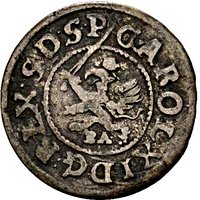
Obverse
Description:
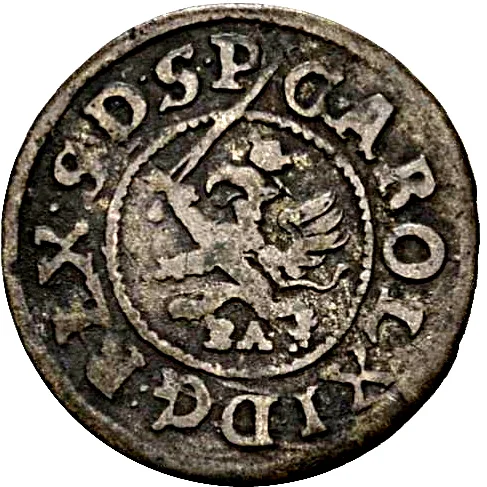
Griffin with initials beneath.
Script: Latin
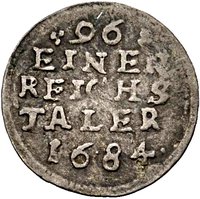
Reverse
Description:
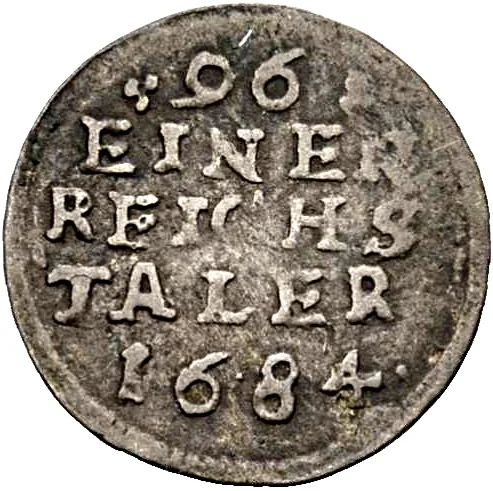
Dated five-line inscription with denomination.
Script: Latin
Edge
Mintings
| Year | Mint Mark | Mintage | Quality | Collection |
|---|---|---|---|---|
| 1684 | BA | — | ||
| 1685 | BA | — | ||
| 1685 | DHM | — | ||
| 1687 | DHM | — |
Historical background
In 1684, the currency situation in Swedish Pomerania was complex and challenging, characterized by a fragmented monetary landscape typical of the Holy Roman Empire. The province did not have a unified currency but operated within a multi-currency system. The official accounting unit was the Swedish riksdaler, but in daily circulation, a plethora of coins were used, including local Pomeranian schillings and pfennigs, various German Reichsthalers and Groschen from neighbouring states, and even Polish and Dutch coins. This created constant difficulties in trade and taxation, as the values of these coins fluctuated against each other and against the accounting unit.
The root of the instability lay in the discrepancy between the officially mandated Kurantgeld (full-value coin) and the debased Schneidemünzen (small change) used for local transactions. Swedish authorities struggled to control the influx of inferior coinage from neighbouring German territories, which often drove better-quality Swedish money out of circulation (Gresham's Law). Furthermore, the Swedish state, engaged in costly continental wars, frequently resorted to manipulating currency values to finance its military, which led to inflation and eroded public trust.
Consequently, the Swedish administration in Stettin faced persistent economic headaches. Efforts to standardize the currency and align it more closely with the imperial monetary system were ongoing but met with limited success due to the entrenched local practices and the broader geopolitical pressures on Sweden. The situation in 1684 was thus one of monetary confusion, where official policy, market reality, and the demands of imperial warfare were in constant tension, hindering efficient economic governance in the dominion.
The root of the instability lay in the discrepancy between the officially mandated Kurantgeld (full-value coin) and the debased Schneidemünzen (small change) used for local transactions. Swedish authorities struggled to control the influx of inferior coinage from neighbouring German territories, which often drove better-quality Swedish money out of circulation (Gresham's Law). Furthermore, the Swedish state, engaged in costly continental wars, frequently resorted to manipulating currency values to finance its military, which led to inflation and eroded public trust.
Consequently, the Swedish administration in Stettin faced persistent economic headaches. Efforts to standardize the currency and align it more closely with the imperial monetary system were ongoing but met with limited success due to the entrenched local practices and the broader geopolitical pressures on Sweden. The situation in 1684 was thus one of monetary confusion, where official policy, market reality, and the demands of imperial warfare were in constant tension, hindering efficient economic governance in the dominion.
✨ Legendary