

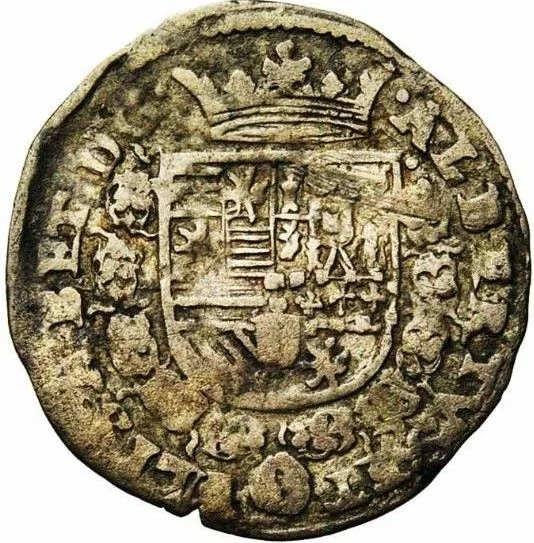
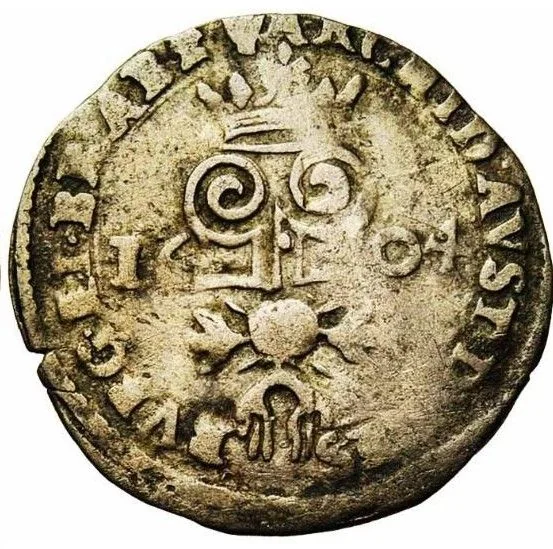
¼ Silver Real – Spanish Netherlands
Netherlands
Context
Years: 1604–1609
Country: Netherlands 
Issuer: Spanish Netherlands
Currency:
(1506—1713)
Demonetized: Yes
Material
Diameter: 22 mm
Weight: 1.73 g
Shape: Irregular round
Technique: Hammered
Alignment: Coin alignment
flip
References
KM: #Click to copy to clipboard26
Numista: #104700
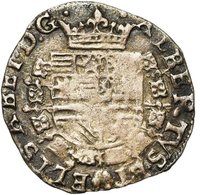
Obverse
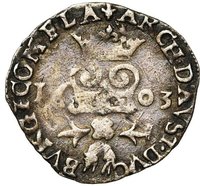
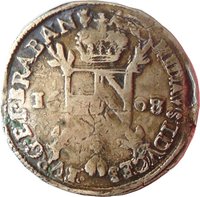
Reverse
Description:
Crowned firesteel flanks the date; below, the Golden Fleece jewel. Mintmark concludes legend.
Inscription:
· ARCHID · AVST · DVCES · BVRG · ET · BRAB · Z ·
Script: Latin
Edge
Mints
| Name | Mark |
|---|---|
| Antwerp | Hand |
| Maastricht | Star |
| 's-Hertogenbosch | Tree |
Mintings
| Year | Mint Mark | Mintage | Quality | Collection |
|---|---|---|---|---|
| 1604 | — | — | ||
| 1605 | — | — | ||
| 1609 | — | — |
Historical background
In 1604, the Spanish Netherlands was mired in a severe and complex monetary crisis, a direct consequence of the ongoing Eighty Years' War (1568-1648). The region, a battleground between Spanish Habsburg forces and the Dutch Republic, suffered from economic exhaustion, disrupted trade, and the immense fiscal demands of maintaining the Army of Flanders. To meet these costs, the authorities frequently resorted to debasement—reducing the precious metal content in coins—which led to rampant inflation, a loss of public confidence in the currency, and chaotic circulation of both domestic and foreign coins of uncertain value.
The situation was characterized by a proliferation of different coins. Alongside officially debased local currency, there circulated a flood of foreign coins from neighboring states, as well as older, heavier Spanish Netherlands coins that were hoarded or exported for their higher intrinsic metal value. This phenomenon, described by Gresham's Law ("bad money drives out good"), created a dysfunctional multi-currency system where daily transactions became fraught with confusion and dispute over exchange rates and the true worth of each coin. The economic instability hampered commerce and deepened the hardship of the civilian population.
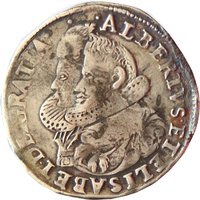
Recognizing the need for reform, the Archdukes Albert and Isabella, the sovereign rulers of the Spanish Netherlands, were actively working towards a solution. The previous year, in 1603, they had issued placards (ordinances) to begin stabilizing the currency, and their efforts would culminate in the landmark Currency Ordinance of November 1606. The 1604 period, therefore, represents the tense peak of the crisis, a moment of severe monetary disorder that compelled the central authorities to prepare a comprehensive recoinage and standardization to restore financial order and sovereign control over the mint.
The situation was characterized by a proliferation of different coins. Alongside officially debased local currency, there circulated a flood of foreign coins from neighboring states, as well as older, heavier Spanish Netherlands coins that were hoarded or exported for their higher intrinsic metal value. This phenomenon, described by Gresham's Law ("bad money drives out good"), created a dysfunctional multi-currency system where daily transactions became fraught with confusion and dispute over exchange rates and the true worth of each coin. The economic instability hampered commerce and deepened the hardship of the civilian population.
Recognizing the need for reform, the Archdukes Albert and Isabella, the sovereign rulers of the Spanish Netherlands, were actively working towards a solution. The previous year, in 1603, they had issued placards (ordinances) to begin stabilizing the currency, and their efforts would culminate in the landmark Currency Ordinance of November 1606. The 1604 period, therefore, represents the tense peak of the crisis, a moment of severe monetary disorder that compelled the central authorities to prepare a comprehensive recoinage and standardization to restore financial order and sovereign control over the mint.
✨ Legendary