

½ Riksdaler – Sweden
Sweden
Context
Years: 1767–1768
Issuer: Sweden 
Ruler: Adolphus Frederick
Currency:
(1719—1798)
Demonetized: Yes
Total mintage: 9,125
Material
References
KM: #Click to copy to clipboard489
Numista: #103632
Value
Bullion value: $36.16
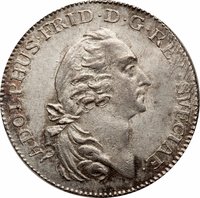
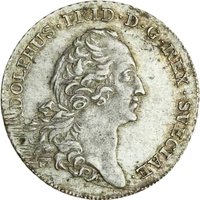
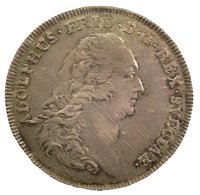
Obverse
Description:
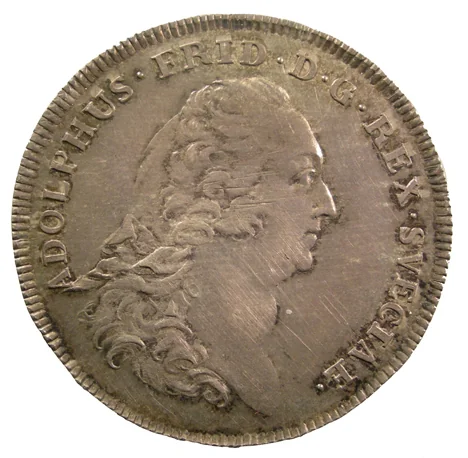
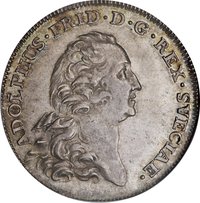
King Adolf Fredrick facing right, long hair, legend around rim.
Inscription:
ADOLPHUS • FRID • D • G • REX • SVECIAE •
Script: Latin
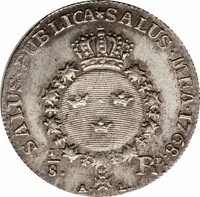
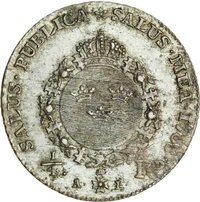
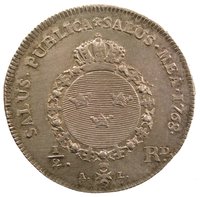
Reverse
Description:
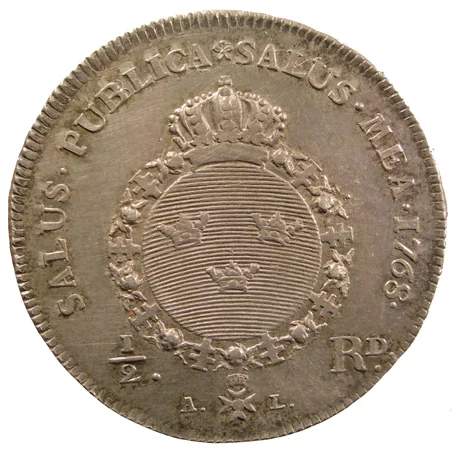
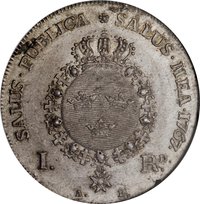
Swedish Three Crowns orb within the Seraphim Order chain. The pendant divides the mintmark, with the value on the orb's sides. The King's motto and date appear above the crown.
Inscription:
SALUS • PUBLICA * SALUS • MEA • 1767
I/2. RD.
A. L.
I/2. RD.
A. L.
Script: Latin
Edge
Lettering:MANIBUS NE LAEDAR AVARIS
Legend:
MANIBUS NE LAEDAR AVARIS
Categories
| Symbols> Coat of Arms |
Mintings
| Year | Mint Mark | Mintage | Quality | Collection |
|---|---|---|---|---|
| 1767 | AL | 2,649 | ||
| 1768 | AL | 6,476 |
Historical background
In 1767, Sweden was navigating a complex and precarious monetary situation, a direct legacy of the Riksdag of the Estates' decision in 1745 to abandon the silver standard. This move, taken to finance the costly Russo-Swedish War (1741–1743), unleashed an era of rampant paper money issuance. The state's central bank, the Riksens Ständers Bank (the Bank of the Estates), was compelled to issue vast quantities of riksdaler riksgälds, a fiat currency not backed by specie. While useful for short-term war financing, this policy led to severe inflation and a catastrophic loss of public confidence in the paper money, which traded at a steep and fluctuating discount compared to silver coinage.
The year 1767 fell within the turbulent period known as the "Age of Liberty" (1719–1772), where political power was contested between the Hat and Cap parties in the Riksdag. Monetary policy became a central battleground. The ruling Hats, representing mercantile and manufacturing interests, generally favored a soft currency to stimulate the economy and fund state projects. Their opponents, the Caps, who drew support from peasants and clergy, advocated for a return to sound money and a silver standard to curb inflation and protect savers. In 1767, the Caps were in the ascendant, having gained power in the 1765 Riksdag, and were actively grappling with the deep monetary crisis they had inherited.
Consequently, the primary economic challenge in 1767 was the staggering disparity between the depreciated paper currency and silver. The riksdaler riksgälds had lost so much value that everyday transactions were fraught with confusion and distrust, hampering trade and economic stability. The Cap government, led by Chancellor Axel von Fersen, was under intense pressure to stabilize the currency. Their efforts, which would culminate in the failed redemption attempt of 1768, aimed to restore the value of the paper money and ultimately return to a metallic standard, a contentious and immensely difficult task that defined Sweden's financial landscape at the time.
The year 1767 fell within the turbulent period known as the "Age of Liberty" (1719–1772), where political power was contested between the Hat and Cap parties in the Riksdag. Monetary policy became a central battleground. The ruling Hats, representing mercantile and manufacturing interests, generally favored a soft currency to stimulate the economy and fund state projects. Their opponents, the Caps, who drew support from peasants and clergy, advocated for a return to sound money and a silver standard to curb inflation and protect savers. In 1767, the Caps were in the ascendant, having gained power in the 1765 Riksdag, and were actively grappling with the deep monetary crisis they had inherited.
Consequently, the primary economic challenge in 1767 was the staggering disparity between the depreciated paper currency and silver. The riksdaler riksgälds had lost so much value that everyday transactions were fraught with confusion and distrust, hampering trade and economic stability. The Cap government, led by Chancellor Axel von Fersen, was under intense pressure to stabilize the currency. Their efforts, which would culminate in the failed redemption attempt of 1768, aimed to restore the value of the paper money and ultimately return to a metallic standard, a contentious and immensely difficult task that defined Sweden's financial landscape at the time.
Series: 1767 Sweden circulation coins
✨ Legendary