

1 Albertin – Spanish Netherlands
Netherlands
Context
Years: 1600–1605
Country: Netherlands 
Issuer: Spanish Netherlands
Currency:
(1506—1713)
Demonetized: Yes
Total mintage: 234,744
Material
Diameter: 21 mm
Weight: 2.91 g
Gold weight: 2.30 g
Shape: Irregular round
Composition: 79.2% Gold
Magnetic: No
Technique: Hammered
Alignment: Coin alignment
flip
References
KM: #Click to copy to clipboard8.2
Numista: #103287
Value
Bullion value: $383.69
Obverse
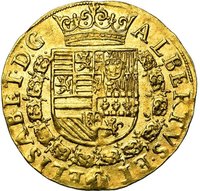
Description:
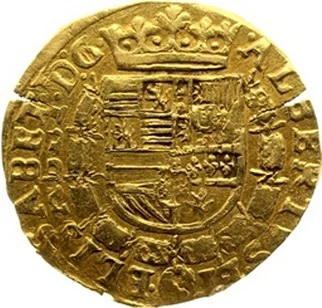
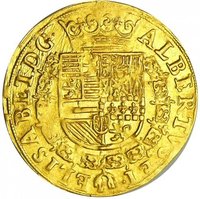
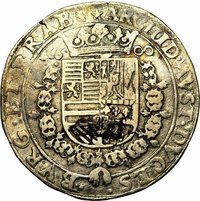
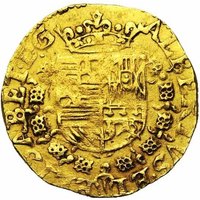
Coat of arms crowned and encircled by the Golden Fleece collar.
Inscription:
· ALBERTVS · ET · ELISABET D : G ·
Script: Latin
Reverse
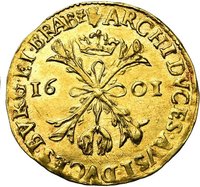
Description:
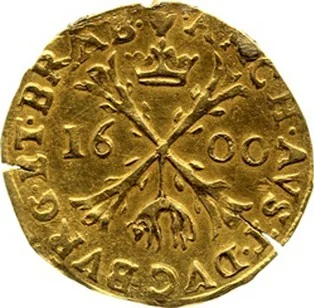
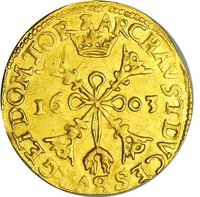
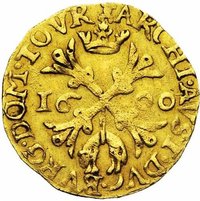
Burgundian cross with Golden Fleece pendant divides date.
Inscription:
ARCH · AVST · DVC · BVRG · ET · BRAB ·
16 00
16 00
Script: Latin
Edge
Categories
| Symbols> Coat of Arms |
Mints
| Name | Mark |
|---|---|
| Antwerp | — |
| Maastricht | Star |
Mintings
Historical background
By 1600, the currency situation in the Spanish Netherlands was one of profound disorder and economic strain, a direct consequence of the ongoing Eighty Years' War. The region, a commercial powerhouse, suffered from the Spanish Crown's relentless financial demands to fund its military campaigns. This led to repeated debasements of the coinage, where the official mint reduced the precious metal content in coins while maintaining their face value. The result was a flood of unstable, low-quality currency that eroded public trust and disrupted the very foundations of Antwerp's sophisticated financial markets.
The monetary chaos was compounded by the circulation of a bewildering variety of coins. Alongside the officially debased domestic issues, there were older, full-weight coins (which were hoarded), and countless foreign currencies from trade, particularly German and Dutch. This created a complex and inefficient system where exchange rates fluctuated wildly, and merchants required expert "money changers" to assess the true metal value of each payment. The government's attempts to fix official exchange rates for different coins (through placards) were largely ineffective, as market realities consistently diverged from royal decrees.
This unstable environment acted as a significant drag on the economy, increasing transaction costs and creating uncertainty for commerce. It also fueled social tension, as wages paid in debased coinage failed to keep pace with rising prices, effectively impoverishing the working population. Thus, the currency crisis of 1600 was not merely a financial technicality but a key symptom of the wider political and military conflict, undermining the economic vitality of the Spanish Netherlands at the dawn of the seventeenth century.
The monetary chaos was compounded by the circulation of a bewildering variety of coins. Alongside the officially debased domestic issues, there were older, full-weight coins (which were hoarded), and countless foreign currencies from trade, particularly German and Dutch. This created a complex and inefficient system where exchange rates fluctuated wildly, and merchants required expert "money changers" to assess the true metal value of each payment. The government's attempts to fix official exchange rates for different coins (through placards) were largely ineffective, as market realities consistently diverged from royal decrees.
This unstable environment acted as a significant drag on the economy, increasing transaction costs and creating uncertainty for commerce. It also fueled social tension, as wages paid in debased coinage failed to keep pace with rising prices, effectively impoverishing the working population. Thus, the currency crisis of 1600 was not merely a financial technicality but a key symptom of the wider political and military conflict, undermining the economic vitality of the Spanish Netherlands at the dawn of the seventeenth century.

✨ Legendary