

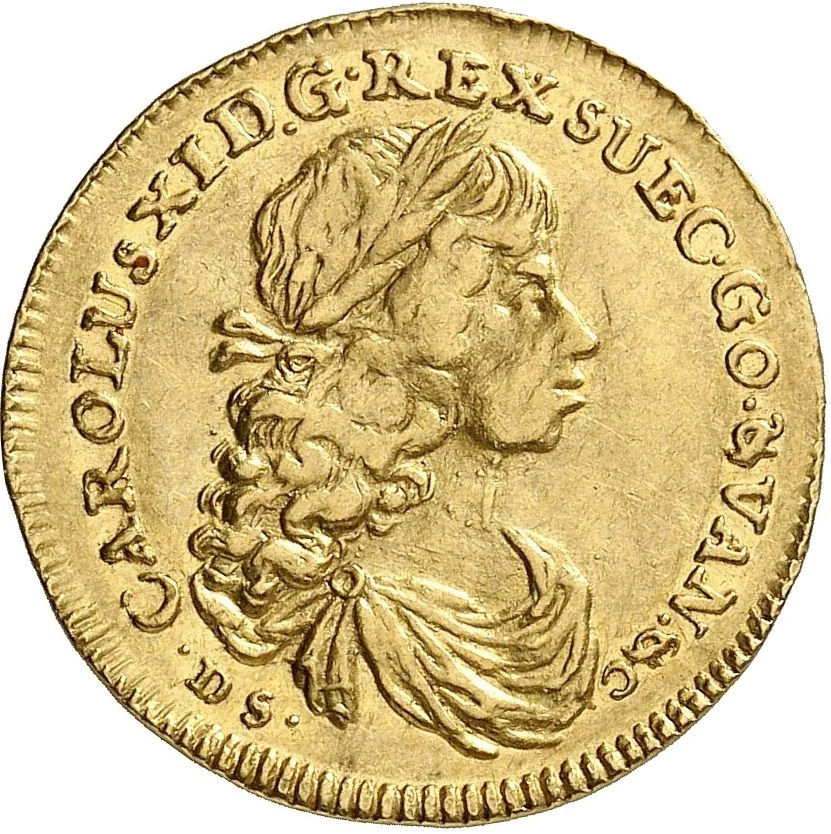
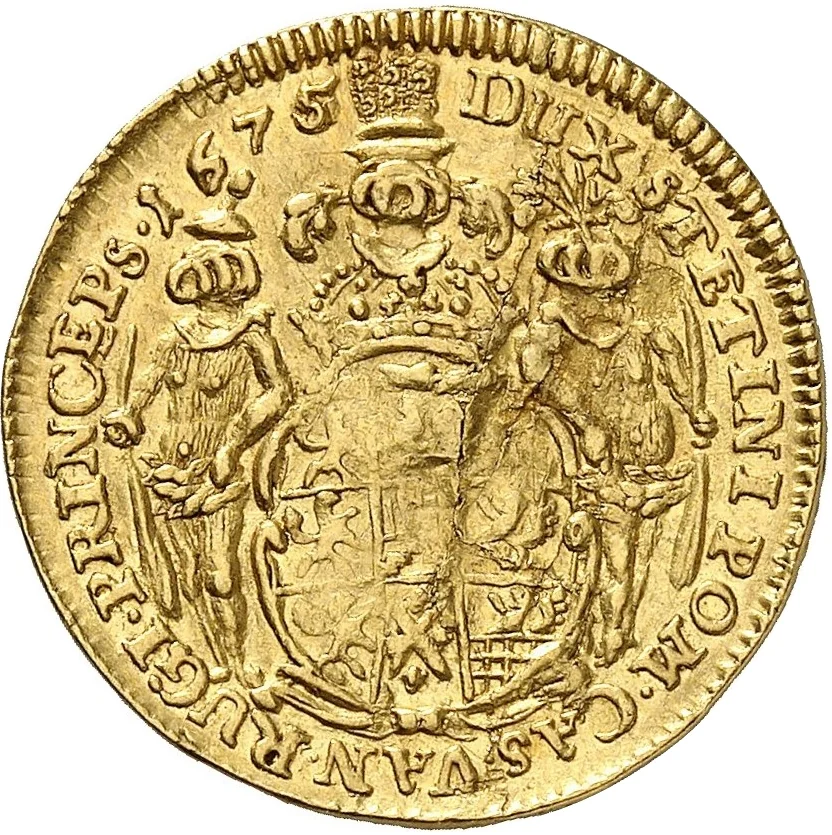
1 Ducat – Swedish dominion of Pomerania
Sweden
Context
Year: 1675
Country: Sweden 
Issuer: Swedish dominion of Pomerania
Ruler: Charles XI
Currency:
(1630—1815)
Demonetized: Yes
References
KM: #Click to copy to clipboard257.3
Numista: #137078
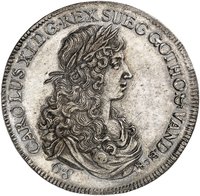
Obverse
Description:
Right-facing bust.
Inscription:
CAROLUS XI D . G . REX SUEC . GO . & VAN . &c
Script: Latin
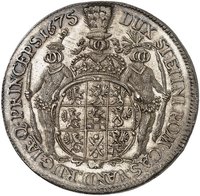
Reverse
Description:
Arms with crowned helm and supporters.
Inscription:
DUX STETINI POM . CAS . VAN . RUGI . PRINCEPS . 1675
Script: Latin
Edge
Mintings
| Year | Mint Mark | Mintage | Quality | Collection |
|---|---|---|---|---|
| 1675 | DS | — |
Historical background
In 1675, the currency situation in Swedish Pomerania was one of considerable complexity and strain, directly tied to the broader turmoil of the Scanian War (1675–1679). As a Swedish dominion on German soil, the duchy operated within a fragmented monetary landscape. It was officially part of the Holy Roman Empire's currency systems, notably the Reichsthaler and Gulden, but Swedish imperial ambitions and wartime demands meant Stockholm often sought to impose its own monetary policies. This created a dual system where local German coinage circulated alongside Swedish riksdaler and öre, leading to frequent confusion, exchange rate disputes, and widespread counterfeiting.
The outbreak of war with Brandenburg and Denmark in 1675 exacerbated these issues dramatically. Swedish Pomerania became a primary battlefield, leading to massive military expenditures and the forced quartering of troops. To finance these costs, Swedish authorities, both local and from Stockholm, increasingly resorted to debasement—reducing the precious metal content in coins—and the emergency minting of inferior Klippe coins (square-cut coins struck from hammered plate metal). This rapid inflation of the money supply, combined with the disruption of trade and agriculture, caused prices to soar and severely undermined public trust in the currency.
Consequently, the monetary economy began to fracture. Creditors suffered heavy losses, merchants hoarded older, full-value coins, and everyday transactions were often conducted through barter or using a confusing array of old and new coins valued by weight rather than face value. The currency chaos of 1675 was therefore a direct reflection of the dominion's precarious position: caught between imperial German traditions, Swedish fiscal demands, and the devastating economic realities of a war fought on its own soil.
The outbreak of war with Brandenburg and Denmark in 1675 exacerbated these issues dramatically. Swedish Pomerania became a primary battlefield, leading to massive military expenditures and the forced quartering of troops. To finance these costs, Swedish authorities, both local and from Stockholm, increasingly resorted to debasement—reducing the precious metal content in coins—and the emergency minting of inferior Klippe coins (square-cut coins struck from hammered plate metal). This rapid inflation of the money supply, combined with the disruption of trade and agriculture, caused prices to soar and severely undermined public trust in the currency.
Consequently, the monetary economy began to fracture. Creditors suffered heavy losses, merchants hoarded older, full-value coins, and everyday transactions were often conducted through barter or using a confusing array of old and new coins valued by weight rather than face value. The currency chaos of 1675 was therefore a direct reflection of the dominion's precarious position: caught between imperial German traditions, Swedish fiscal demands, and the devastating economic realities of a war fought on its own soil.
✨ Legendary