

1⁄48 thaler – Swedish dominion of Pomerania
Add to wishlist
Sweden
Context
Years: 1661–1694
Country: Sweden
Issuer: Swedish dominion of Pomerania
Ruler: Charles XI
Currency:
(1630—1815)
Subdivision: 1⁄48 thaler = 1 Schilling
Demonetized: Yes
Material
References
KM: #
Numista: #136780
Value
Bullion value: $2.84
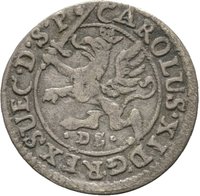
Obverse
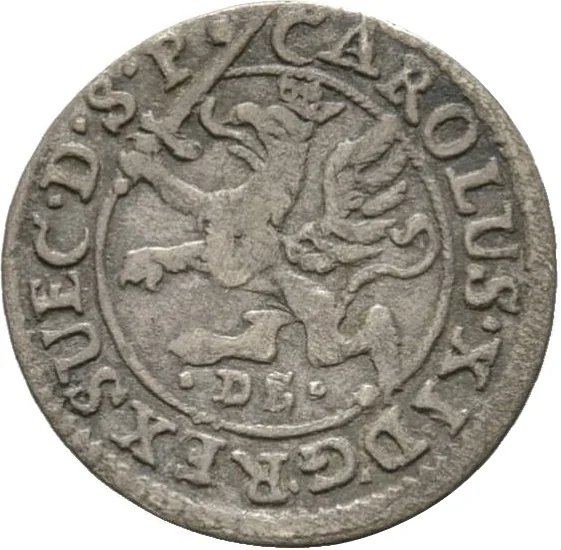
Description:
Crowned griffin with sword, initials below.
Inscription:
CAROLUS XI D G REX SUEC D S P
D S
D S
Script: Latin
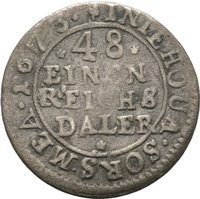
Reverse
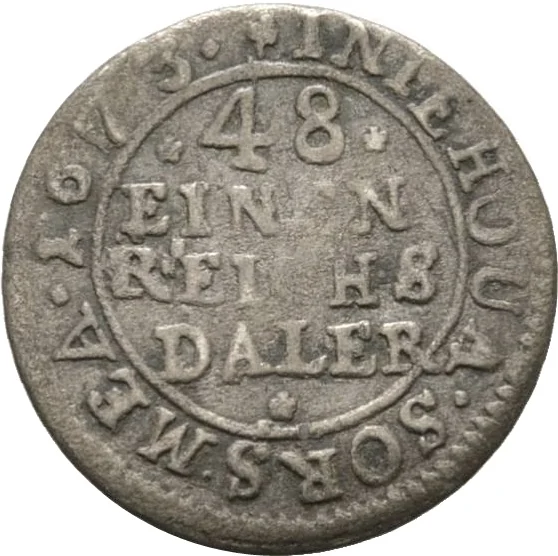
Description:
Inner circle: value. Legend: date.
Inscription:
48 EINEN REICHS DALER
INIEHOUA SORS MEA 1673
INIEHOUA SORS MEA 1673
Script: Latin
Edge
Plain
Mintings
| Year | Mint Mark | Mintage | Quality | Collection |
|---|---|---|---|---|
| 1661 | VB | — | ||
| 1670 | HIH | — | ||
| 1671 | HIH | — | ||
| 1672 | DS | — | ||
| 1673 | DS | — | ||
| 1674 | DS | — | ||
| 1675 | DS | — | ||
| 1676 | DS | — | ||
| 1680 | CS | — | ||
| 1681 | BA | — | ||
| 1681 | CS | — | ||
| 1682 | BA | — | ||
| 1683 | BA | — | ||
| 1684 | BA | — | ||
| 1685 | BA | — | ||
| 1686 | DHM | — | ||
| 1689 | DHM | — | ||
| 1690 | ILA | — | ||
| 1691 | ILA | — | ||
| 1692 | ILA | — | ||
| 1693 | ILA | — | ||
| 1694 | ILA | — |
Historical background
In 1661, the currency situation in Swedish Pomerania was complex and strained, a direct legacy of the Thirty Years' War and Sweden's ongoing military conflicts. The territory, acquired by Sweden in 1648, was economically depleted and integrated into a Swedish imperial system that prioritized extracting resources to fund the crown's wars, particularly against Poland and Denmark. This led to a proliferation of various circulating coins, including local issues, Swedish copper daler, and a multitude of German and Dutch coins, creating a chaotic and unstable monetary environment that hindered trade and economic recovery.
The core of the problem was Sweden's own monetary policy, which was based on a forced copper standard. To finance its wars, the Swedish crown heavily devalued its copper coinage, and this debased currency was funneled into Pomerania to pay troops and procure supplies. Consequently, the value of money was highly unstable, and prices were subject to sharp inflation. Good-quality foreign silver coins, which were preferred for trade, commanded a significant premium and were often hoarded, leading to a classic "bad money drives out good" (Gresham's Law) scenario that further disrupted the local economy.
Facing this crisis, the Swedish administration in Stettin under Governor-General Carl Gustav Wrangel attempted to impose order. In 1661, efforts were made to regulate the currency by setting official exchange rates between the various circulating coins and the Swedish daler. However, these measures were largely reactive and struggled against market forces and the sheer volume of debased coinage. The situation remained difficult, reflecting Pomerania's role as a fiscal and military outpost rather than a prospering province, with its monetary stability sacrificed to the broader needs of the Swedish Empire's wartime economy.
The core of the problem was Sweden's own monetary policy, which was based on a forced copper standard. To finance its wars, the Swedish crown heavily devalued its copper coinage, and this debased currency was funneled into Pomerania to pay troops and procure supplies. Consequently, the value of money was highly unstable, and prices were subject to sharp inflation. Good-quality foreign silver coins, which were preferred for trade, commanded a significant premium and were often hoarded, leading to a classic "bad money drives out good" (Gresham's Law) scenario that further disrupted the local economy.
Facing this crisis, the Swedish administration in Stettin under Governor-General Carl Gustav Wrangel attempted to impose order. In 1661, efforts were made to regulate the currency by setting official exchange rates between the various circulating coins and the Swedish daler. However, these measures were largely reactive and struggled against market forces and the sheer volume of debased coinage. The situation remained difficult, reflecting Pomerania's role as a fiscal and military outpost rather than a prospering province, with its monetary stability sacrificed to the broader needs of the Swedish Empire's wartime economy.
✨ Legendary