

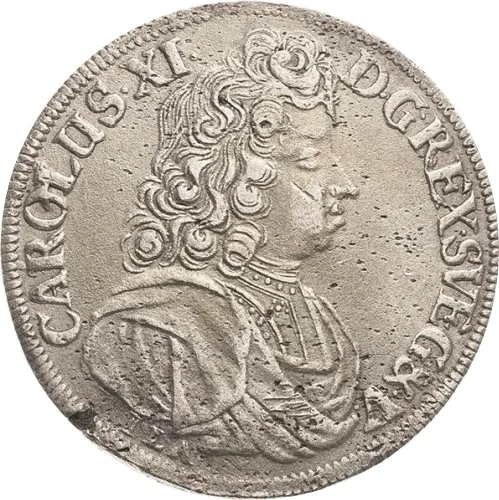
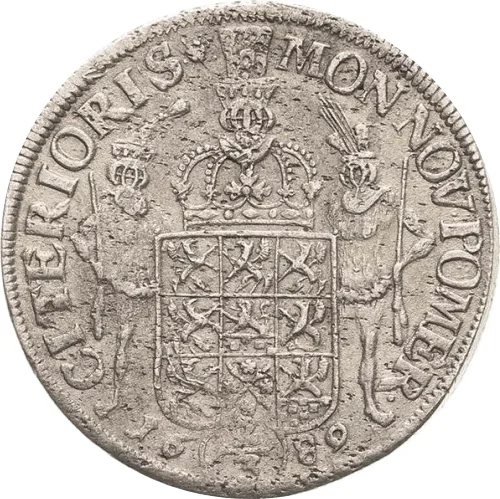
⅔ Thaler – Swedish dominion of Pomerania
Sweden
Context
Years: 1660–1692
Country: Sweden 
Issuer: Swedish dominion of Pomerania
Ruler: Charles XI
Currency:
(1630—1815)
Demonetized: Yes
References
KM: #Click to copy to clipboard307.1
Numista: #136753
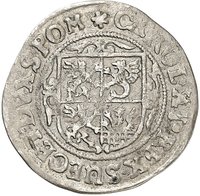
Obverse
Description:
Right-facing bust.
Script: Latin
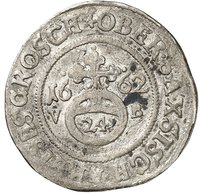
Reverse
Description:
Crowned, helmeted arms with supporters.
Script: Latin
Edge
Mints
| Name | Mark |
|---|---|
| Szczecin | — |
Mintings
| Year | Mint Mark | Mintage | Quality | Collection |
|---|---|---|---|---|
| 1660 | ILA | — | ||
| 1686 | DHM | — | ||
| 1687 | DHM | — | ||
| 1688 | DHM | — | ||
| 1689 | — | — | ||
| 1689 | ILA | — | ||
| 1690 | ILA | — | ||
| 1691 | ILA | — | ||
| 1692 | ILA | — |
Historical background
In 1660, the currency situation in Swedish Pomerania was complex and strained, reflecting the broader economic aftermath of the Thirty Years' War and Sweden's ongoing military engagements. The territory operated within a fragmented monetary system, where multiple currencies circulated simultaneously. Alongside the official Swedish coinage, a plethora of older Imperial Reichsthalers, local Pomeranian coins, and currencies from neighbouring states like Brandenburg and Poland were in use, creating constant challenges for trade and taxation due to fluctuating exchange rates and values.
This monetary confusion was exacerbated by Sweden's own fiscal policies. To finance its wars, particularly against Poland and Denmark, the Swedish crown often resorted to debasement—reducing the precious metal content in coins minted both in Sweden and its Pomeranian possessions. This practice led to inflation, a loss of public trust in the currency, and the phenomenon of "good" older coins being hoarded or exported, while "bad" debased coins flooded the market. The Swedish administration struggled to impose its monetary authority, as the lucrative right of minting was sometimes farmed out or used as a political tool.
Consequently, by 1660, the economy of Swedish Pomerania was marked by monetary instability. While efforts were made to standardize and control the currency, the pressing financial needs of the Swedish state often took precedence, undermining long-term economic stability. The situation hindered recovery and integration into the Swedish realm, leaving the local population and merchants to navigate a difficult and unreliable monetary landscape that would persist for decades.
This monetary confusion was exacerbated by Sweden's own fiscal policies. To finance its wars, particularly against Poland and Denmark, the Swedish crown often resorted to debasement—reducing the precious metal content in coins minted both in Sweden and its Pomeranian possessions. This practice led to inflation, a loss of public trust in the currency, and the phenomenon of "good" older coins being hoarded or exported, while "bad" debased coins flooded the market. The Swedish administration struggled to impose its monetary authority, as the lucrative right of minting was sometimes farmed out or used as a political tool.
Consequently, by 1660, the economy of Swedish Pomerania was marked by monetary instability. While efforts were made to standardize and control the currency, the pressing financial needs of the Swedish state often took precedence, undermining long-term economic stability. The situation hindered recovery and integration into the Swedish realm, leaving the local population and merchants to navigate a difficult and unreliable monetary landscape that would persist for decades.
✨ Legendary