

1⁄12 Thaler – Swedish dominion of Pomerania
Sweden
Context
Years: 1681–1688
Country: Sweden 
Issuer: Swedish dominion of Pomerania
Ruler: Charles XI
Currency:
(1630—1815)
Demonetized: Yes
References
KM: #Click to copy to clipboard283.1
Numista: #136745
Obverse
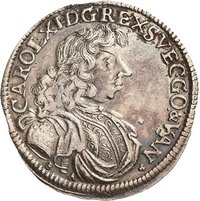
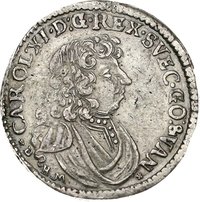
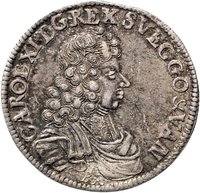
Description:
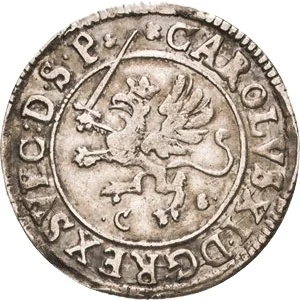
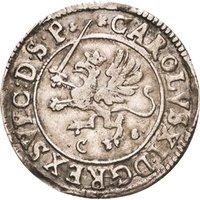
Crowned griffin with sword, left-facing, encircled.
Script: Latin
Reverse
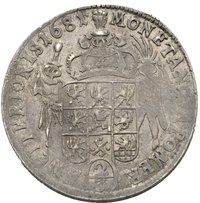
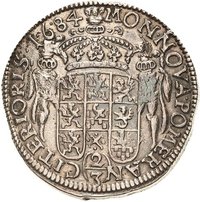
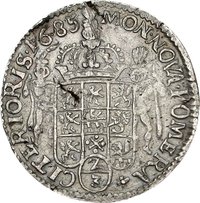
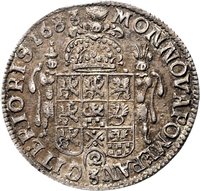
Description:
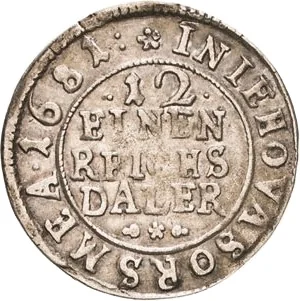
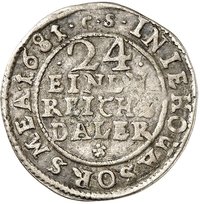
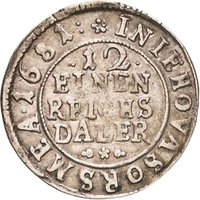
Inner circle: value and initials. Legend: date.
Script: Latin
Edge
Mintings
| Year | Mint Mark | Mintage | Quality | Collection |
|---|---|---|---|---|
| 1681 | BA | — | ||
| 1681 | CS | — | ||
| 1682 | BA | — | ||
| 1688 | DHM | — |
Historical background
In 1681, the currency situation in Swedish Pomerania was complex and challenging, reflecting the province's position as a geopolitical and economic crossroads. The territory, acquired by Sweden in 1648, operated within a dual monetary system. Officially, the Swedish government attempted to impose its own monetary standard, with the Swedish riksdaler as the central unit. However, in daily practice, the diverse array of German states' coins, particularly the ubiquitous Reichsthaler and local Mecklenburg and Brandenburg issues, continued to circulate widely. This created a persistent struggle between Stockholm's desire for monetary control and the region's entrenched economic ties to the Holy Roman Empire.
The situation was further destabilized by the widespread debasement of coinage occurring across Northern Europe in the late 17th century, a period often called the Kipper- und Wipperzeit. Neighboring states frequently reduced the silver content of their coins to fund military expenditures, leading to an influx of inferior money into Pomerania. Good, high-value Swedish and full-weight Reichsthaler were often hoarded or exported, while poor-quality coins flooded the market, causing inflation and eroding public trust in the currency. This "bad money drives out good" dynamic (Gresham's Law) plagued local trade and complicated taxation.
Consequently, Swedish authorities faced significant difficulties in administering the province's finances. The disparity between the nominal and intrinsic value of coins disrupted commerce, hindered the collection of taxes in reliable specie, and created opportunities for arbitrage. While efforts were made to set official exchange rates (Kurantzettel) between the myriad coins, the system remained chaotic. This monetary confusion ultimately undermined Swedish economic interests in Pomerania, limiting revenue and highlighting the practical limits of imperial control over a region deeply integrated into German economic networks.
The situation was further destabilized by the widespread debasement of coinage occurring across Northern Europe in the late 17th century, a period often called the Kipper- und Wipperzeit. Neighboring states frequently reduced the silver content of their coins to fund military expenditures, leading to an influx of inferior money into Pomerania. Good, high-value Swedish and full-weight Reichsthaler were often hoarded or exported, while poor-quality coins flooded the market, causing inflation and eroding public trust in the currency. This "bad money drives out good" dynamic (Gresham's Law) plagued local trade and complicated taxation.
Consequently, Swedish authorities faced significant difficulties in administering the province's finances. The disparity between the nominal and intrinsic value of coins disrupted commerce, hindered the collection of taxes in reliable specie, and created opportunities for arbitrage. While efforts were made to set official exchange rates (Kurantzettel) between the myriad coins, the system remained chaotic. This monetary confusion ultimately undermined Swedish economic interests in Pomerania, limiting revenue and highlighting the practical limits of imperial control over a region deeply integrated into German economic networks.
✨ Legendary