

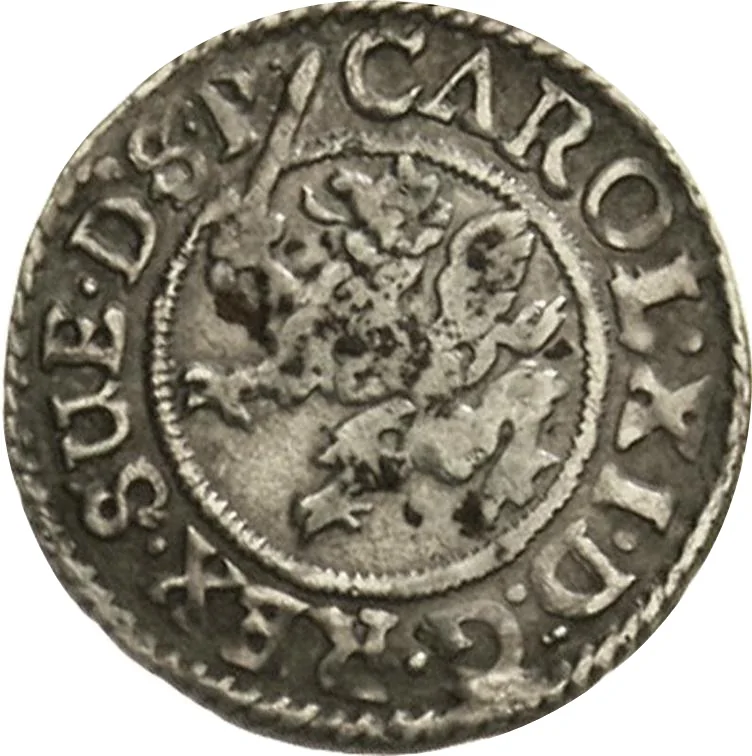
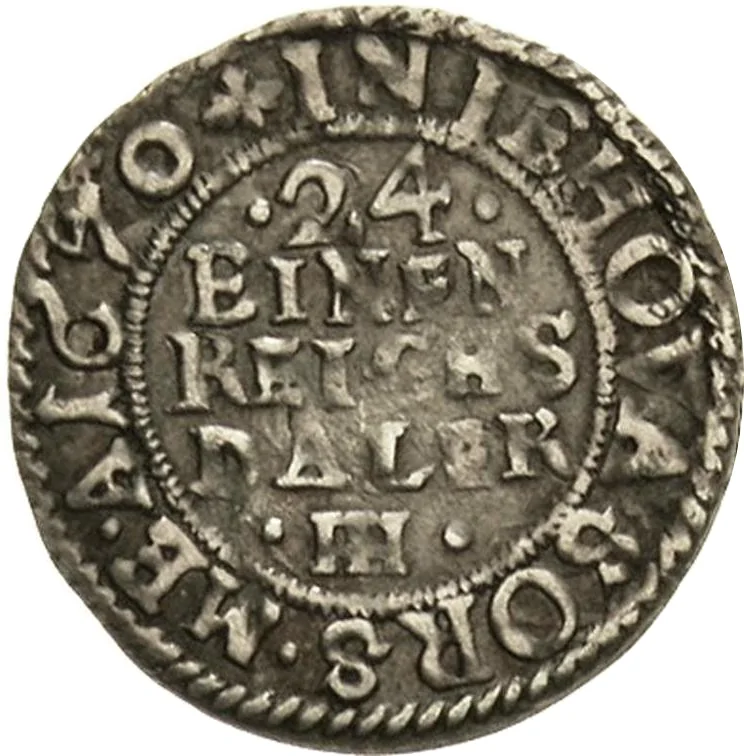
1⁄24 Thaler – Swedish dominion of Pomerania
Sweden
Context
Years: 1670–1688
Country: Sweden 
Issuer: Swedish dominion of Pomerania
Ruler: Charles XI
Currency:
(1630—1815)
Demonetized: Yes
References
KM: #Click to copy to clipboard247.1
Numista: #136450
Obverse
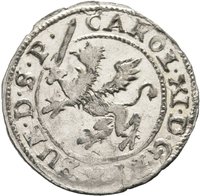
Description:
Sword-wielding griffin, left-facing.
Script: Latin
Reverse
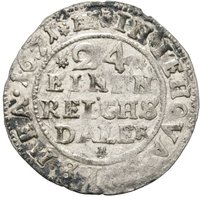
Description:
Inner circle: value and initials. Legend: date.
Script: Latin
Edge
Mintings
| Year | Mint Mark | Mintage | Quality | Collection |
|---|---|---|---|---|
| 1670 | HIH | — | ||
| 1671 | HIH | — | ||
| 1687 | DHM | — | ||
| 1688 | DHM | — |
Historical background
In 1670, the currency situation in Swedish Pomerania was complex and strained, reflecting both local economic pressures and the broader monetary policies of the Swedish Empire. The province operated within a dual monetary system: the Swedish state demanded taxes and conducted its official accounting in the stable Swedish riksdaler, while daily local commerce relied on a debased regional coinage, primarily the Pomeranian schilling. This created a constant tension, as the value of the local currency against the riksdaler was unstable and often subject to manipulation.
The root of the instability lay in the Thirty Years' War and subsequent conflicts, which had severely depleted the region's economy. To generate revenue, Swedish authorities, like their predecessors, frequently engaged in coinage debasement—reducing the precious metal content in locally minted coins while officially maintaining their face value. This practice led to chronic inflation, a loss of public trust in the currency, and the circulation of a confusing array of foreign coins from neighbouring German states, further complicating trade and pricing.
Consequently, the year 1670 fell within a period of ongoing monetary crisis and attempted reforms. Swedish kings, including Charles XI, issued ordinances to regulate exchange rates and curb the worst abuses, but these measures were often ineffective on the ground. The fundamental disconnect between the "hard" imperial currency required for state finances and the "soft" local money used in the marketplace placed a heavy burden on Pomeranian peasants and burghers, stifling economic recovery and creating a persistent source of administrative difficulty for the Swedish dominion.
The root of the instability lay in the Thirty Years' War and subsequent conflicts, which had severely depleted the region's economy. To generate revenue, Swedish authorities, like their predecessors, frequently engaged in coinage debasement—reducing the precious metal content in locally minted coins while officially maintaining their face value. This practice led to chronic inflation, a loss of public trust in the currency, and the circulation of a confusing array of foreign coins from neighbouring German states, further complicating trade and pricing.
Consequently, the year 1670 fell within a period of ongoing monetary crisis and attempted reforms. Swedish kings, including Charles XI, issued ordinances to regulate exchange rates and curb the worst abuses, but these measures were often ineffective on the ground. The fundamental disconnect between the "hard" imperial currency required for state finances and the "soft" local money used in the marketplace placed a heavy burden on Pomeranian peasants and burghers, stifling economic recovery and creating a persistent source of administrative difficulty for the Swedish dominion.
✨ Legendary