

1 Ducat – Swedish dominion of Pomerania
Sweden
Context
Years: 1654–1658
Country: Sweden 
Issuer: Swedish dominion of Pomerania
Ruler: Charles X Gustav
Currency:
(1630—1815)
Demonetized: Yes
Material
References
KM: #Click to copy to clipboard215.1
Numista: #136447
Value
Bullion value: $576.36
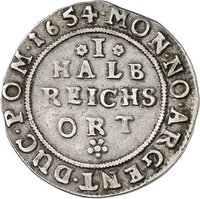
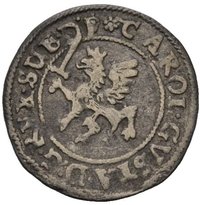
Obverse
Description:
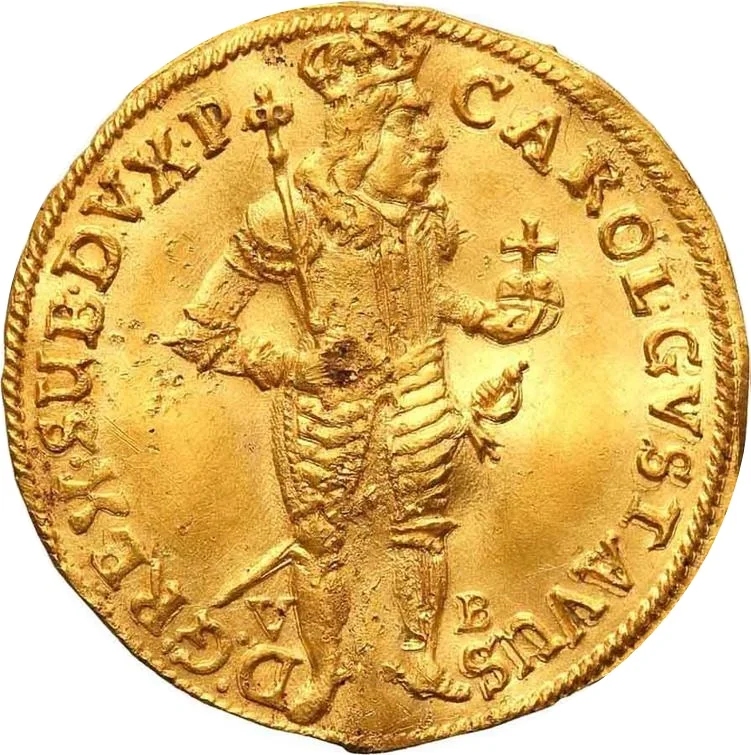
King Karl X holding scepter and orb.
Inscription:
CAROL GVSTAVUS - D G REX SUE DVX P
Script: Latin
Reverse
Edge
Mintings
| Year | Mint Mark | Mintage | Quality | Collection |
|---|---|---|---|---|
| 1654 | — | — | ||
| 1656 | VB | — | ||
| 1658 | VB | — |
Historical background
During the mid-17th century, Swedish Pomerania, a remnant of Sweden's gains in the Thirty Years' War, operated within a complex and fragmented monetary system. The territory did not have a unified currency but was a zone of competing circulations. The official currency was the Swedish klippe and mark, but in practice, these coexisted with a multitude of other coins. Imperial Reichsthalers, Polish coins, and various German state issues from neighbouring territories all circulated freely, their values fluctuating based on metallic content and local demand. This created a chaotic environment for trade and taxation, complicated further by the widespread problem of debased and clipped coins.
The Swedish administration, based in Stettin (Szczecin), struggled to exert monetary control. While attempts were made to standardise the system by promoting Swedish coinage, the economic reality was dictated by the region's deep integration into broader German and Baltic trade networks. Furthermore, the Swedish state itself contributed to instability by frequently demanding its Pomeranian war contributions and taxes in high-quality Reichsthalers, thereby draining the province of its soundest money. This practice, known as "currency suction," left the local economy with a disproportionate amount of inferior coinage.
By 1654, the situation was one of chronic disorder and economic strain. The lack of a reliable standard hampered commerce and state revenue collection. The ongoing financial demands from Stockholm, coupled with the aftermath of the devastating war, meant that Pomerania's currency chaos was both a symptom and a cause of wider economic hardship. It reflected the broader challenge of Swedish rule: administering a German territory with its own economic traditions while attempting to integrate it into a distant Scandinavian empire, all amidst the fragile recovery of the post-Westphalian peace.
The Swedish administration, based in Stettin (Szczecin), struggled to exert monetary control. While attempts were made to standardise the system by promoting Swedish coinage, the economic reality was dictated by the region's deep integration into broader German and Baltic trade networks. Furthermore, the Swedish state itself contributed to instability by frequently demanding its Pomeranian war contributions and taxes in high-quality Reichsthalers, thereby draining the province of its soundest money. This practice, known as "currency suction," left the local economy with a disproportionate amount of inferior coinage.
By 1654, the situation was one of chronic disorder and economic strain. The lack of a reliable standard hampered commerce and state revenue collection. The ongoing financial demands from Stockholm, coupled with the aftermath of the devastating war, meant that Pomerania's currency chaos was both a symptom and a cause of wider economic hardship. It reflected the broader challenge of Swedish rule: administering a German territory with its own economic traditions while attempting to integrate it into a distant Scandinavian empire, all amidst the fragile recovery of the post-Westphalian peace.
✨ Legendary