

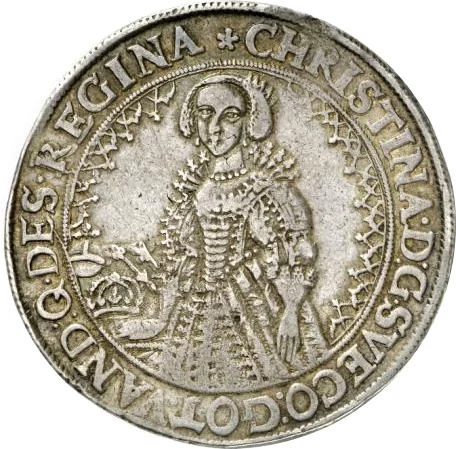
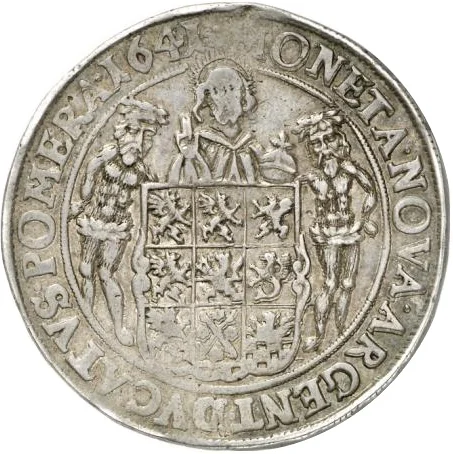
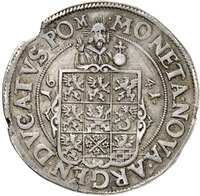
1 Thaler – Swedish dominion of Pomerania
Sweden
Obverse
Description:
Half-length portrait in a circle, crowned at left.
Script: Latin
Reverse
Description:
Christ upheld the cross.
Script: Latin
Edge
Mintings
| Year | Mint Mark | Mintage | Quality | Collection |
|---|---|---|---|---|
| 1640 | — | — | ||
| 1641 | — | — |
Historical background
In 1640, Swedish Pomerania was a war-torn territory caught in the complex monetary chaos of the Thirty Years' War. Since its acquisition by Sweden in 1630, the duchy operated within a fractured German currency landscape, where the official Reichsthaler competed with a plethora of debased local coins from neighboring states. The Swedish administration, primarily focused on military extraction, contributed to the instability by introducing its own low-quality "Klippe" coins to finance its garrison armies, further flooding the market with unreliable currency.
This period was characterized by severe "Kipper und Wipper" inflation, a crisis where various states and cities repeatedly debased their small change (primarily copper Schillinge and Dreier), leading to a collapse in public trust. Good silver coins were hoarded, while worthless small change circulated for daily transactions, crippling local trade and causing prices to soar. The Swedish authorities, though aware of the problem, lacked the resources and stability to impose a uniform monetary system, leaving the population to navigate a confusing and exploitative multi-currency environment.
Consequently, the economic life of Pomerania was defined by uncertainty and hardship. The currency situation mirrored the territory's broader plight: it was a resource to be tapped for the Swedish war effort rather than a stable domain to be developed. Any attempts at monetary reform would remain ineffective until after the war's conclusion, with the 1648 Peace of Westphalia finally providing the political framework for Sweden to begin implementing more systematic, though still challenging, financial control over its German possession.
This period was characterized by severe "Kipper und Wipper" inflation, a crisis where various states and cities repeatedly debased their small change (primarily copper Schillinge and Dreier), leading to a collapse in public trust. Good silver coins were hoarded, while worthless small change circulated for daily transactions, crippling local trade and causing prices to soar. The Swedish authorities, though aware of the problem, lacked the resources and stability to impose a uniform monetary system, leaving the population to navigate a confusing and exploitative multi-currency environment.
Consequently, the economic life of Pomerania was defined by uncertainty and hardship. The currency situation mirrored the territory's broader plight: it was a resource to be tapped for the Swedish war effort rather than a stable domain to be developed. Any attempts at monetary reform would remain ineffective until after the war's conclusion, with the 1648 Peace of Westphalia finally providing the political framework for Sweden to begin implementing more systematic, though still challenging, financial control over its German possession.
✨ Legendary