

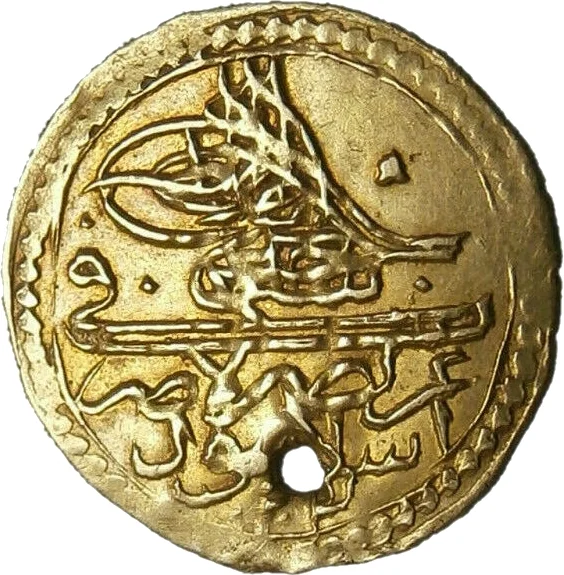
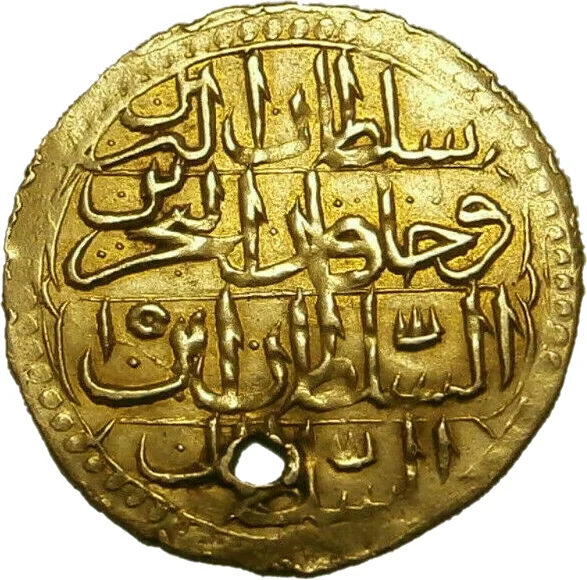
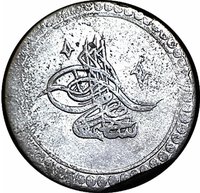
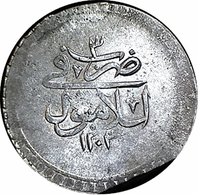
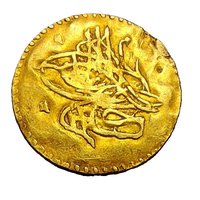
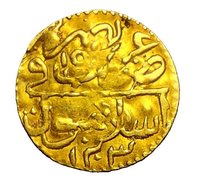
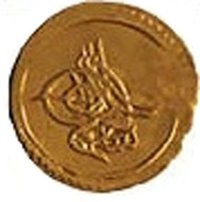
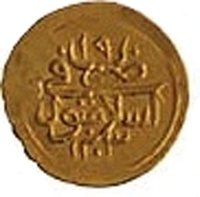
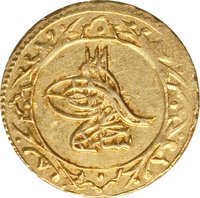
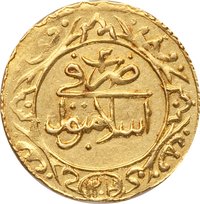
½ Zeri Mahbub – Ottoman Empire
Turkey
Context
Year: 1789
Islamic (Hijri) Year: 1203
Country: Turkey 
Issuer: Ottoman Empire
Ruler: Selim III
Currency:
(1688—1844)
Demonetized: Yes
Material
References
KM: #Click to copy to clipboard517
Numista: #135790
Value
Bullion value: $198.41
Mints
| Name | Mark |
|---|---|
| Constantinople | — |
Mintings
| Year | Mint Mark | Mintage | Quality | Collection |
|---|---|---|---|---|
| 1789 | — | — |
Historical background
In 1789, the Ottoman Empire’s currency system was in a state of profound crisis, characterized by severe debasement and inflation. The primary unit, the akçe, had been so drastically reduced in silver content over the preceding century that it was nearly valueless, leading to its effective demonetization. In its place, the kuruş (piastre), a larger silver coin, and the gold altın served as the main currencies for state finance and large transactions. However, to finance endless wars with Russia and Austria, and to cover massive budget deficits, the state repeatedly resorted to clipping coins and issuing new, lower-purity kuruş, eroding public trust and destabilizing the economy.
This monetary instability was exacerbated by a chronic shortage of specie, particularly silver, which flowed out to pay for military imports and consumer goods from Europe, worsening the empire's negative trade balance. The situation created a chaotic multi-currency environment where various European gold and silver coins, such as the Dutch rijksdaalder and the Spanish real, circulated alongside Ottoman issues, their values fluctuating wildly in the bazaar based on intrinsic metal content rather than face value. The government’s attempts to fix exchange rates by decree (narh) were largely ineffective, leading to widespread hoarding of sound coins (Gresham’s Law in action) and further strangling daily commerce.
Sultan Selim III, who ascended the throne in 1789, inherited this financial disarray, which directly undermined his ability to fund the ongoing war and his later reform agenda, the Nizam-ı Cedid (New Order). The currency crisis was symptomatic of deeper structural issues: a weakening central mint authority, loss of control over provincial economies, and the empire’s increasing integration into a European-dominated global economy on unfavorable terms. Thus, in 1789, the Ottoman monetary system was not merely a financial problem, but a critical threat to the very fiscal-military survival of the state.
This monetary instability was exacerbated by a chronic shortage of specie, particularly silver, which flowed out to pay for military imports and consumer goods from Europe, worsening the empire's negative trade balance. The situation created a chaotic multi-currency environment where various European gold and silver coins, such as the Dutch rijksdaalder and the Spanish real, circulated alongside Ottoman issues, their values fluctuating wildly in the bazaar based on intrinsic metal content rather than face value. The government’s attempts to fix exchange rates by decree (narh) were largely ineffective, leading to widespread hoarding of sound coins (Gresham’s Law in action) and further strangling daily commerce.
Sultan Selim III, who ascended the throne in 1789, inherited this financial disarray, which directly undermined his ability to fund the ongoing war and his later reform agenda, the Nizam-ı Cedid (New Order). The currency crisis was symptomatic of deeper structural issues: a weakening central mint authority, loss of control over provincial economies, and the empire’s increasing integration into a European-dominated global economy on unfavorable terms. Thus, in 1789, the Ottoman monetary system was not merely a financial problem, but a critical threat to the very fiscal-military survival of the state.
✨ Legendary