

1 thaler – Holy Roman Empire
Add to wishlist
Germany
Context
Year: 1764
Country: Germany
Issuer: Holy Roman Empire
Period:
(1756—1763)
Ruler: Francis I
Currency:
(1520—1754)
Demonetized: Yes
Material
References
KM: #
Numista: #132848
Value
Bullion value: $59.73
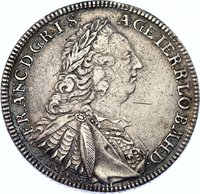
Obverse
Description:
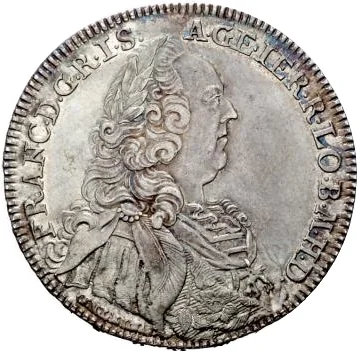
Laureate armored bust of Francis I, right.
Inscription:
FRANC • D • G • R • I • S • A • GE • IER • R • LO • B • M • H • D •
Script: Latin
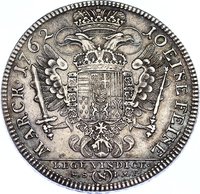
Reverse
Description:
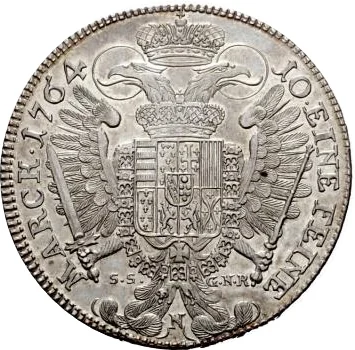
Crowned arms with chain on eagle's breast.
Inscription:
10 • EINE FEINE MARCK •1764
Script: Latin
Edge
Inscriptions in relief
Legend:
LEGE-VINDICE
Categories
| Person> Monarch |
| Symbol> Double-headed eagle |
Mints
| Name | Mark |
|---|---|
| Nuremberg | N |
Mintings
| Year | Mint Mark | Mintage | Quality | Collection |
|---|---|---|---|---|
| 1764 | N | — |
Historical background
In 1764, the currency situation within the Holy Roman Empire was one of profound fragmentation and instability, a direct legacy of its decentralized political structure. The Empire was a mosaic of over 300 largely autonomous states, free cities, and knightly territories, each typically asserting the right to mint its own coin. This resulted in a bewildering array of circulating currencies, with thalers, gulden, kreuzers, and groschen of varying standards and metallic content coexisting. The primary regulatory framework, the Reichsmünzordnung (Imperial Coinage Ordinance), was last updated in 1559 and was utterly obsolete, unable to control the chronic debasement of coinage by individual princes seeking to finance their treasuries.
The core problem was the disparity between large-denomination Kurantmünzen (specie coins), which were supposed to contain full intrinsic metal value, and the small-change Landmünzen or Scheidemünzen used for daily transactions. States routinely issued excessive amounts of these smaller coins with a face value far exceeding their metal content, leading to inflation, loss of public trust, and complex exchange rates that hampered trade. The Seven Years' War (1756-1763), which had just concluded, dramatically worsened the crisis. Warring states, especially Prussia and Austria, had flooded their territories with depreciated coinage to pay for the conflict, leaving the German lands with a chaotic monetary hangover of uncertain and degraded currency.
Recognizing the severe economic damage, 1764 marked a year of significant, though regionally limited, reform. Under the leadership of Empress Maria Theresa, the Habsburg monarchy and the Bavarian Wittelsbachs concluded the Austro-Bavarian Coinage Convention. This treaty created a stable, common currency zone in southern Germany, defining a fixed standard for the Conventionsthaler and regulating subsidiary coinage. While a crucial step, it also underscored the Empire's inability to enact universal reform; instead, stability was achieved through regional agreements between major powers, further cementing the monetary division of the Empire into competing blocs on the path to the later Thaler and Gulden zones.
The core problem was the disparity between large-denomination Kurantmünzen (specie coins), which were supposed to contain full intrinsic metal value, and the small-change Landmünzen or Scheidemünzen used for daily transactions. States routinely issued excessive amounts of these smaller coins with a face value far exceeding their metal content, leading to inflation, loss of public trust, and complex exchange rates that hampered trade. The Seven Years' War (1756-1763), which had just concluded, dramatically worsened the crisis. Warring states, especially Prussia and Austria, had flooded their territories with depreciated coinage to pay for the conflict, leaving the German lands with a chaotic monetary hangover of uncertain and degraded currency.
Recognizing the severe economic damage, 1764 marked a year of significant, though regionally limited, reform. Under the leadership of Empress Maria Theresa, the Habsburg monarchy and the Bavarian Wittelsbachs concluded the Austro-Bavarian Coinage Convention. This treaty created a stable, common currency zone in southern Germany, defining a fixed standard for the Conventionsthaler and regulating subsidiary coinage. While a crucial step, it also underscored the Empire's inability to enact universal reform; instead, stability was achieved through regional agreements between major powers, further cementing the monetary division of the Empire into competing blocs on the path to the later Thaler and Gulden zones.
✨ Legendary