

1 thaler – Holy Roman Empire
Add to wishlist
Germany
Context
Years: 1760–1763
Country: Germany
Issuer: Holy Roman Empire
Period:
(1756—1763)
Ruler: Francis I
Currency:
(1520—1754)
Demonetized: Yes
Material
References
KM: #
Numista: #29437
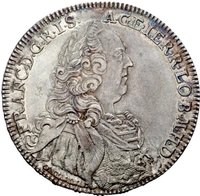
Obverse
Description:
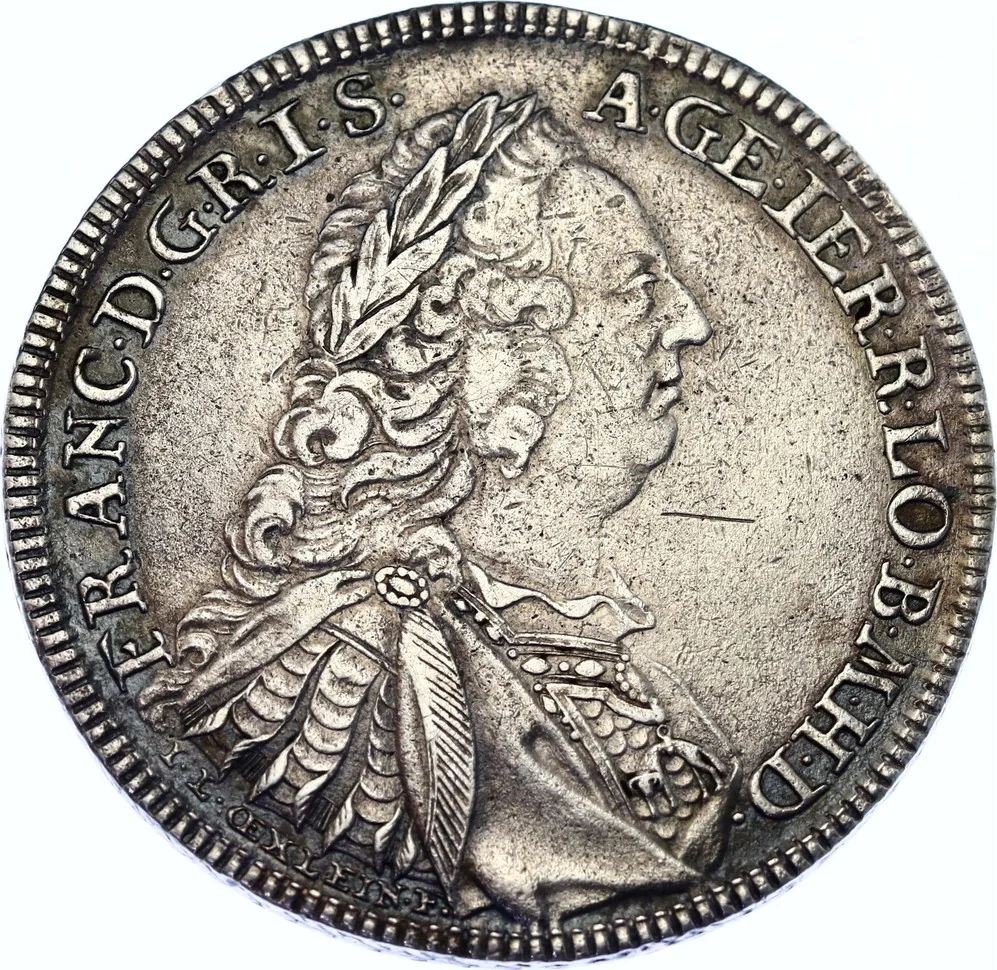
Bust of Francis I, right profile.
Inscription:
FRANC.D.G.R.I.S.A.GE.IER.R.LO.B.M.H.D.
Script: Latin
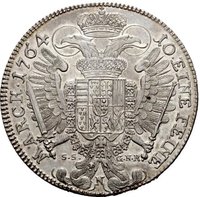
Reverse
Description:
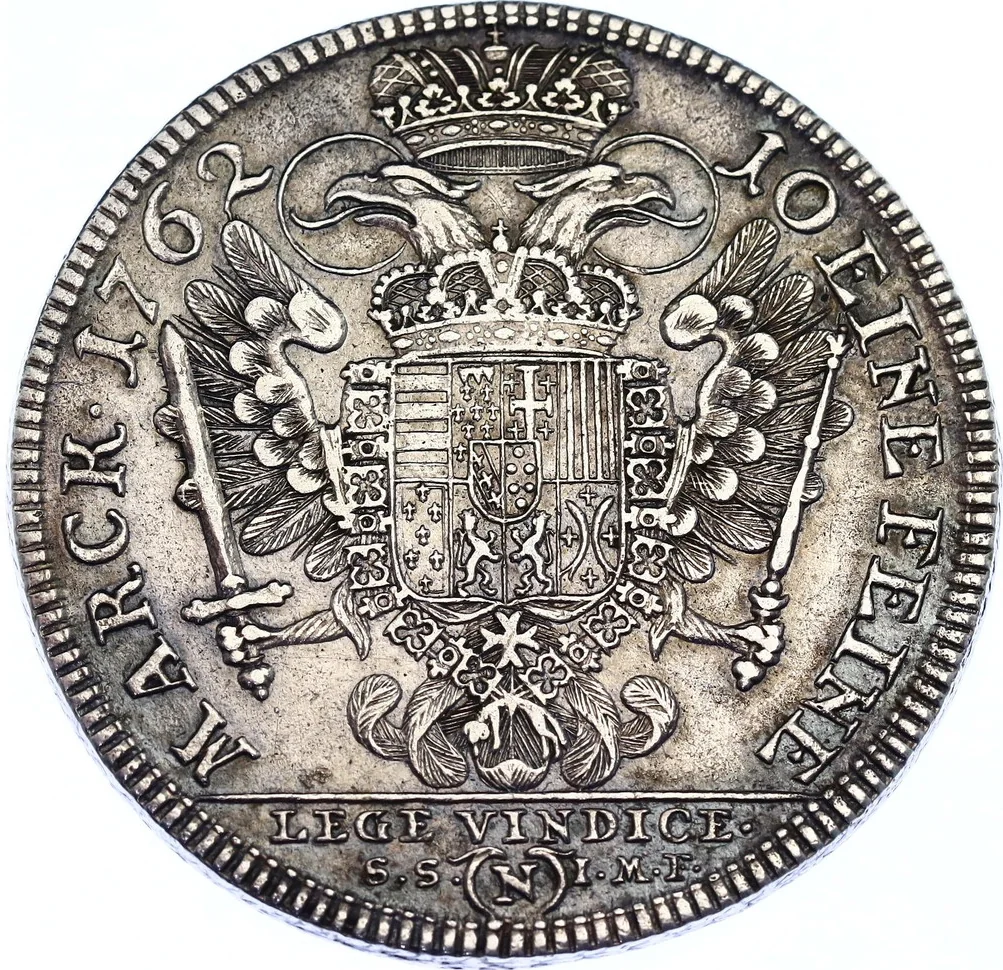
Imperial double-headed eagle.
Inscription:
10 EINEFEINE MARCK 1762
LEGE VINDICE
LEGE VINDICE
Script: Latin
Edge
Categories
| Person> Monarch |
| Symbol> Double-headed eagle |
Mints
| Name | Mark |
|---|---|
| Nuremberg | N |
Mintings
| Year | Mint Mark | Mintage | Quality | Collection |
|---|---|---|---|---|
| 1760 | — | — | ||
| 1762 | — | — | ||
| 1763 | — | — |
Historical background
By 1760, the currency situation within the Holy Roman Empire was one of profound complexity and instability, a direct legacy of its fragmented political structure. There was no single imperial currency; instead, a bewildering array of over 1,000 different coins circulated, issued by the Emperor, ecclesiastical princes, imperial knights, and over 300 secular territories like Austria, Prussia, and Bavaria. This system was theoretically governed by the Imperial Coinage Ordinance (Reichsmünzordnung), but its regulations were widely ignored. Princes routinely debased their coinage—reducing precious metal content—to finance state expenses, particularly the ongoing Seven Years' War (1756-1763), in which many were participants. This created a chaotic monetary landscape where the value of coins was not fixed and trust in currency was low.
The core problem was the disconnect between the official Reichsthaler (Imperial Thaler), used as an accounting unit, and the physical coins in everyday use, such as Groschen, Kreuzers, and Gulden. Each territory minted its own versions with varying silver content, leading to Gresham's Law in practice: "bad" debased coins drove "good" full-weight coins out of circulation, as people hoarded the latter. This was exacerbated by the war, as belligerents like Prussia issued massive quantities of low-quality coin to pay for armies, flooding the markets. For merchants and the public, this meant constant uncertainty, the need for exchange tables (Wechseltabellen), and significant transaction costs, severely hampering intra-imperial trade and economic coherence.
In response, attempts at regional stabilization were emerging. The most significant was the Conventionsfuß system, where groups of states agreed on a common silver standard for their thalers. The 1753 Vienna Coinage Treaty between Austria and Bavaria, which established the Conventionsthaler, was a notable example. However, these agreements were partial and regional, often undermined by the fiscal demands of war. Thus, in 1760, the Empire's currency was a patchwork of depreciating coins, marked by localized efforts at order but overall characterized by confusion and inflationary pressure, reflecting the Empire's own struggle between central authority and particularist interests.
The core problem was the disconnect between the official Reichsthaler (Imperial Thaler), used as an accounting unit, and the physical coins in everyday use, such as Groschen, Kreuzers, and Gulden. Each territory minted its own versions with varying silver content, leading to Gresham's Law in practice: "bad" debased coins drove "good" full-weight coins out of circulation, as people hoarded the latter. This was exacerbated by the war, as belligerents like Prussia issued massive quantities of low-quality coin to pay for armies, flooding the markets. For merchants and the public, this meant constant uncertainty, the need for exchange tables (Wechseltabellen), and significant transaction costs, severely hampering intra-imperial trade and economic coherence.
In response, attempts at regional stabilization were emerging. The most significant was the Conventionsfuß system, where groups of states agreed on a common silver standard for their thalers. The 1753 Vienna Coinage Treaty between Austria and Bavaria, which established the Conventionsthaler, was a notable example. However, these agreements were partial and regional, often undermined by the fiscal demands of war. Thus, in 1760, the Empire's currency was a patchwork of depreciating coins, marked by localized efforts at order but overall characterized by confusion and inflationary pressure, reflecting the Empire's own struggle between central authority and particularist interests.
✨ Legendary