

1 farthing – United Kingdom
Add to wishlist
United Kingdom
Context
Year: 1799
Issuer: United Kingdom
Ruler: George III
Currency:
(1158—1970)
Demonetization: 31 December 1869
Material
References
KM: #
Numista: #13162
Obverse
Description:
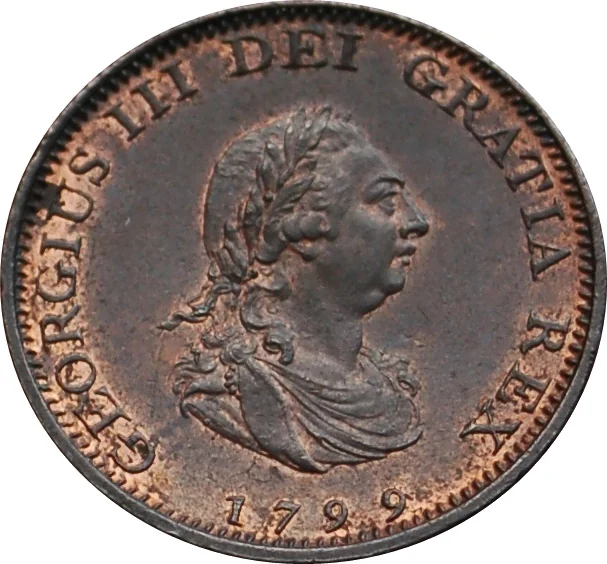
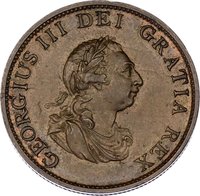
George III laureate bust right, draped, legend surrounding, date beneath.
Inscription:
GEORGIUS III DEI GRATIA REX
1799
1799
Script: Latin
Engraver: Conrad Heinrich Küchler
Reverse
Description:
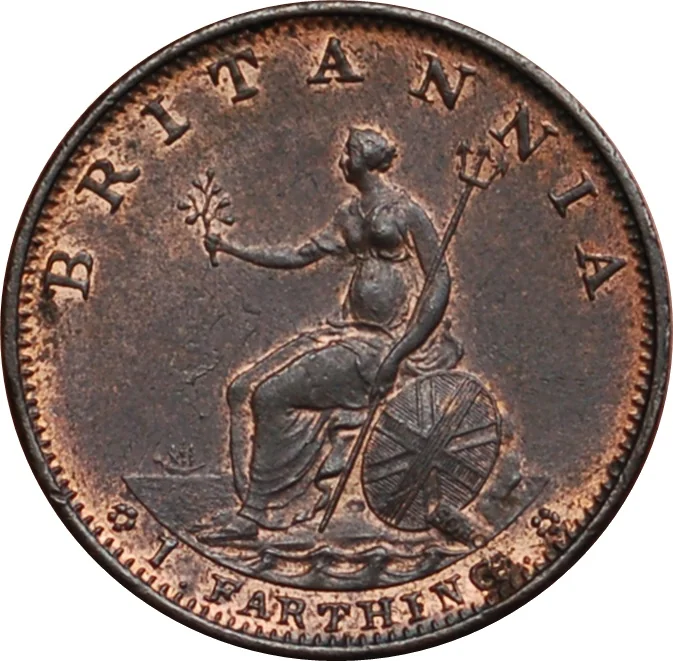
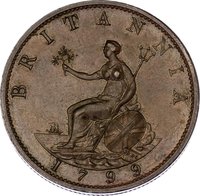
Britannia seated left, holding trident and shield with Union flag, olive branch in raised right hand. Legend above, denomination below. Soho mint mark by shield.
Inscription:
BRITANNIA
SOHO
1.FARTHING.
SOHO
1.FARTHING.
Script: Latin
Engraver: Conrad Heinrich Küchler
Edge
Engrailed
Categories
| Object> Armour |
| Geography> Sea |
| Transportation> Watercraft |
Mints
| Name | Mark |
|---|---|
| Soho Mint | — |
Mintings
| Year | Mint Mark | Mintage | Quality | Collection |
|---|---|---|---|---|
| 1799 | — | — | ||
| 1799 | — | — | Proof |
Historical background
In 1799, the United Kingdom’s currency system was under severe strain, primarily due to the financial demands of the ongoing French Revolutionary Wars (1792-1802). The government, led by Prime Minister William Pitt the Younger, was funding the conflict through extensive borrowing, leading to a dramatic increase in the national debt. This fiscal pressure, combined with poor harvests, caused a shortage of gold coinage—the foundation of the monetary system—as people hoarded precious metal. The Bank of England, in response, had suspended the convertibility of its banknotes into gold in 1797 under the Bank Restriction Act, placing the country on an inconvertible paper standard.
This move to a fiat currency, while necessary to prevent a run on the Bank's gold reserves, created a complex and often unstable monetary environment. The value of Bank of England notes was no longer anchored to a specific weight of gold, leading to fluctuations and a gradual depreciation against bullion. A proliferation of private provincial banknotes and tokens issued by merchants and manufacturers further complicated the circulation, as these varied widely in reliability and creditworthiness. Consequently, the public had to navigate a confusing mix of paper promises, with the risk of local bank failures rendering notes worthless.
It was within this context of wartime finance and monetary instability that Pitt introduced the first income tax in British history in his budget of 1799. This radical measure was a direct attempt to raise substantial revenue without further depleting gold reserves or increasing the debt burden through more borrowing. The tax, initially presented as a temporary wartime expedient, underscored the extreme financial pressures of the era and marked a pivotal moment in British fiscal policy, all while the nation's currency remained detached from its traditional gold anchor.
This move to a fiat currency, while necessary to prevent a run on the Bank's gold reserves, created a complex and often unstable monetary environment. The value of Bank of England notes was no longer anchored to a specific weight of gold, leading to fluctuations and a gradual depreciation against bullion. A proliferation of private provincial banknotes and tokens issued by merchants and manufacturers further complicated the circulation, as these varied widely in reliability and creditworthiness. Consequently, the public had to navigate a confusing mix of paper promises, with the risk of local bank failures rendering notes worthless.
It was within this context of wartime finance and monetary instability that Pitt introduced the first income tax in British history in his budget of 1799. This radical measure was a direct attempt to raise substantial revenue without further depleting gold reserves or increasing the debt burden through more borrowing. The tax, initially presented as a temporary wartime expedient, underscored the extreme financial pressures of the era and marked a pivotal moment in British fiscal policy, all while the nation's currency remained detached from its traditional gold anchor.
🌱 Common