

1 dicken – Salm-Dhaun, Wildgraviate and Rhingraviate of
Add to wishlist
Germany
Context
References
KM: #
Numista: #131401
Value
Bullion value: $15.89
Obverse
Description:
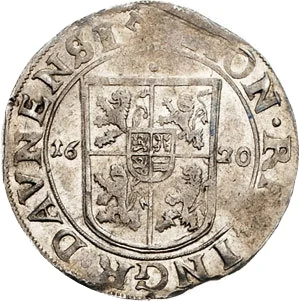
4-fold arms, central shield, arms split date.
Inscription:
MON . RHEINGR . DAVNENSIVM
Script: Latin
Reverse
Description:
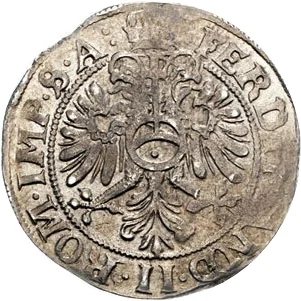
Imperial eagle with orb, crowned, surrounded by Ferdinand II's titles.
Script: Latin
Edge
Mintings
| Year | Mint Mark | Mintage | Quality | Collection |
|---|---|---|---|---|
| 1620 | — | — |
Historical background
In 1620, the currency situation within the small, intertwined counties of Salm-Dhaun, Wild- and Rhingraviate was one of profound complexity and instability, emblematic of the wider monetary chaos in the Holy Roman Empire. These territories did not mint their own major coins but were awash in a bewildering variety of circulating specie. Imperial Talers, Spanish 8-Reales, Dutch Leeuwendaalders, and various regional issues from neighboring princes all circulated simultaneously, their values constantly shifting against one another based on metallic content and perceived trust. This created a perpetual challenge for commerce and taxation, as the actual value of a coin was often divorced from its face value.
The root of the instability lay in the Kipper- und Wipperzeit (literally "Clipping and Swinging" time), a period of rampant currency debasement that peaked in the early 1620s. While the Wild- and Rhingraves were not major instigators, they were severely impacted. Neighboring princes and cities, seeking to finance their growing military expenditures at the dawn of the Thirty Years' War, were melting down good coin, re-minting it with reduced precious metal content, and flooding the region with this degraded currency. This triggered hyperinflation, a collapse of public trust, and a vicious cycle where good coins were hoarded (Gresham's Law in action) while bad coins drove out daily transactions.
Consequently, authorities in Salm-Dhaun and the Wild- and Rhingraviate faced a crisis of monetary sovereignty. Their response likely involved frequent publication of Münztafeln (currency tables) that attempted to fix exchange rates for the dozens of coins in use, and ordinances forbidding the circulation of particularly debased issues. However, these measures were largely reactive and struggled against the overwhelming economic forces of war and deception. The currency situation, therefore, was not merely a financial nuisance but a source of social distress and a significant vulnerability as the region stood on the precipice of the full-scale war that would soon engulf it.
The root of the instability lay in the Kipper- und Wipperzeit (literally "Clipping and Swinging" time), a period of rampant currency debasement that peaked in the early 1620s. While the Wild- and Rhingraves were not major instigators, they were severely impacted. Neighboring princes and cities, seeking to finance their growing military expenditures at the dawn of the Thirty Years' War, were melting down good coin, re-minting it with reduced precious metal content, and flooding the region with this degraded currency. This triggered hyperinflation, a collapse of public trust, and a vicious cycle where good coins were hoarded (Gresham's Law in action) while bad coins drove out daily transactions.
Consequently, authorities in Salm-Dhaun and the Wild- and Rhingraviate faced a crisis of monetary sovereignty. Their response likely involved frequent publication of Münztafeln (currency tables) that attempted to fix exchange rates for the dozens of coins in use, and ordinances forbidding the circulation of particularly debased issues. However, these measures were largely reactive and struggled against the overwhelming economic forces of war and deception. The currency situation, therefore, was not merely a financial nuisance but a source of social distress and a significant vulnerability as the region stood on the precipice of the full-scale war that would soon engulf it.
✨ Legendary