

1 Ducat – Landgraviate of Hesse-Cassel
Context
Material
References
KM: #Click to copy to clipboard409
Numista: #131343
Value
Bullion value: $585.26
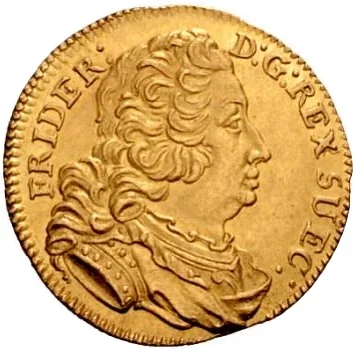
Obverse
Description:
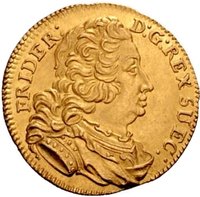
Friedrich, right-facing bust.
Script: Latin
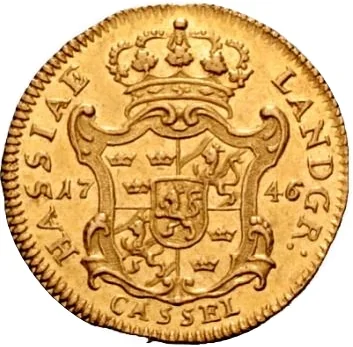
Reverse
Description:
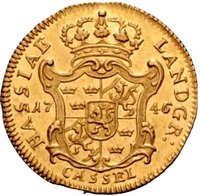
Arms of Hessen and Sweden.
Script: Latin
Edge
Mints
| Name | Mark |
|---|---|
| Kassel | — |
Mintings
| Year | Mint Mark | Mintage | Quality | Collection |
|---|---|---|---|---|
| 1731 | — | — | ||
| 1737 | — | — | ||
| 1746 | — | — | ||
| 1749 | — | — | ||
| 1750 | — | — |
Historical background
In 1731, the currency situation in the Landgraviate of Hesse-Cassel was one of significant complexity and instability, a legacy of the region's strategic importance and the financial demands of its rulers. The landgraviate, a significant German principality within the Holy Roman Empire, did not have a unified, stable coinage system. Instead, its monetary landscape was a fragmented patchwork of various circulating coins, including those minted locally under the authority of Landgrave Charles I, as well as a multitude of foreign currencies from neighboring states like Prussia, Hanover, and the Dutch Republic. This proliferation was exacerbated by the practice of "Kipper- und Wipperzeit," a period of coin debasement in the early 17th century, the chaotic effects of which still lingered.
The core of the problem lay in the discrepancy between the official Reichsthaler (Imperial Thaler), a theoretical accounting unit, and the actual, physically minted coins in circulation. Landgrave Charles I, like many German princes, sought to generate revenue through Münzregal (the sovereign right to mint coins), often issuing lighter, debased subsidiary coins (such as Gute Groschen and Kreuzers) for local use while demanding payments like taxes in full-weight Reichsthalers. This created a two-tier system that disadvantaged the general populace and merchants, leading to confusion, loss in exchange, and hindered commerce. The value of money was not intrinsic but fluctuated based on official minting ordinances (Münzedikte) that frequently attempted, with limited success, to fix exchange rates between the myriad of coins.
Consequently, the year 1731 fell within a period of ongoing monetary struggle. The landgraviate's economy, heavily influenced by its military trade (providing mercenary soldiers) and transit routes, suffered from this lack of a reliable standard. While efforts at reform were discussed, a true stabilization would only begin under his successor, Landgrave Frederick I, and more decisively under the enlightened rule of Landgrave Frederick II later in the century. Thus, in 1731, Hesse-Cassel's currency remained a source of economic friction and administrative challenge, characteristic of the broader monetary disunity within the Holy Roman Empire prior to the modern era.
The core of the problem lay in the discrepancy between the official Reichsthaler (Imperial Thaler), a theoretical accounting unit, and the actual, physically minted coins in circulation. Landgrave Charles I, like many German princes, sought to generate revenue through Münzregal (the sovereign right to mint coins), often issuing lighter, debased subsidiary coins (such as Gute Groschen and Kreuzers) for local use while demanding payments like taxes in full-weight Reichsthalers. This created a two-tier system that disadvantaged the general populace and merchants, leading to confusion, loss in exchange, and hindered commerce. The value of money was not intrinsic but fluctuated based on official minting ordinances (Münzedikte) that frequently attempted, with limited success, to fix exchange rates between the myriad of coins.
Consequently, the year 1731 fell within a period of ongoing monetary struggle. The landgraviate's economy, heavily influenced by its military trade (providing mercenary soldiers) and transit routes, suffered from this lack of a reliable standard. While efforts at reform were discussed, a true stabilization would only begin under his successor, Landgrave Frederick I, and more decisively under the enlightened rule of Landgrave Frederick II later in the century. Thus, in 1731, Hesse-Cassel's currency remained a source of economic friction and administrative challenge, characteristic of the broader monetary disunity within the Holy Roman Empire prior to the modern era.
✨ Legendary