

½ Crown – United Kingdom
United Kingdom
Context
Years: 1715–1726
Issuer: United Kingdom 
Ruler: George I
Currency:
(1158—1970)
Demonetization: 31 December 1969
Material
References
KM: #Click to copy to clipboard540
Numista: #13075
Value
Bullion value: $39.84
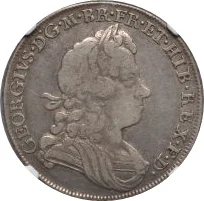
Obverse
Description:
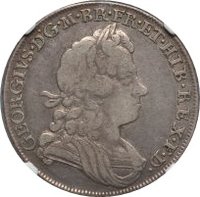
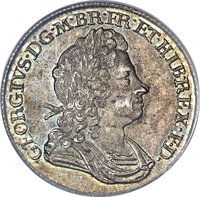
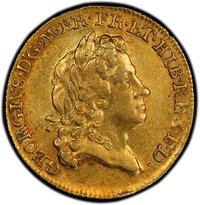
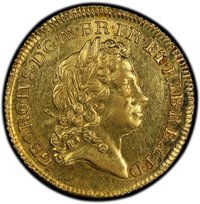
King George I laureate, draped bust right, surrounded by legend.
Inscription:
GEORGIVS·D·G·M·BR·FR·ET·HIB·REX·F·D·
Script: Latin
Engraver: John Croker
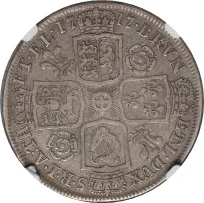
Reverse
Description:
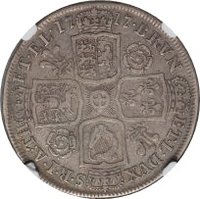
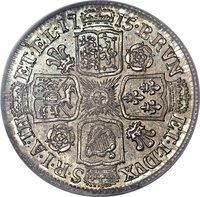
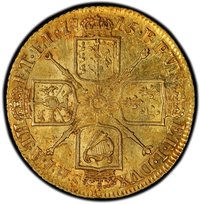
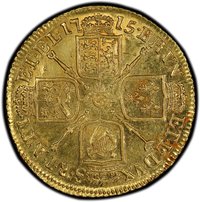
Crowned cruciform shields, central Garter star, date above, legend around. Varieties exist.
Inscription:
BRVN ET·L·DUX S·R·I·A·TH ET·EL·1717·
Script: Latin
Engraver: Johann Ochs
Edge
Raised lettering with Regnal year in words
Legend:
+DECVS ET TUTAMEN ANNO REGNI SECVNDO
Mintings
| Year | Mint Mark | Mintage | Quality | Collection |
|---|---|---|---|---|
| 1715 | — | — | ||
| 1717 | — | — | ||
| 1720 | — | — | ||
| 1723 | — | — | ||
| 1726 | — | — |
Historical background
In 1715, the United Kingdom's currency system was in a fragile and transitional state, deeply shaped by the recent political upheavals of the Glorious Revolution (1688) and the Acts of Union (1707). The most pressing issue was the severe degradation of silver coinage. For decades, coins had been clipped and worn, reducing their intrinsic metal value below their face value. This led to Gresham's Law in action: "bad money drives out good." People hoarded or exported full-weight silver coins, leaving only the debased and unreliable coins in daily circulation, which crippled trade and public confidence in the currency.
The government, under King George I and the Whig ministry, was actively seeking a solution. The Great Recoinage of 1696, under William III, had attempted to solve this by recalling and reminting all silver coins, but it was only partially successful and economically painful. By 1715, the focus had shifted towards a de facto gold standard. The introduction of the guinea, a gold coin originally worth 20 shillings, had become the preferred medium for large transactions and was fluctuating in value against the unstable silver shilling. This created a bimetallic system that was inherently unstable, as the market ratio between gold and silver constantly diverged from the official mint ratio.
Furthermore, the era saw the early rise of financial instruments and institutions that would reduce reliance on physical coin. The founding of the Bank of England in 1694 and the proliferation of Exchequer bills and private banknotes in London began to supplement the inadequate coinage. However, in 1715, these were still largely confined to the commercial elite and the capital. For the majority of the population, especially in the provinces, the daily struggle with worn, clipped, and scarce silver and copper small change remained the defining feature of the currency situation, highlighting a stark divide between the emerging world of public credit and the tangible realities of the common economy.
The government, under King George I and the Whig ministry, was actively seeking a solution. The Great Recoinage of 1696, under William III, had attempted to solve this by recalling and reminting all silver coins, but it was only partially successful and economically painful. By 1715, the focus had shifted towards a de facto gold standard. The introduction of the guinea, a gold coin originally worth 20 shillings, had become the preferred medium for large transactions and was fluctuating in value against the unstable silver shilling. This created a bimetallic system that was inherently unstable, as the market ratio between gold and silver constantly diverged from the official mint ratio.
Furthermore, the era saw the early rise of financial instruments and institutions that would reduce reliance on physical coin. The founding of the Bank of England in 1694 and the proliferation of Exchequer bills and private banknotes in London began to supplement the inadequate coinage. However, in 1715, these were still largely confined to the commercial elite and the capital. For the majority of the population, especially in the provinces, the daily struggle with worn, clipped, and scarce silver and copper small change remained the defining feature of the currency situation, highlighting a stark divide between the emerging world of public credit and the tangible realities of the common economy.
✨ Legendary