

15 Kreuzer – Austrian Empire
Austria
Context
Year: 1662
Country: Austria 
Issuer: Austrian Empire
Ruler: Leopold I
Currency:
(1520—1754)
Demonetized: Yes
Material
References
KM: #Click to copy to clipboard1197
Numista: #130701
Value
Bullion value: $18.59
Obverse
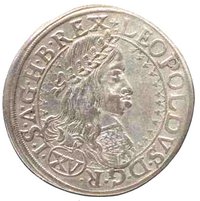
Description:
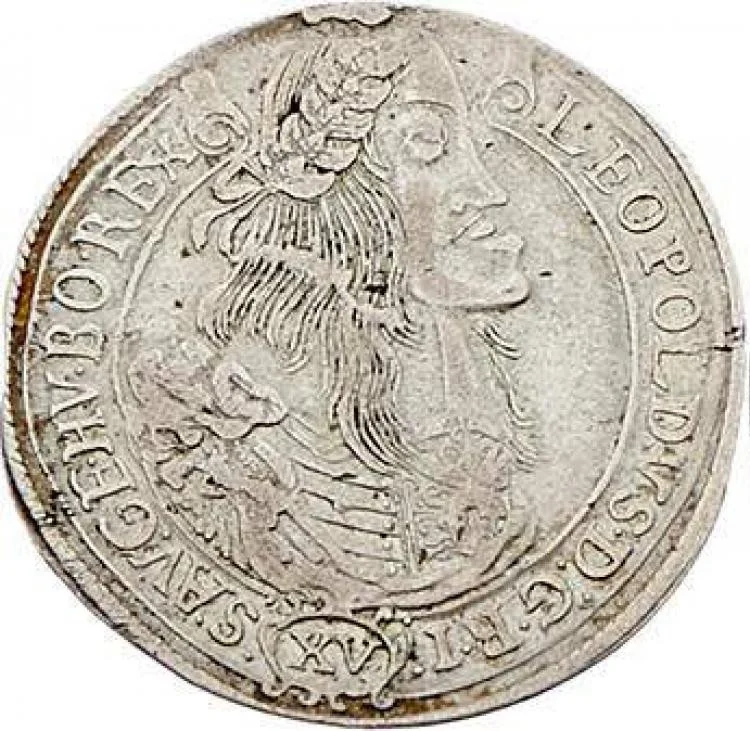
Portrait with smooth hair, a lion head on the shoulder, head touching the rim. Roman numeral value on a streamer below.
Inscription:
LEOPOLDVS D G R I (XV) S AV GE HV BO REX
Script: Latin
Reverse
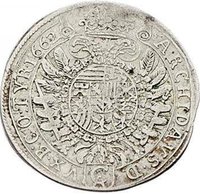
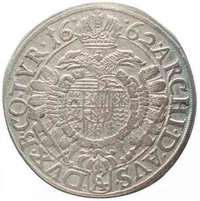
Description:
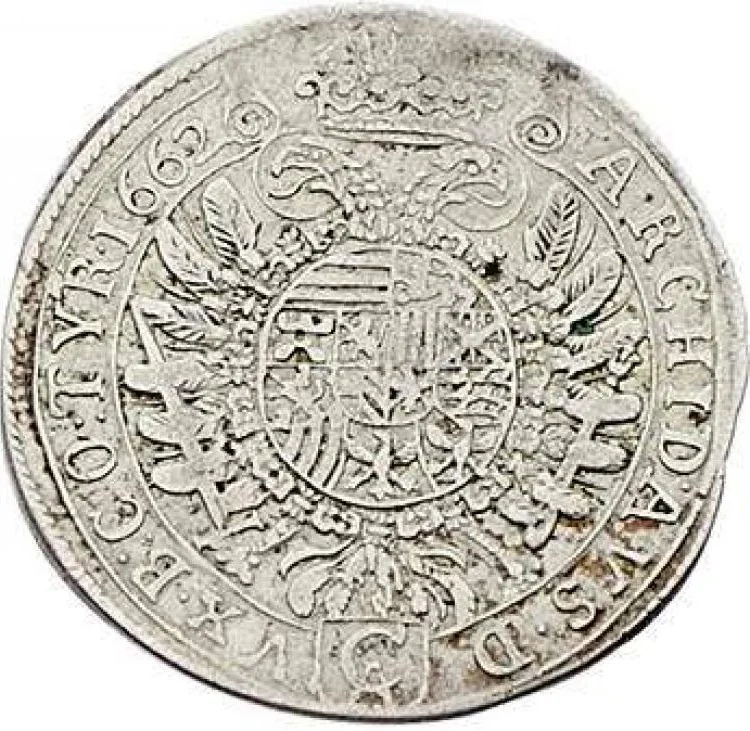
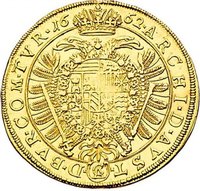
Imperial double-headed eagle in circle. Undivided date ends legend, mint mark beneath. Legend on streamer.
Inscription:
ARCHID AVS D (CA) VX B CO TYR 1662
Script: Latin
Edge
Mints
| Name | Mark |
|---|---|
| Münze Österreich | CA |
Mintings
| Year | Mint Mark | Mintage | Quality | Collection |
|---|---|---|---|---|
| 1662 | CA | — |
Historical background
In 1662, the Habsburg Monarchy, often referred to as the Austrian Empire, was in a state of severe monetary crisis following the financial exhaustion of the Thirty Years' War (1618-1648). To cover immense war debts and the costs of ongoing conflicts with the Ottoman Empire, the state had increasingly resorted to debasing its coinage. The primary silver coin, the Reichsthaler, was steadily reduced in silver content, while vast quantities of low-quality copper coins, known as Kipper- und Wipperzeit coinage, were minted and forced into circulation. This created a classic situation of bad money driving out good, as people hoarded older, purer silver coins, further destabilizing the economy and causing rampant inflation, particularly hurting soldiers, officials, and those on fixed incomes.
The situation culminated in 1662 with a drastic and poorly received monetary reform. Emperor Leopold I, advised by his banker and financier Johann Philipp von Sinzendorf, attempted to reset the currency by introducing a new copper coin, the Kreuzer, at an artificially high face value. This so-called "Vienna Currency Standard" aimed to create a stable fiduciary coinage (based on state decree rather than metal value) to replace the chaotic mix of debased coins. However, the public had no confidence in this overvalued copper money, as the state's fiscal position remained dire and the intrinsic metal value was far below the nominal value. The new coins were widely rejected, leading to a collapse in their value and a paralysis of trade.
The failed reform of 1662 exacerbated the economic distress within the Habsburg lands, particularly in Austria and Bohemia. It underscored the monarchy's weak central financial authority and its reliance on short-term, destructive measures to address deep structural deficits. The crisis only began to find resolution later in the 1660s under the guidance of Count Georg Ludwig von Sinzendorf, who implemented a more sustainable recoinage, gradually restored a silver-based currency, and improved fiscal administration, laying fragile groundwork for future stability.
The situation culminated in 1662 with a drastic and poorly received monetary reform. Emperor Leopold I, advised by his banker and financier Johann Philipp von Sinzendorf, attempted to reset the currency by introducing a new copper coin, the Kreuzer, at an artificially high face value. This so-called "Vienna Currency Standard" aimed to create a stable fiduciary coinage (based on state decree rather than metal value) to replace the chaotic mix of debased coins. However, the public had no confidence in this overvalued copper money, as the state's fiscal position remained dire and the intrinsic metal value was far below the nominal value. The new coins were widely rejected, leading to a collapse in their value and a paralysis of trade.
The failed reform of 1662 exacerbated the economic distress within the Habsburg lands, particularly in Austria and Bohemia. It underscored the monarchy's weak central financial authority and its reliance on short-term, destructive measures to address deep structural deficits. The crisis only began to find resolution later in the 1660s under the guidance of Count Georg Ludwig von Sinzendorf, who implemented a more sustainable recoinage, gradually restored a silver-based currency, and improved fiscal administration, laying fragile groundwork for future stability.

✨ Legendary