

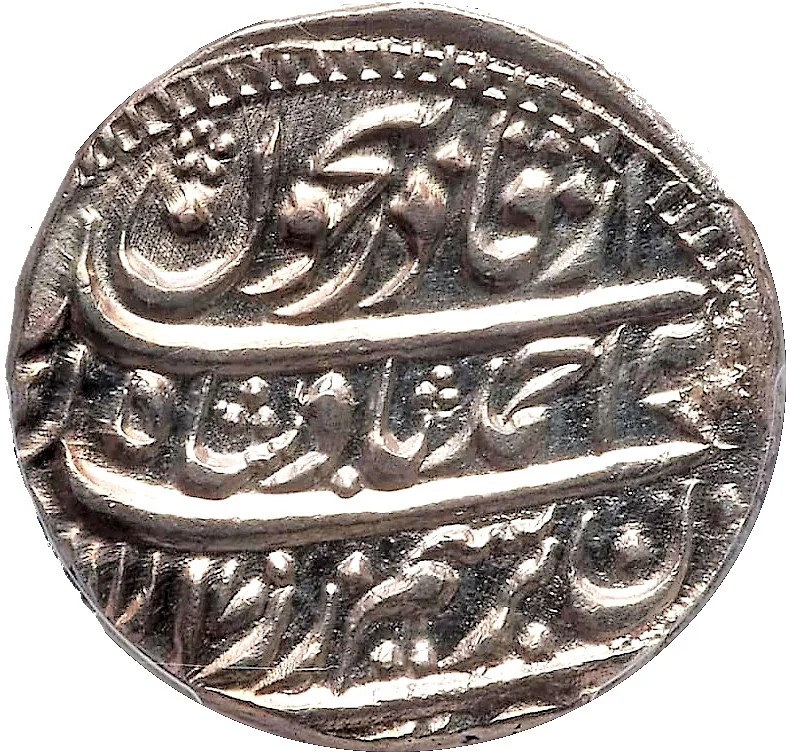
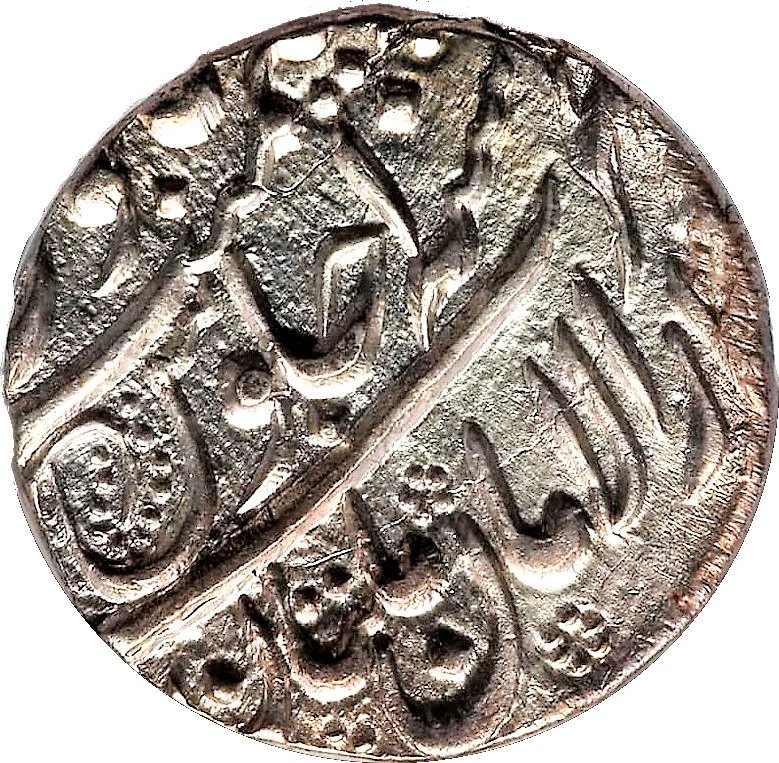
1 Rupee – Afghanistan
Afghanistan
Context
Year: 1757
Islamic (Hijri) Year: 1170
Issuer: Afghanistan 
Ruler: Ahmad Shah
Currency:
(1747—1891)
Demonetized: Yes
Material
References
KM: #Click to copy to clipboardA645
Numista: #129953
Value
Bullion value: $33.31
Obverse
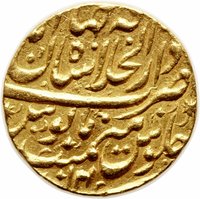
Description:
Carved words.
Script: Arabic
Reverse
Description:
"Dar al-Aman" epithet.
Script: Arabic
Edge
Mintings
| Year | Mint Mark | Mintage | Quality | Collection |
|---|---|---|---|---|
| 1757 | — | — |
Historical background
In 1757, the currency situation in Afghanistan was characterized by fragmentation and transition, reflecting the region's turbulent political landscape. The year fell within the reign of Ahmad Shah Durrani, founder of the Durrani Empire (c. 1747–1772), who had recently unified much of modern-day Afghanistan, Pakistan, and parts of Iran and India. While he established a centralizing authority, the monetary system still bore the legacy of preceding Persian and Mughal influences. The primary circulating coins were silver rupees and gold mohurs, often minted in major cities like Kandahar and Kabul, but their weight, purity, and design could vary significantly, as local khans and former rulers sometimes issued their own coinage.
The economy was fundamentally agrarian and reliant on trade routes, notably the Silk Road, which necessitated a currency acceptable across borders. Consequently, alongside Ahmad Shah's own Durrani rupees, older Mughal rupees and Persian tomans remained in wide circulation, creating a complex multi-currency environment. The state's minting activity served dual purposes: to facilitate commerce and to project the new empire's sovereignty, with coins bearing Ahmad Shah's name and titles in Persian script. However, the scarcity of precious metals within Afghanistan's own mines meant that much bullion was acquired through military campaigns, particularly the regular invasions of northern India, which brought vast plunder, including coin, to the treasury in Kandahar.
Overall, the currency situation in 1757 was one of an emerging imperial standard attempting to impose order on a historically decentralized system. While Ahmad Shah's rule provided greater political cohesion, the monetary reality remained a patchwork of local and foreign coins. The stability of the currency was directly tied to the success of military campaigns and control over trade networks, making it more a reflection of the empire's power and reach than a uniformly administered economic tool. This period laid the groundwork for a more standardized Afghan monetary system that would develop in the following decades.
The economy was fundamentally agrarian and reliant on trade routes, notably the Silk Road, which necessitated a currency acceptable across borders. Consequently, alongside Ahmad Shah's own Durrani rupees, older Mughal rupees and Persian tomans remained in wide circulation, creating a complex multi-currency environment. The state's minting activity served dual purposes: to facilitate commerce and to project the new empire's sovereignty, with coins bearing Ahmad Shah's name and titles in Persian script. However, the scarcity of precious metals within Afghanistan's own mines meant that much bullion was acquired through military campaigns, particularly the regular invasions of northern India, which brought vast plunder, including coin, to the treasury in Kandahar.
Overall, the currency situation in 1757 was one of an emerging imperial standard attempting to impose order on a historically decentralized system. While Ahmad Shah's rule provided greater political cohesion, the monetary reality remained a patchwork of local and foreign coins. The stability of the currency was directly tied to the success of military campaigns and control over trade networks, making it more a reflection of the empire's power and reach than a uniformly administered economic tool. This period laid the groundwork for a more standardized Afghan monetary system that would develop in the following decades.

💎 Extremely Rare