

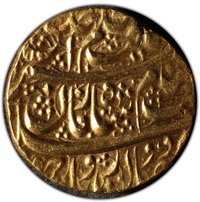
1 Mohur – Afghanistan
Afghanistan
Context
Material
Diameter: 23 mm
Weight: 10.8 g
Gold weight: 10.80 g
Shape: Irregular round
Composition: Gold
Magnetic: No
References
KM: #Click to copy to clipboard715
Numista: #129889
Value
Bullion value: $1797.98
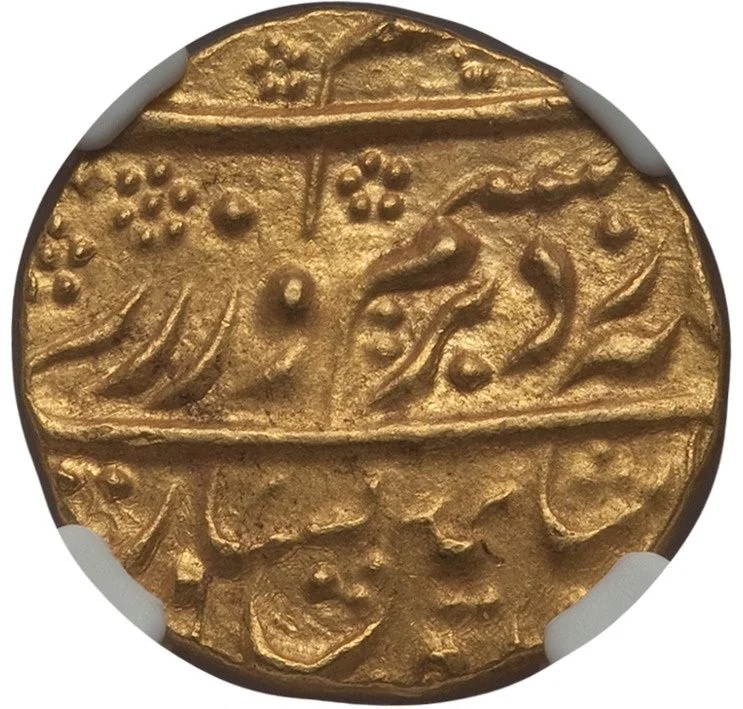
Obverse
Description:
First couplet
spread across
three lines.
spread across
three lines.
Script: Arabic
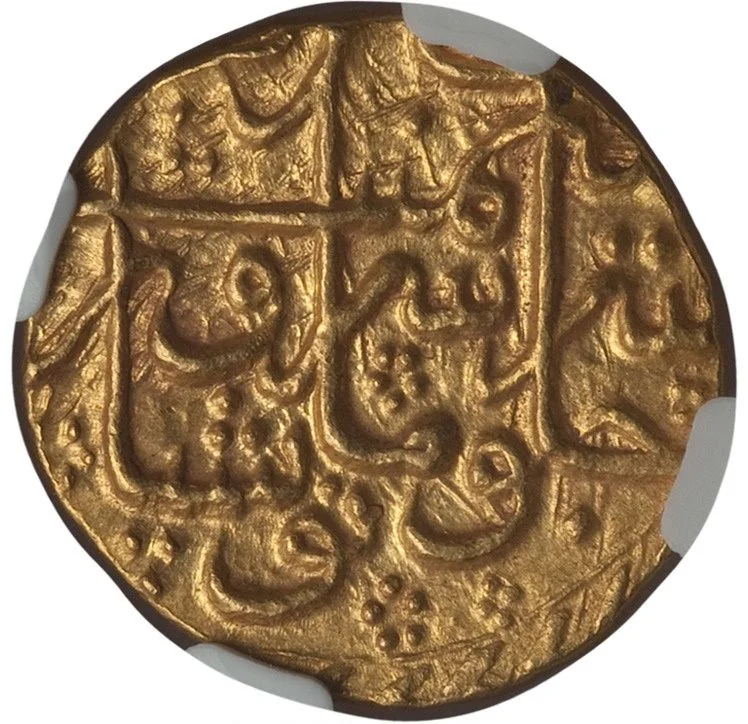
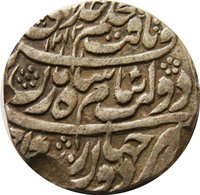
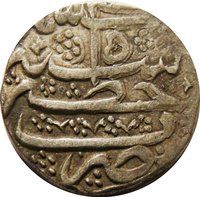
Reverse
Description:
Inscribed.
Script: Arabic
Edge
Mints
| Name | Mark |
|---|---|
| Peshawar | — |
Mintings
| Year | Mint Mark | Mintage | Quality | Collection |
|---|---|---|---|---|
| — | — | — |
Historical background
In 1796, the currency situation in Afghanistan was characterized by fragmentation and the legacy of imperial collapse, reflecting the broader political instability of the period. The Durrani Empire, founded by Ahmad Shah Durrani in 1747, was in a state of severe decline following his death in 1772. By the 1790s, the empire had fractured, with various principalities and rival claimants—particularly the sons of Timur Shah Durrani, who died in 1793—vying for control. This political disintegration directly impacted the monetary system, as no single authority could enforce a uniform currency across the region. Coins from previous reigns, along with foreign currencies, remained in circulation, creating a complex and unreliable economic environment.
The primary circulating coins were silver rupees and gold mohurs, minted in various cities like Kabul, Kandahar, and Peshawar. These coins often bore the names of past rulers, such as Ahmad Shah or Timur Shah, but their weight, purity, and value could vary significantly depending on the mint and the current local ruler's ability to control production. The debasement of coinage was a common problem, as regional governors and contenders for the throne would often reduce the silver content to finance their military campaigns, eroding public trust in the currency. Concurrently, older Mughal rupees, Persian coins, and even currencies from Central Asian khanates circulated in trade, further complicating transactions.
This monetary fragmentation mirrored the decentralized and contested nature of Afghan polity at the close of the 18th century. The lack of a standardized currency hindered long-distance trade and tax collection, weakening the economic foundations of any aspiring central power. Ultimately, the currency situation in 1796 was less a unified system and more a patchwork of inherited and locally issued coins, awaiting the consolidation of power that would begin with Dost Mohammad Khan's rise in the 1820s and the eventual establishment of the Emirate of Afghanistan.
The primary circulating coins were silver rupees and gold mohurs, minted in various cities like Kabul, Kandahar, and Peshawar. These coins often bore the names of past rulers, such as Ahmad Shah or Timur Shah, but their weight, purity, and value could vary significantly depending on the mint and the current local ruler's ability to control production. The debasement of coinage was a common problem, as regional governors and contenders for the throne would often reduce the silver content to finance their military campaigns, eroding public trust in the currency. Concurrently, older Mughal rupees, Persian coins, and even currencies from Central Asian khanates circulated in trade, further complicating transactions.
This monetary fragmentation mirrored the decentralized and contested nature of Afghan polity at the close of the 18th century. The lack of a standardized currency hindered long-distance trade and tax collection, weakening the economic foundations of any aspiring central power. Ultimately, the currency situation in 1796 was less a unified system and more a patchwork of inherited and locally issued coins, awaiting the consolidation of power that would begin with Dost Mohammad Khan's rise in the 1820s and the eventual establishment of the Emirate of Afghanistan.
✨ Legendary