

1 Akce – Damascus Eyalet
Syria
Context
Year: 1618
Islamic (Hijri) Year: 1027
Country: Syria 
Issuer: Damascus Eyalet
Ruler: Osman II
Currency:
(1516—1687)
Demonetized: Yes
Material
References
KM: #Click to copy to clipboard30
Numista: #103072
Value
Bullion value: $1.00
Obverse
Reverse
Edge
Mints
| Name | Mark |
|---|---|
| Damascus | — |
Mintings
| Year | Mint Mark | Mintage | Quality | Collection |
|---|---|---|---|---|
| 1618 | — | — |
Historical background
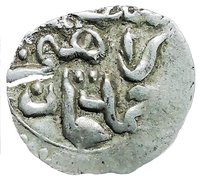
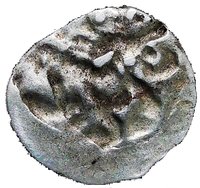
In 1618, the currency situation in Damascus Eyalet, a key Ottoman province encompassing much of the Levant, was characterized by severe instability and debasement, reflecting broader imperial fiscal crises. The primary unit was the silver akçe, but its value had been steadily eroded by the "Great Debasement" policies of the central government in Istanbul, which repeatedly reduced the silver content of coins to finance prolonged wars, notably against the Safavid Empire. This led to rampant inflation, price volatility, and a loss of public confidence in the official coinage, disrupting local markets and long-distance trade for which Damascus was a crucial hub.
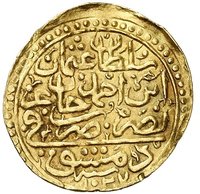
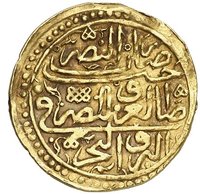
Alongside the official currency, a complex mosaic of foreign and older coins circulated out of necessity. Spanish pieces of eight, Venetian ducats, and various Persian coins—valued for their reliable silver content—were commonly used in large transactions, particularly in the thriving merchant quarters of Damascus and the port of Sidon. This created a dual system where daily small-scale trade relied on the unstable akçe, while international commerce and state treasuries operated in more stable foreign specie, requiring money changers (sarrafs) to play an indispensable and powerful role in assessing and exchanging this heterogeneous mix.
The provincial administration faced significant challenges in collecting taxes and paying troops, as soldiers often refused the devalued akçe, demanding payment in higher-quality coin. This monetary chaos exacerbated social tensions and contributed to local unrest, as the erosion of purchasing power hurt fixed-wage earners, soldiers, and the urban poor. Thus, the currency situation in 1618 was not merely an economic issue but a source of political fragility, undermining both the authority of the local governor and the economic foundations of one of the empire's most important provinces.
Alongside the official currency, a complex mosaic of foreign and older coins circulated out of necessity. Spanish pieces of eight, Venetian ducats, and various Persian coins—valued for their reliable silver content—were commonly used in large transactions, particularly in the thriving merchant quarters of Damascus and the port of Sidon. This created a dual system where daily small-scale trade relied on the unstable akçe, while international commerce and state treasuries operated in more stable foreign specie, requiring money changers (sarrafs) to play an indispensable and powerful role in assessing and exchanging this heterogeneous mix.
The provincial administration faced significant challenges in collecting taxes and paying troops, as soldiers often refused the devalued akçe, demanding payment in higher-quality coin. This monetary chaos exacerbated social tensions and contributed to local unrest, as the erosion of purchasing power hurt fixed-wage earners, soldiers, and the urban poor. Thus, the currency situation in 1618 was not merely an economic issue but a source of political fragility, undermining both the authority of the local governor and the economic foundations of one of the empire's most important provinces.
✨ Legendary