

½ Penny – England
United Kingdom
Context
Year: 1694
Country: United Kingdom 
Issuer: England 
Ruler: Mary II
Currency:
(1158—1970)
Demonetization: 1 August 1969
Material
References
KM: #Click to copy to clipboard475.3
Numista: #12960
Obverse
Description:
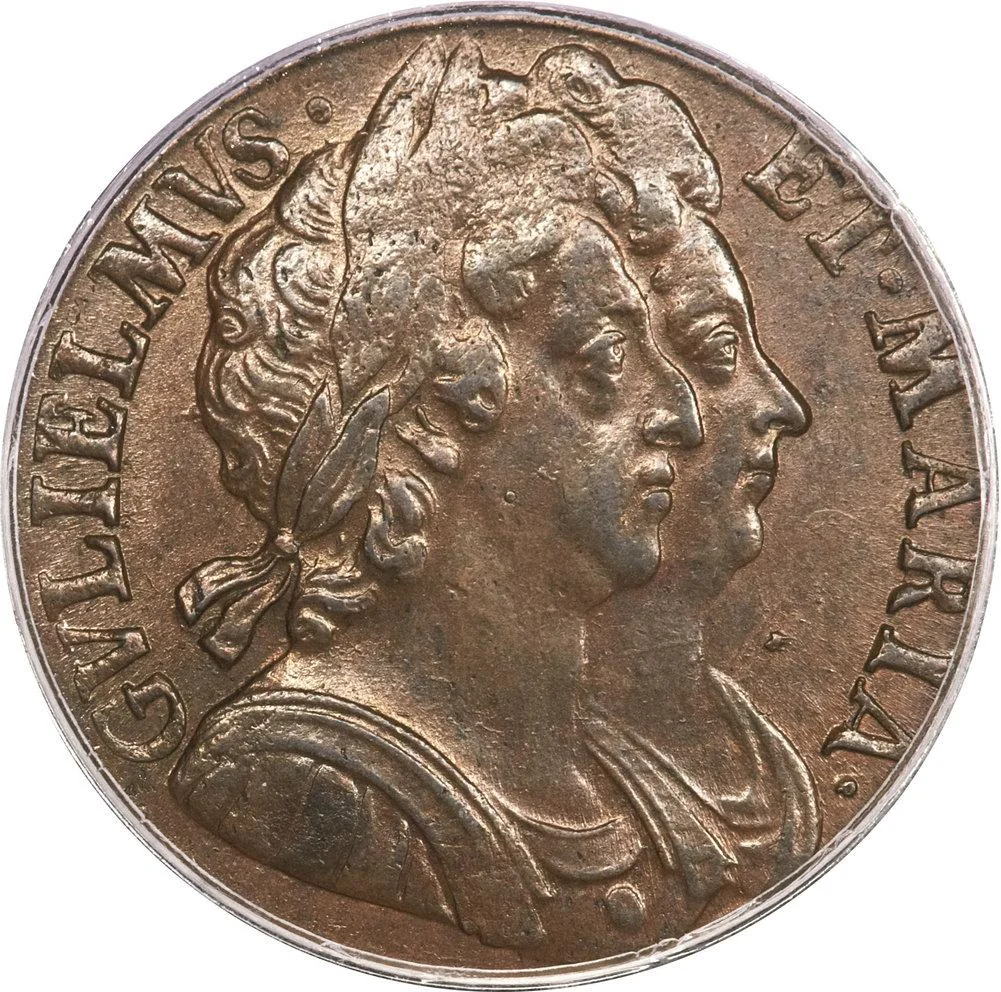
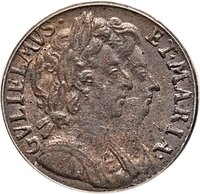
Conjoined busts of William and Mary right, legend around.
Inscription:
GVLIELMVS·ET·MARIA·
Script: Latin
Reverse
Description:
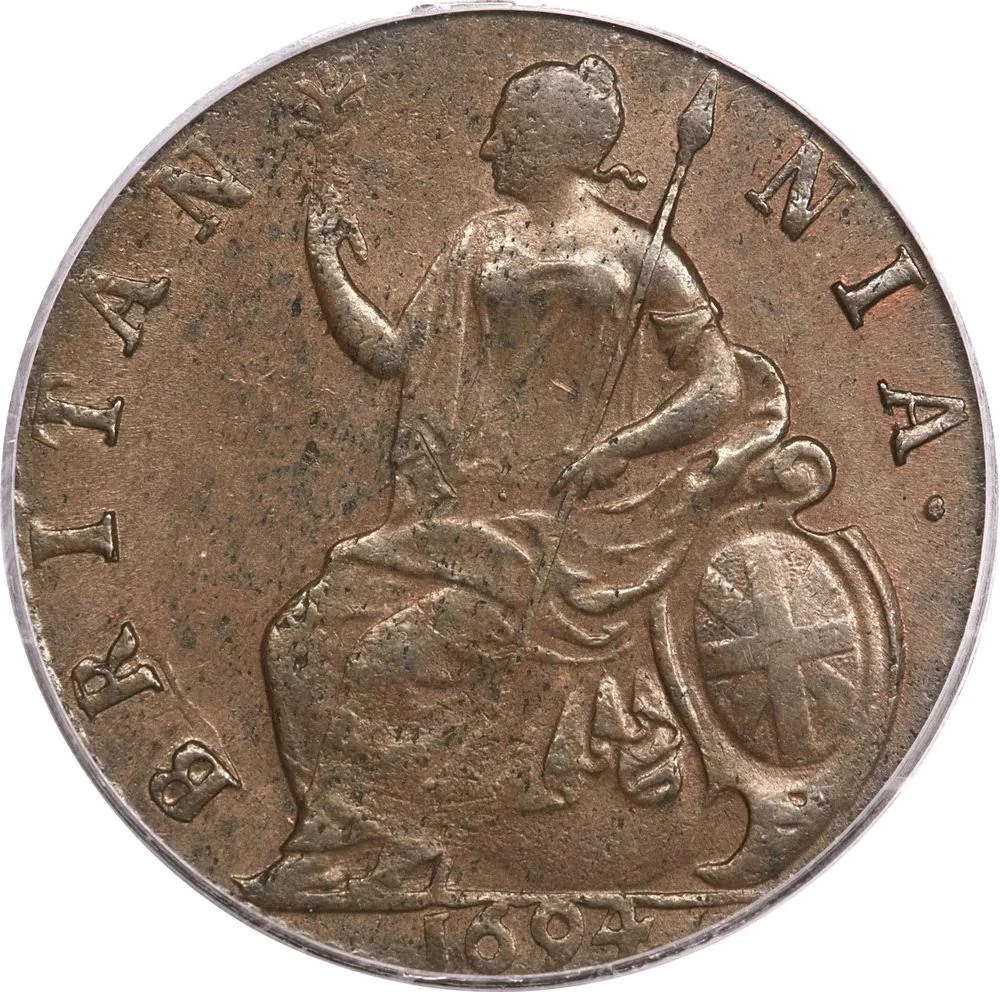
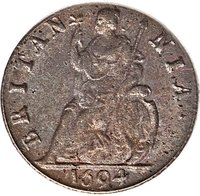
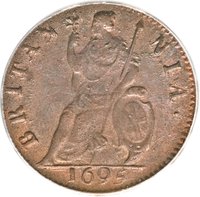
Britannia seated left, holding olive branch and spear, Union flag shield beside, legend around, date below.
Inscription:
BRITANNIA
1694
1694
Script: Latin
Engraver: John Roettier
Edge
Plain
Mints
| Name | Mark |
|---|---|
| Royal Mint (Tower of London) | — |
Mintings
| Year | Mint Mark | Mintage | Quality | Collection |
|---|---|---|---|---|
| 1694 | — | — |
Historical background
In 1694, England’s currency system was under severe strain, a direct consequence of prolonged warfare with France. King William III’s Nine Years' War had drained the Treasury, and the government’s credit was exhausted. Traditional short-term loans from goldsmith bankers were insufficient, and a 1693 attempt to raise a £1 million long-term loan had failed. The financial crisis was compounded by a chaotic physical currency: clipped and counterfeit silver coins circulated widely, undermining trade and tax revenues, as their bullion value fell below their face value. The state was fiscally paralysed, unable to reliably pay its soldiers and sailors, threatening the war effort and domestic stability.
The immediate solution was an innovative deal brokered by the financier William Paterson. In return for lending the government £1.2 million at 8% interest, a consortium of subscribers was incorporated by royal charter as the Governor and Company of the Bank of England. This was not merely a loan but a fundamental restructuring of public finance. The Bank would act as the government’s banker, managing its accounts and issuing negotiable notes against the debt. These notes, backed by the state’s future tax revenues (specifically from new shipping taxes), began to circulate as a trusted paper currency, providing a much-needed stable medium of exchange beyond the debased coinage.
Thus, the currency situation of 1694 was the catalyst for a revolutionary financial institution. The establishment of the Bank of England created a permanent national debt, secured by Parliament, which gave investors confidence. Its banknotes laid the foundation for a modern paper currency system, while the recoinage of 1696, facilitated by the Bank’s credit, would eventually resolve the silver coin crisis. This moment marked England’s decisive shift from a medieval coin-based economy toward a powerful system of public credit and managed currency, securing its military ambitions and enabling its future financial and imperial dominance.
The immediate solution was an innovative deal brokered by the financier William Paterson. In return for lending the government £1.2 million at 8% interest, a consortium of subscribers was incorporated by royal charter as the Governor and Company of the Bank of England. This was not merely a loan but a fundamental restructuring of public finance. The Bank would act as the government’s banker, managing its accounts and issuing negotiable notes against the debt. These notes, backed by the state’s future tax revenues (specifically from new shipping taxes), began to circulate as a trusted paper currency, providing a much-needed stable medium of exchange beyond the debased coinage.
Thus, the currency situation of 1694 was the catalyst for a revolutionary financial institution. The establishment of the Bank of England created a permanent national debt, secured by Parliament, which gave investors confidence. Its banknotes laid the foundation for a modern paper currency system, while the recoinage of 1696, facilitated by the Bank’s credit, would eventually resolve the silver coin crisis. This moment marked England’s decisive shift from a medieval coin-based economy toward a powerful system of public credit and managed currency, securing its military ambitions and enabling its future financial and imperial dominance.
🌟 Uncommon