

1 Crown – England
United Kingdom
Context
Year: 1681
Country: United Kingdom 
Issuer: England 
Ruler: Charles II
Currency:
(1158—1970)
Demonetized: Yes
Material
References
KM: #Click to copy to clipboard445.2
Numista: #12945
Value
Bullion value: $79.13
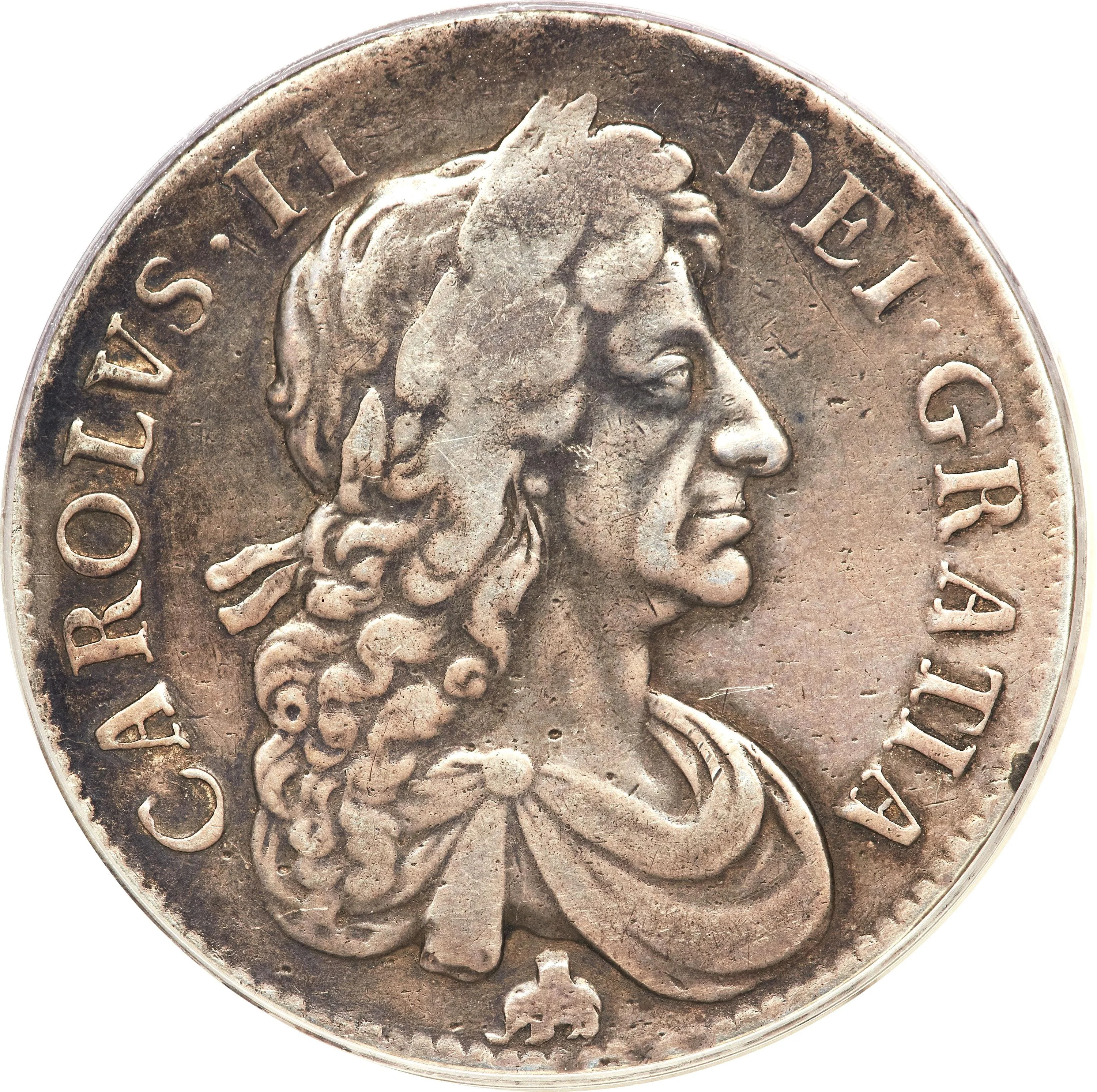
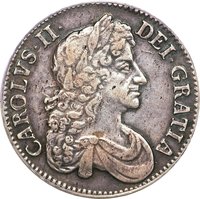
Obverse
Description:
Charles II bust right, elephant & castle below.
Inscription:
CAROLVS·II· DEI·GRATIA
Script: Latin
Engraver: John Roettier
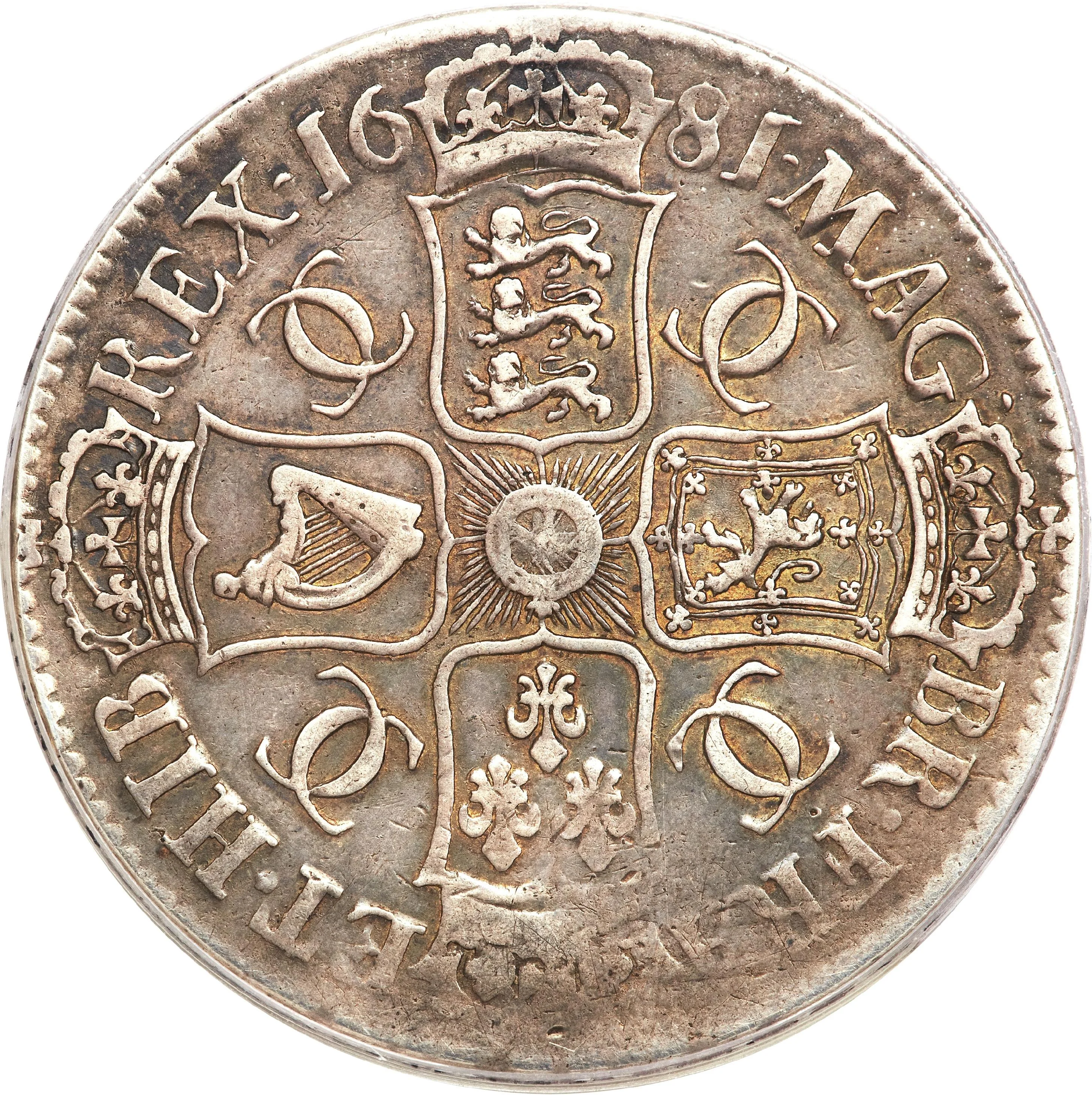
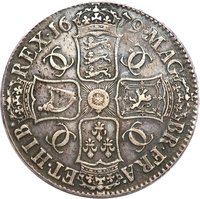
Reverse
Description:
Crowned shields flank central Garter star, interlinked C's in angles, date above, legend around.
Inscription:
MAG· BR·FRA· ET·HIB· REX·16 81·
CC CC CC CC
CC CC CC CC
Script: Latin
Engraver: John Roettier
Edge
Regnal year in Latin
Legend:
TERTIO TERTIO
Categories
| Symbols> Coat of Arms |
| Animal> Feline |
| Animal> Elephant |
| Building> Castle or fortification |
| Symbol> Crown |
Mintings
| Year | Mint Mark | Mintage | Quality | Collection |
|---|---|---|---|---|
| 1681 | — | — |
Historical background
In 1681, England’s currency was predominantly silver-based, centred on the hammered silver coinage that had been the staple of the economy for centuries. However, this system was in a state of severe crisis. Widespread clipping (shaving metal from coin edges) and counterfeiting had drastically reduced the average weight and silver content of coins in circulation, degrading their intrinsic value. While their face value remained the same, this created a fundamental instability: people hoarded full-weight coins for their bullion value, while only the light, "bad" money circulated, leading to inflation and a loss of confidence in everyday transactions. The problem was acute, hampering trade and state finance.
This monetary decay occurred under the reign of King Charles II, whose government had long been aware of the issue but had struggled to find a solution. A stopgap measure in 1672 had seen the minting of new milled-edge coins, designed by French engineer Pierre Blondeau to be clipping-resistant. However, these were not produced in sufficient quantity to replace the old coinage and were largely withdrawn from circulation as they were immediately hoarded. By 1681, the situation was reaching a breaking point, with the disparity between the nominal and metallic value of the currency causing economic friction and complicating the Crown's own revenue collection.
The year 1681 itself was not one of decisive monetary reform but of escalating pressure that would soon force action. Politically, it fell in the period between the Exclusion Crisis and the beginning of Charles II's more autocratic rule, meaning state attention was divided. Nevertheless, the deteriorating coinage was a ticking economic bomb. It would ultimately lead, just a few years later in the 1690s, to the Great Recoinage under King William III—a drastic and expensive state-led project to recall and replace all the old hammered money. Thus, the currency situation in 1681 represents the final, degraded chapter of England’s ancient silver coinage, poised on the brink of a necessary but painful financial revolution.
This monetary decay occurred under the reign of King Charles II, whose government had long been aware of the issue but had struggled to find a solution. A stopgap measure in 1672 had seen the minting of new milled-edge coins, designed by French engineer Pierre Blondeau to be clipping-resistant. However, these were not produced in sufficient quantity to replace the old coinage and were largely withdrawn from circulation as they were immediately hoarded. By 1681, the situation was reaching a breaking point, with the disparity between the nominal and metallic value of the currency causing economic friction and complicating the Crown's own revenue collection.
The year 1681 itself was not one of decisive monetary reform but of escalating pressure that would soon force action. Politically, it fell in the period between the Exclusion Crisis and the beginning of Charles II's more autocratic rule, meaning state attention was divided. Nevertheless, the deteriorating coinage was a ticking economic bomb. It would ultimately lead, just a few years later in the 1690s, to the Great Recoinage under King William III—a drastic and expensive state-led project to recall and replace all the old hammered money. Thus, the currency situation in 1681 represents the final, degraded chapter of England’s ancient silver coinage, poised on the brink of a necessary but painful financial revolution.
✨ Legendary