

1 Teston – Ferrara
Italy
Context
Year: 1656
Country: Italy 
Issuer: Ferrara
Ruler: Alexander VII
Currency:
(1534—1835)
Demonetized: Yes
Material
References
KM: #Click to copy to clipboard87
Numista: #128707
Value
Bullion value: $26.83
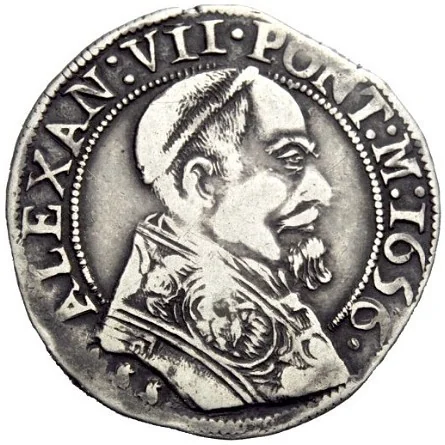
Obverse
Description:
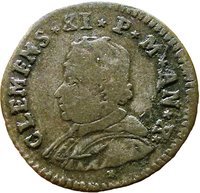
Capped bust right, IS monogram twice below shoulder.
Inscription:
ALEXAN : VII · PONT : M : 1656 ·
Script: Latin
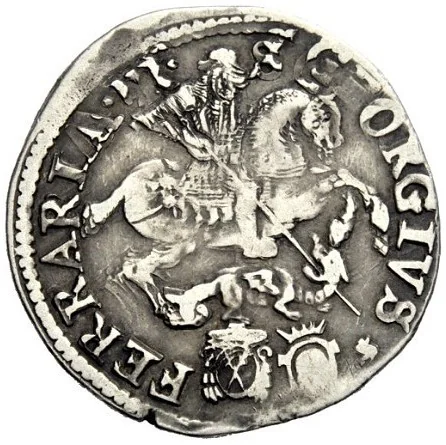
Reverse
Description:
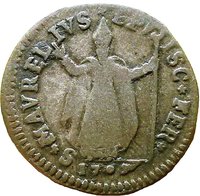
Saint George slaying dragon on horseback; below, Spada and Ferrara arms with IS monogram.
Inscription:
S GEORGIVS FERRARIA PR
Script: Latin
Edge
Mints
| Name | Mark |
|---|---|
| Ferrara | — |
Mintings
| Year | Mint Mark | Mintage | Quality | Collection |
|---|---|---|---|---|
| 1656 | — | — |
Historical background
In 1656, the Duchy of Ferrara was navigating a complex monetary landscape typical of the Italian peninsula in the mid-seventeenth century. The state did not possess its own exclusive minting authority for high-value coinage; instead, it operated within the broader monetary systems of the Papal States and other Italian powers. The circulating medium was a heterogeneous mix of silver scudi and lire, alongside a plethora of foreign coins, particularly from Venice and Spain, whose relative values fluctuated based on their precious metal content. This created a constant challenge for merchants and authorities, who had to account for frequent exchange rate adjustments and the physical degradation of coins through clipping and wear.
The economic context was one of strain, exacerbated by the broader European crisis of the mid-century. Ferrara, under papal rule since the devolution of 1598, faced fiscal pressures from central administration and the economic aftermath of the Thirty Years' War, which disrupted trade networks. Furthermore, the devastating plague of 1630–31 had severely depopulated the region, depressing agricultural and manufacturing output for decades. This economic fragility made the duchy particularly sensitive to monetary instability, as inflationary pressures from debasements elsewhere in Europe could easily import inflation, eroding local purchasing power and complicating tax collection and debt settlement.
Local transactions, especially for everyday goods, relied heavily on a system of petty coinage of copper and billon (debased silver). The Duke of Ferrara, Alfonso IV d'Este, did have the right to mint these lower-denomination coins, such as quattrini and sesini. However, the temptation to debase this "black money" to generate seigniorage revenue was ever-present, risking a disconnect between the official and market values of these coins. Consequently, the currency situation in 1656 Ferrara was characterized by a fragile duality: a "large money" system of external silver coins for major commerce, and a vulnerable local "small money" system prone to manipulation, all set against a backdrop of post-plague demographic and economic recovery.
The economic context was one of strain, exacerbated by the broader European crisis of the mid-century. Ferrara, under papal rule since the devolution of 1598, faced fiscal pressures from central administration and the economic aftermath of the Thirty Years' War, which disrupted trade networks. Furthermore, the devastating plague of 1630–31 had severely depopulated the region, depressing agricultural and manufacturing output for decades. This economic fragility made the duchy particularly sensitive to monetary instability, as inflationary pressures from debasements elsewhere in Europe could easily import inflation, eroding local purchasing power and complicating tax collection and debt settlement.
Local transactions, especially for everyday goods, relied heavily on a system of petty coinage of copper and billon (debased silver). The Duke of Ferrara, Alfonso IV d'Este, did have the right to mint these lower-denomination coins, such as quattrini and sesini. However, the temptation to debase this "black money" to generate seigniorage revenue was ever-present, risking a disconnect between the official and market values of these coins. Consequently, the currency situation in 1656 Ferrara was characterized by a fragile duality: a "large money" system of external silver coins for major commerce, and a vulnerable local "small money" system prone to manipulation, all set against a backdrop of post-plague demographic and economic recovery.
✨ Legendary