

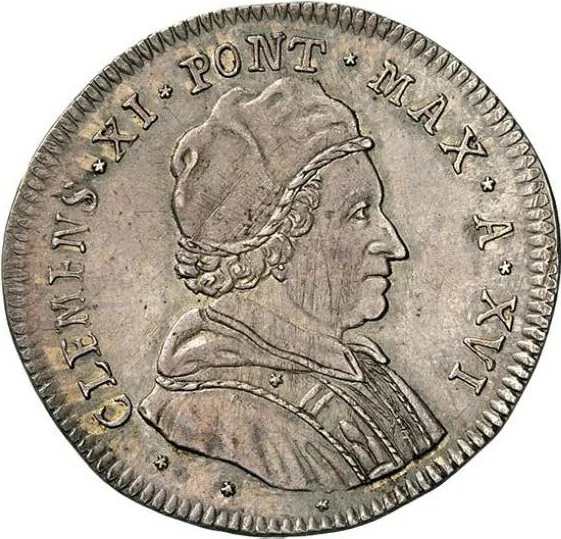
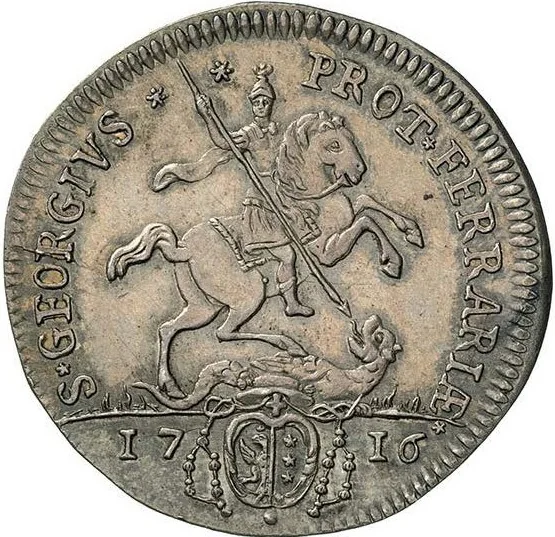
1 Teston – Ferrara
Italy
Context
Material
References
KM: #Click to copy to clipboard117
Numista: #128683
Value
Bullion value: $25.82
Obverse
Reverse
Description:
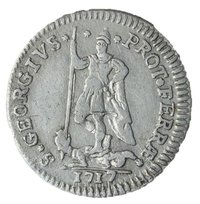
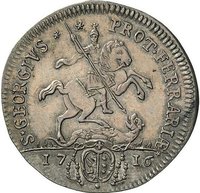
St. George slaying dragon over date and coat of arms.
Inscription:
S·GEORGIVS PROT·FERRARIÆ
17 16
17 16
Script: Latin
Edge
Categories
| Mythology> Fantastic animal |
| Animal> Horse |
| Object> Armour |
| Person> Monarch |
| Person> Religious figure |
| Object> Hat |
| Object> Cold weapons |
Mintings
| Year | Mint Mark | Mintage | Quality | Collection |
|---|---|---|---|---|
| 1716 | — | — |
Historical background
In 1716, Ferrara existed within a complex and fragmented monetary landscape, typical of the Italian peninsula before unification. The city was part of the Papal States, having been annexed by the Church in 1598, and thus its official currency was the Papal scudo. However, the practical reality was one of significant monetary pluralism. Alongside Papal coinage, a multitude of foreign currencies circulated freely, most notably the silver lira and ducatone from the neighbouring Duchy of Modena, Venetian zecchini, and various Spanish and French coins brought through trade. This created a constant need for money-changers (campsores) and published exchange lists (tariffe) to navigate the daily calculations of value.
The local economy was further strained by the poor quality of the circulating coinage. Decades of currency debasement, "clipping" of precious metal from coin edges, and the influx of underweight foreign imitations had led to a severe shortage of "good" or full-weight coin. This triggered Gresham's Law in practice, where "bad money drives out good"; people hoarded high-value, full-weight coins, conducting daily transactions with worn or suspect currency. This environment of uncertainty hampered commerce, as the intrinsic metal value of a coin could differ significantly from its nominal face value, creating friction in every transaction.
Consequently, the monetary situation in 1716 Ferrara was characterized by administrative effort and public frustration. Papal authorities regularly issued proclamations to fix exchange rates and condemn counterfeiters, attempting to impose order from Rome. Yet, the porous borders and entrenched mercantile practices made effective control nearly impossible. For merchants, artisans, and citizens, the system demanded vigilance and expertise, turning simple trade into a calculated risk. The currency chaos was a daily reminder of Ferrara's diminished political autonomy and the challenges of operating within the broader, turbulent European monetary system of the early eighteenth century.
The local economy was further strained by the poor quality of the circulating coinage. Decades of currency debasement, "clipping" of precious metal from coin edges, and the influx of underweight foreign imitations had led to a severe shortage of "good" or full-weight coin. This triggered Gresham's Law in practice, where "bad money drives out good"; people hoarded high-value, full-weight coins, conducting daily transactions with worn or suspect currency. This environment of uncertainty hampered commerce, as the intrinsic metal value of a coin could differ significantly from its nominal face value, creating friction in every transaction.
Consequently, the monetary situation in 1716 Ferrara was characterized by administrative effort and public frustration. Papal authorities regularly issued proclamations to fix exchange rates and condemn counterfeiters, attempting to impose order from Rome. Yet, the porous borders and entrenched mercantile practices made effective control nearly impossible. For merchants, artisans, and citizens, the system demanded vigilance and expertise, turning simple trade into a calculated risk. The currency chaos was a daily reminder of Ferrara's diminished political autonomy and the challenges of operating within the broader, turbulent European monetary system of the early eighteenth century.
✨ Legendary