

⅔ thaler – Franconian Circle
Add to wishlist
Germany
Context
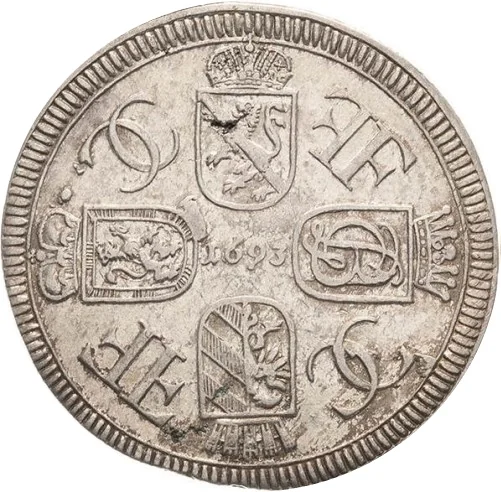
Year: 1693
Country: Germany
Issuer: Franconian Circle
Period:
(1219—1806)
Ruler: George Frederick II
Currency:
Demonetized: Yes
References
KM: #
Numista: #128164
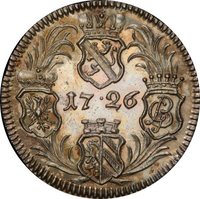
Obverse
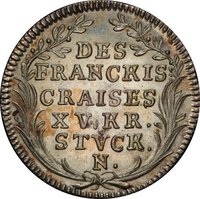
Reverse
Description:
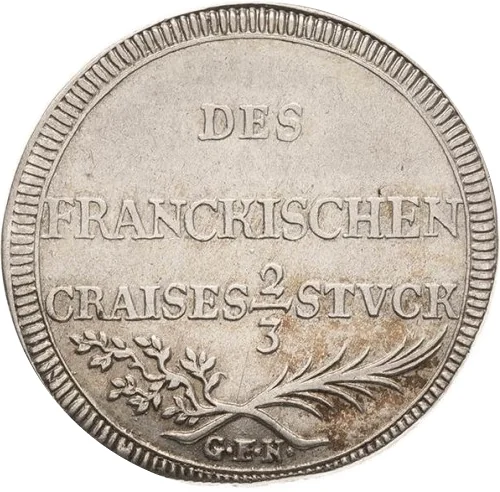
Denomination above laurel and palm branch.
Inscription:
DES // FRANKISCHEN // CRAISES 2/3 STVCK
Script: Latin
Edge
Mints
| Name | Mark |
|---|---|
| Nuremberg | — |
Mintings
| Year | Mint Mark | Mintage | Quality | Collection |
|---|---|---|---|---|
| 1693 | — | — |
Historical background
In 1693, the currency situation within the Franconian Circle of the Holy Roman Empire was one of profound crisis and complexity, exacerbated by the ongoing Nine Years' War (1688-1697). The Circle, a defensive and administrative coalition of ecclesiastical and secular states like the Prince-Bishoprics of Würzburg and Bamberg and the Imperial City of Nuremberg, faced severe financial strain from funding military contingents for the Imperial Army. This pressure led member states to increasingly resort to debasing their coinage—reducing the precious metal content while maintaining face value—to generate short-term revenue, a practice known as Kipper- und Wipperzeit, which had previously caused widespread economic chaos in the early 17th century.
The result was a chaotic monetary landscape where a plethora of debased, lightweight coins from various mints flooded the region, driving older, full-weight coins out of circulation (Gresham's Law). This severely disrupted trade and credit, as the value of money became unstable and unpredictable. The crisis was not merely local; it was part of a wider imperial monetary disorder, as other Circles and territories engaged in similar practices, leading to a loss of confidence in currency across the Empire. Everyday transactions became fraught, harming merchants and the general population through hidden inflation and uncertainty.
Recognizing the collective damage, the Franconian Circle attempted coordinated responses, including issuing ordinances to regulate minting and control the inflow of foreign debased coinage. However, these measures were often undermined by the urgent financial needs of individual member states and the lack of a supreme enforcing authority. Thus, the year 1693 stands as a peak within a longer period of monetary instability, highlighting the tension between regional cooperation and individual survival in the fragmented political structure of the Empire during a costly war.
The result was a chaotic monetary landscape where a plethora of debased, lightweight coins from various mints flooded the region, driving older, full-weight coins out of circulation (Gresham's Law). This severely disrupted trade and credit, as the value of money became unstable and unpredictable. The crisis was not merely local; it was part of a wider imperial monetary disorder, as other Circles and territories engaged in similar practices, leading to a loss of confidence in currency across the Empire. Everyday transactions became fraught, harming merchants and the general population through hidden inflation and uncertainty.
Recognizing the collective damage, the Franconian Circle attempted coordinated responses, including issuing ordinances to regulate minting and control the inflow of foreign debased coinage. However, these measures were often undermined by the urgent financial needs of individual member states and the lack of a supreme enforcing authority. Thus, the year 1693 stands as a peak within a longer period of monetary instability, highlighting the tension between regional cooperation and individual survival in the fragmented political structure of the Empire during a costly war.
✨ Legendary