

15 kreuzers – Franconian Circle
Add to wishlist
Germany
Context
Year: 1726
Country: Germany
Issuer: Franconian Circle
Period:
(1219—1806)
Ruler: William Frederick
Currency:
Demonetized: Yes
References
KM: #
Numista: #412788
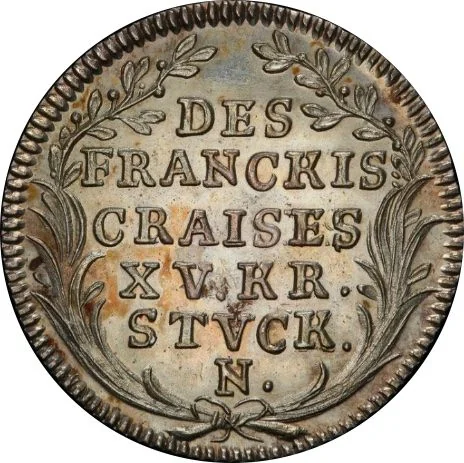
Obverse
Description:
Inscription in laurel wreath.
Inscription:
DES
FRANCKIS
CRAISES
XV. KR.
STVCK.
N.
FRANCKIS
CRAISES
XV. KR.
STVCK.
N.
Script: Latin
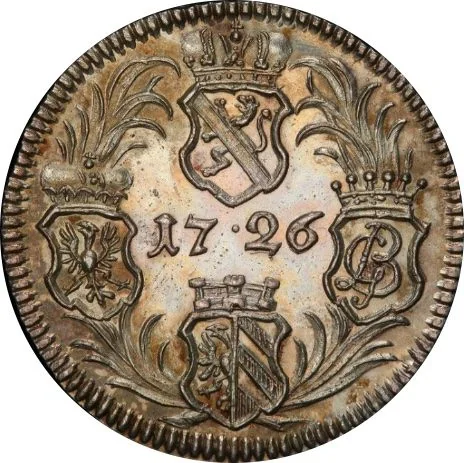
Reverse
Description:
Date divided by punctuation, centered on four crowned arms amid branches.
Inscription:
17·26
Script: Latin
Edge
Historical background
In 1726, the currency situation within the Franconian Circle, a defensive and administrative association of mostly ecclesiastical and minor secular states in the Holy Roman Empire, was characterized by profound fragmentation and instability. There was no single, unified currency. Instead, a confusing multitude of coins circulated, issued by the various Circle members like the Prince-Bishoprics of Würzburg and Bamberg, the Imperial City of Nuremberg, and numerous counts and knights. These entities all exercised their traditional Münzregal (right of coinage), leading to a plethora of gulden, kreuzers, batzen, and pfennigs of varying weight, purity, and value.
This monetary chaos was actively harmful to commerce and public trust. Debasement was a common practice, as individual states would reduce the precious metal content in their coins to generate short-term profit, exporting the newly weakened currency and causing inflation. The result was a classic "bad money drives out good" scenario, where older, full-value coins were hoarded or melted down. While the Circle's Kreistag (diet) periodically issued ordinances to standardize on the Reichstaler as the accounting standard and set exchange rates for local currencies, enforcement across dozens of sovereign entities was weak and often ignored.
Consequently, daily economic life in the Circle was burdened by constant exchange calculations, uncertainty, and friction in trade. The situation underscored the fundamental weakness of the Empire's decentralized political structure in economic matters. While the year 1726 was not itself a moment of crisis, it represented a persistent and unresolved problem that hindered economic integration and provided a constant incentive for competitive devaluation among the Circle's members, to the detriment of the wider regional economy.
This monetary chaos was actively harmful to commerce and public trust. Debasement was a common practice, as individual states would reduce the precious metal content in their coins to generate short-term profit, exporting the newly weakened currency and causing inflation. The result was a classic "bad money drives out good" scenario, where older, full-value coins were hoarded or melted down. While the Circle's Kreistag (diet) periodically issued ordinances to standardize on the Reichstaler as the accounting standard and set exchange rates for local currencies, enforcement across dozens of sovereign entities was weak and often ignored.
Consequently, daily economic life in the Circle was burdened by constant exchange calculations, uncertainty, and friction in trade. The situation underscored the fundamental weakness of the Empire's decentralized political structure in economic matters. While the year 1726 was not itself a moment of crisis, it represented a persistent and unresolved problem that hindered economic integration and provided a constant incentive for competitive devaluation among the Circle's members, to the detriment of the wider regional economy.
✨ Legendary