

1 liard – France
Add to wishlist
France
Obverse
Description:
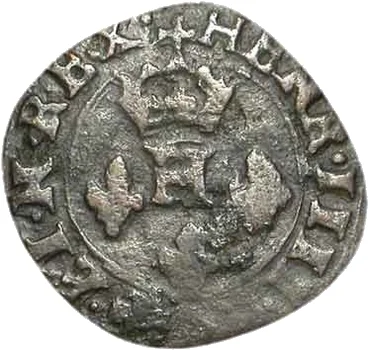
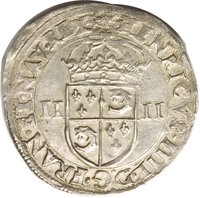
H crowned, between three lilies, two above and one below.
Inscription:
+ HENR. IIII. D. G. F. ET. N. REX.
Script: Latin
Reverse
Edge
Mints
| Name | Mark |
|---|---|
| Chambéry | — |
Mintings
| Year | Mint Mark | Mintage | Quality | Collection |
|---|---|---|---|---|
| 1600 | — | 172,508 | ||
| 1601 | — | 172,508 |
Historical background
In 1600, France was in a state of monetary disarray and transition, emerging from the devastating Wars of Religion (1562-1598). The kingdom operated on a bimetallic system, with both gold (écus d'or) and silver (livres tournois) coins in circulation, but the system was profoundly unstable. The official unit of account was the livre tournois, a theoretical money used for bookkeeping, while actual commerce relied on a chaotic mix of physical coins whose metal content and value fluctuated wildly. Decades of war had forced successive monarchs to repeatedly debase the coinage—reducing the precious metal content—to pay armies, leading to severe inflation, widespread counterfeiting, and a deep loss of public trust in the currency.
This monetary chaos was a primary concern for King Henry IV and his formidable minister, the Duke of Sully, who sought to restore stability to the realm. Their strategy was twofold: first, to rigorously reform the royal finances through better taxation and reduced debt, and second, to address the coinage directly. Sully initiated a policy of reformation des monnaies, calling in old, debased coins and re-minting them with a higher and standardized precious metal content. This process aimed to restore the bon aloi (good alloy) of French coinage, thereby stabilizing its value and reinstating royal credibility. The goal was to fix a reliable exchange rate between gold and silver, though this would remain a persistent challenge.
The situation was further complicated by the circulation of numerous foreign coins, particularly Spanish gold escudos and silver reales from the vast influx of New World bullion, which influenced European economies. Within France itself, various provinces also retained local monetary traditions. Thus, the currency landscape in 1600 was one of fragmentation, with royal authority striving to impose a unified and stable system over a patchwork of physical coins, foreign influences, and inherited inflation—a crucial foundation for the absolute monarchy's economic ambitions in the coming century.
This monetary chaos was a primary concern for King Henry IV and his formidable minister, the Duke of Sully, who sought to restore stability to the realm. Their strategy was twofold: first, to rigorously reform the royal finances through better taxation and reduced debt, and second, to address the coinage directly. Sully initiated a policy of reformation des monnaies, calling in old, debased coins and re-minting them with a higher and standardized precious metal content. This process aimed to restore the bon aloi (good alloy) of French coinage, thereby stabilizing its value and reinstating royal credibility. The goal was to fix a reliable exchange rate between gold and silver, though this would remain a persistent challenge.
The situation was further complicated by the circulation of numerous foreign coins, particularly Spanish gold escudos and silver reales from the vast influx of New World bullion, which influenced European economies. Within France itself, various provinces also retained local monetary traditions. Thus, the currency landscape in 1600 was one of fragmentation, with royal authority striving to impose a unified and stable system over a patchwork of physical coins, foreign influences, and inherited inflation—a crucial foundation for the absolute monarchy's economic ambitions in the coming century.
✨ Legendary