

2 Ducats – Austrian Empire
Austria
Context
Years: 1681–1686
Country: Austria 
Issuer: Austrian Empire
Ruler: Leopold I
Currency:
(1520—1754)
Demonetized: Yes
References
KM: #Click to copy to clipboard1312
Numista: #126213
Value
Bullion value: $1123.08
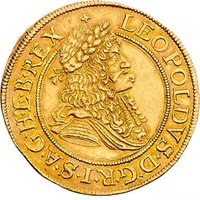
Obverse
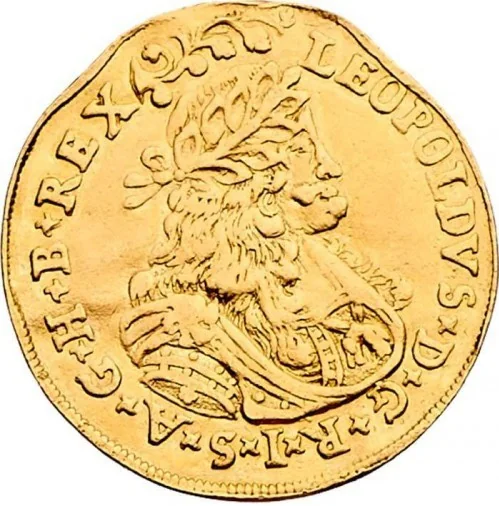
Description:
Portrait without inner circle.
Inscription:
LEOPOLDVS D G R I S A G H B REX
Script: Latin
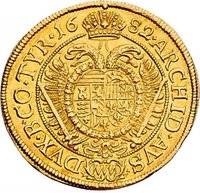
Reverse
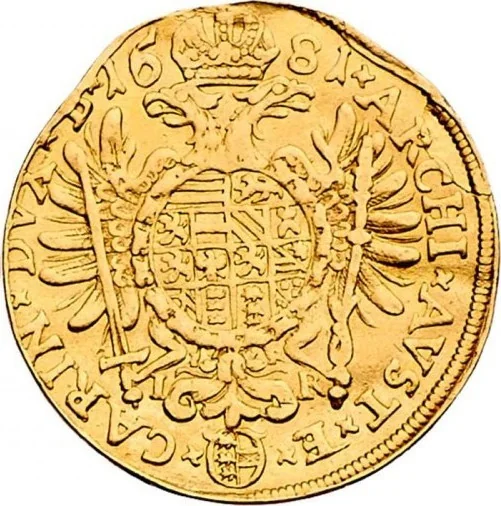
Description:
Imperial eagle with composite arms; shield of Carinthia divides the legend.
Inscription:
ARCHI AVST ET // CARIN DVX B 1681
Script: Latin
Edge
Mints
| Name | Mark |
|---|---|
| Sankt Veit | — |
Mintings
| Year | Mint Mark | Mintage | Quality | Collection |
|---|---|---|---|---|
| 1681 | IR | — | ||
| 1685 | IR | — | ||
| 1686 | HL/VP | — |
Historical background
In 1681, the currency situation within the Habsburg-ruled Austrian Empire was complex and strained, reflecting the broader financial pressures of continuous warfare. The empire was deeply engaged in the Great Turkish War (1683-1699), a massive military effort to repel the Ottoman advance into Central Europe. This protracted conflict demanded extraordinary revenue, leading to chronic fiscal shortfalls that were often addressed by debasing the coinage. The primary silver coin, the Reichsthaler, and its fractional counterparts saw their precious metal content reduced to fund the army, causing inflation and eroding public trust in the currency.
The monetary landscape was not unified, characterized by a patchwork of circulating coins from various imperial mints and a multitude of older, foreign, and regional issues. Alongside the official imperial currency, older Thalers from the 16th century, Hungarian Denars, and even Ottoman coins circulated at fluctuating values. This heterogeneity, combined with the new, inferior coins, created a chaotic system where exchange rates were unstable and transactions were cumbersome. The lack of strong central financial control meant that the negative effects of debasement were unevenly felt across the empire's diverse territories, from Austria proper to Bohemia and Royal Hungary.
Consequently, the year 1681 fell within a period of significant monetary instability, acting as a prelude to the severe crisis that would peak during and after the Siege of Vienna in 1683. The state's reliance on currency manipulation as a form of war financing undermined economic stability, increased the cost of supplying the military, and placed a heavy burden on the population through rising prices. This precarious financial environment highlighted the urgent need for reform, a challenge that would be addressed in the coming decades with attempts to standardize and stabilize the imperial coinage system.
The monetary landscape was not unified, characterized by a patchwork of circulating coins from various imperial mints and a multitude of older, foreign, and regional issues. Alongside the official imperial currency, older Thalers from the 16th century, Hungarian Denars, and even Ottoman coins circulated at fluctuating values. This heterogeneity, combined with the new, inferior coins, created a chaotic system where exchange rates were unstable and transactions were cumbersome. The lack of strong central financial control meant that the negative effects of debasement were unevenly felt across the empire's diverse territories, from Austria proper to Bohemia and Royal Hungary.
Consequently, the year 1681 fell within a period of significant monetary instability, acting as a prelude to the severe crisis that would peak during and after the Siege of Vienna in 1683. The state's reliance on currency manipulation as a form of war financing undermined economic stability, increased the cost of supplying the military, and placed a heavy burden on the population through rising prices. This precarious financial environment highlighted the urgent need for reform, a challenge that would be addressed in the coming decades with attempts to standardize and stabilize the imperial coinage system.
✨ Legendary