

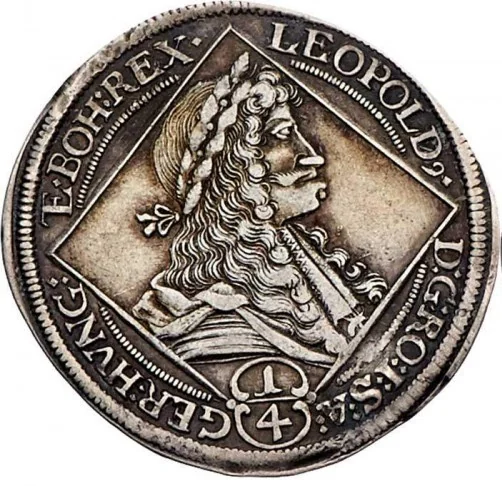
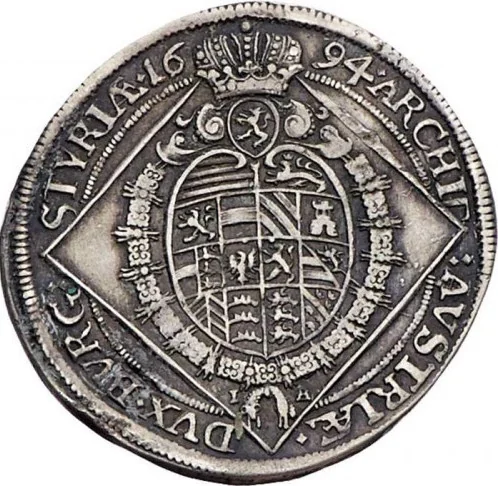
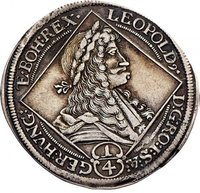
¼ Thaler – Austrian Empire
Austria

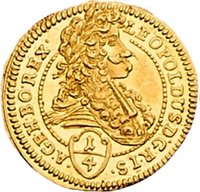
Obverse
Description:
Portrait in a rhombus.
Inscription:
LEOPOLD9 // D G RO I S A (¼) GER HVNG // ET BOH REX
Script: Latin
Engraver: Johann Anton Novak
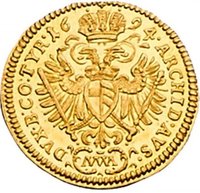
Reverse
Description:
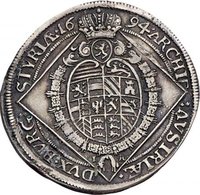
Rhombus with coat of arms.
Inscription:
ARCHID // AVSTRIÆ // DVX BVRG // STYRIÆ 1694
Script: Latin
Edge
Mints
| Name | Mark |
|---|---|
| Graz | — |
Mintings
| Year | Mint Mark | Mintage | Quality | Collection |
|---|---|---|---|---|
| 1694 | — | — |
Historical background
In 1694, the Habsburg Monarchy, often referred to as the Austrian Empire, was embroiled in the Great Turkish War (1683-1699), a conflict that placed immense strain on state finances. The war effort against the Ottoman Empire demanded vast expenditures for armies, fortifications, and supplies, leading to chronic budget deficits. To meet these costs, the government, under Emperor Leopold I, resorted to repeated debasement of the coinage, particularly the small-denomination kreuzer and the silver thaler. This involved reducing the precious metal content in coins while maintaining their face value, a short-term measure that generated immediate revenue but eroded public trust and sparked inflation.
The monetary landscape was inherently complex, as the Habsburg lands lacked a unified currency system. Different regions, such as the Austrian hereditary lands, the Kingdom of Hungary, and the Bohemian Crown, operated with their own traditional coinages and standards. Furthermore, a plethora of foreign coins, especially high-quality Dutch leeuwendaalders and Saxon thalers, circulated widely and were often preferred in trade over the debased domestic issues. This fragmentation created a chaotic exchange environment where the value of money was unstable and varied significantly from one territory to another, hampering commerce and state administration.
The consequences were acutely felt in daily economic life. The debasement led to a rapid rise in prices for basic goods, causing hardship for soldiers on fixed pay and the urban poor. Merchants and creditors suffered losses as the real value of payments declined, leading to market distrust and economic uncertainty. While the state mint profited from seigniorage, the long-term damage to the monetary system was severe, setting the stage for future attempts at reform. The situation in 1694 thus encapsulates a period of fiscal desperation, where the immediate pressures of war overrode the need for monetary stability, exacerbating the empire's structural economic weaknesses.
The monetary landscape was inherently complex, as the Habsburg lands lacked a unified currency system. Different regions, such as the Austrian hereditary lands, the Kingdom of Hungary, and the Bohemian Crown, operated with their own traditional coinages and standards. Furthermore, a plethora of foreign coins, especially high-quality Dutch leeuwendaalders and Saxon thalers, circulated widely and were often preferred in trade over the debased domestic issues. This fragmentation created a chaotic exchange environment where the value of money was unstable and varied significantly from one territory to another, hampering commerce and state administration.
The consequences were acutely felt in daily economic life. The debasement led to a rapid rise in prices for basic goods, causing hardship for soldiers on fixed pay and the urban poor. Merchants and creditors suffered losses as the real value of payments declined, leading to market distrust and economic uncertainty. While the state mint profited from seigniorage, the long-term damage to the monetary system was severe, setting the stage for future attempts at reform. The situation in 1694 thus encapsulates a period of fiscal desperation, where the immediate pressures of war overrode the need for monetary stability, exacerbating the empire's structural economic weaknesses.
✨ Legendary