

8 Skilling – Norway
Norway
Context
Years: 1727–1730
Issuer: Norway 
Ruler: Frederick IV
Currency:
(1523—1746)
Demonetized: Yes
Total mintage: 3,878,000
Material
References
KM: #Click to copy to clipboard224
Numista: #99778
Obverse
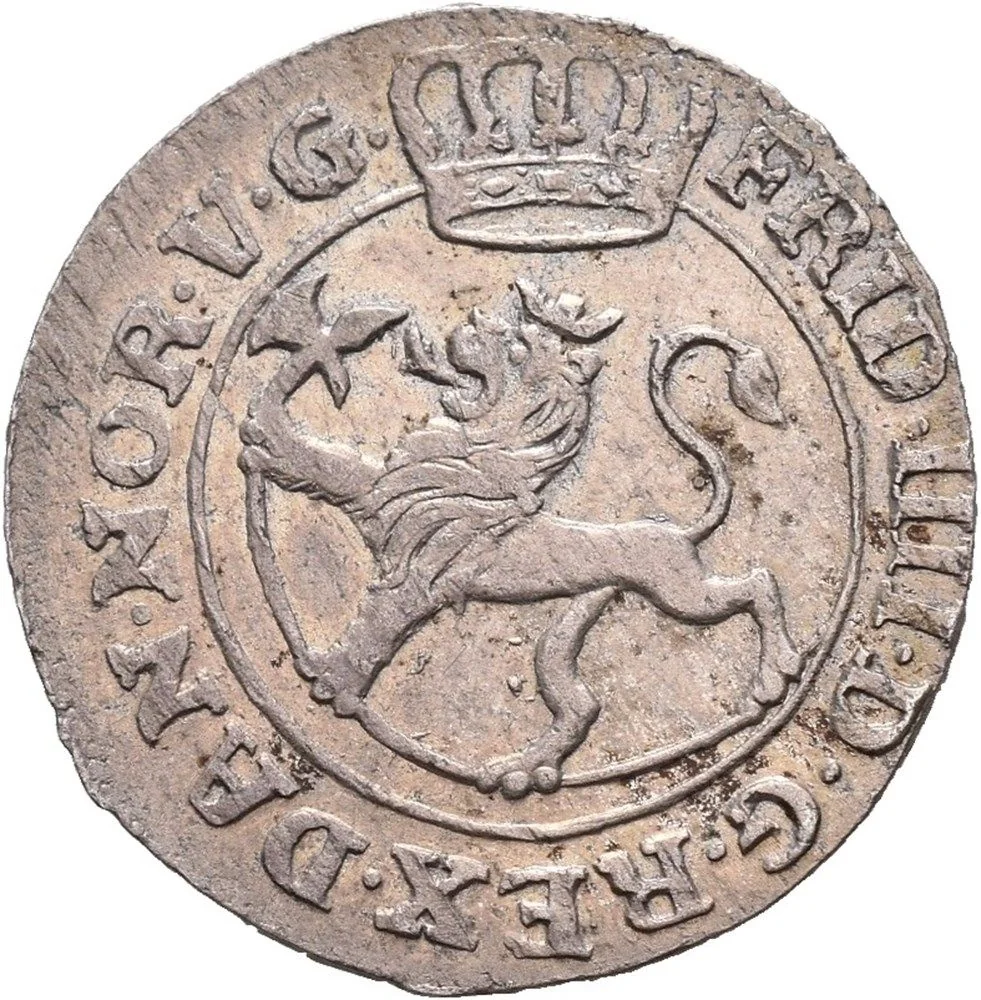
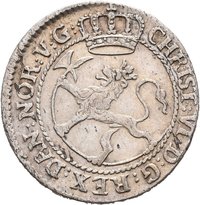
Description:
Norwegian lion with axe facing left, crowned and encircled, with outer inscription and border ring.
Inscription:
FRID·IIII·D·REX·DAN·NOR·V·G·
Script: Latin
Reverse
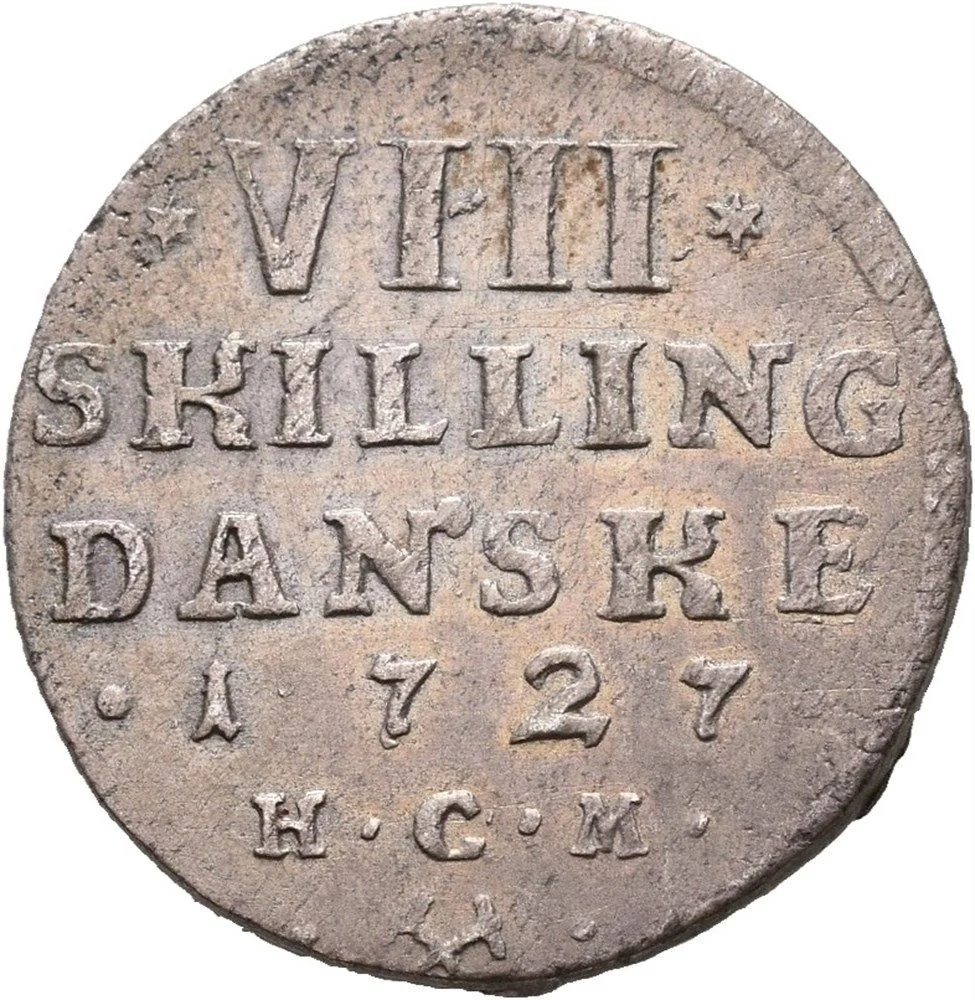
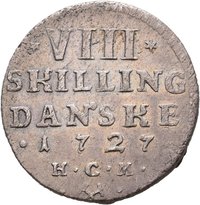
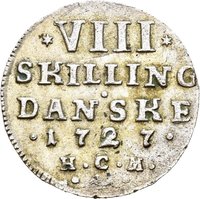
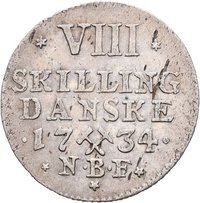
Description:
Value and date on four lines.
Mintmark and initials below.
Beaded edge ring.
Mintmark and initials below.
Beaded edge ring.
Inscription:
✶VIII✶
SKILLING
DANSKE
·1 7 2 7·
H·C·M·
· ⚒ ·
SKILLING
DANSKE
·1 7 2 7·
H·C·M·
· ⚒ ·
Script: Latin
Edge
Plain
Mints
| Name | Mark |
|---|---|
| Norwegian Mint | — |
Mintings
| Year | Mint Mark | Mintage | Quality | Collection |
|---|---|---|---|---|
| 1727 | — | — | ||
| 1728 | — | 1,324,000 | ||
| 1729 | — | 1,121,000 | ||
| 1730 | — | 1,433,000 |
Historical background
In 1727, Norway was part of the dual monarchy of Denmark-Norway, and its currency system was fundamentally tied to that of Copenhagen. The primary circulating coin was the riksdaler specie, a large silver coin that served as the monetary standard. However, the system was chronically strained by a severe shortage of small change for everyday transactions, a problem plaguing much of Europe at the time. This scarcity led to widespread use of worn, clipped, and foreign coins, creating confusion and hindering local trade.
The situation was exacerbated by the monetary policies of the Danish crown. In the preceding decades, the state had repeatedly debased the subsidiary currency—the skilling—to generate seigniorage revenue for the royal treasury, particularly to finance military engagements like the Great Northern War (1700-1721). By 1727, the link between the theoretical value of coins and their intrinsic metal content was weak, fostering public distrust. The shortage of official small coinage also led to the proliferation of private tokens issued by merchants and mining companies, like the Kongsberg Silver Works, which filled a critical gap but further complicated the monetary landscape.
Consequently, the year 1727 fell within a period of monetary instability and transition. The economic pressures would eventually lead to significant reforms, most notably the establishment of Denmark-Norway’s first central bank, the Kurantbanken, in 1736. This institution aimed to stabilize the currency by issuing regulated paper notes, marking the beginning of a long journey toward a more unified and reliable monetary system for the kingdom, though its initial decades would be challenging.
The situation was exacerbated by the monetary policies of the Danish crown. In the preceding decades, the state had repeatedly debased the subsidiary currency—the skilling—to generate seigniorage revenue for the royal treasury, particularly to finance military engagements like the Great Northern War (1700-1721). By 1727, the link between the theoretical value of coins and their intrinsic metal content was weak, fostering public distrust. The shortage of official small coinage also led to the proliferation of private tokens issued by merchants and mining companies, like the Kongsberg Silver Works, which filled a critical gap but further complicated the monetary landscape.
Consequently, the year 1727 fell within a period of monetary instability and transition. The economic pressures would eventually lead to significant reforms, most notably the establishment of Denmark-Norway’s first central bank, the Kurantbanken, in 1736. This institution aimed to stabilize the currency by issuing regulated paper notes, marking the beginning of a long journey toward a more unified and reliable monetary system for the kingdom, though its initial decades would be challenging.
💎 Extremely Rare