

16 skilling – Norway
Add to wishlist
Norway
Context
Years: 1644–1647
Issuer: Norway
Ruler: Christian IV
Currency:
(1523—1746)
Subdivision: 16 skilling = 1 Mark
Demonetization: 1813
Total mintage: 65,182
Material
References
KM: #
Numista: #99346
Value
Bullion value: $8.08
Obverse
Description:
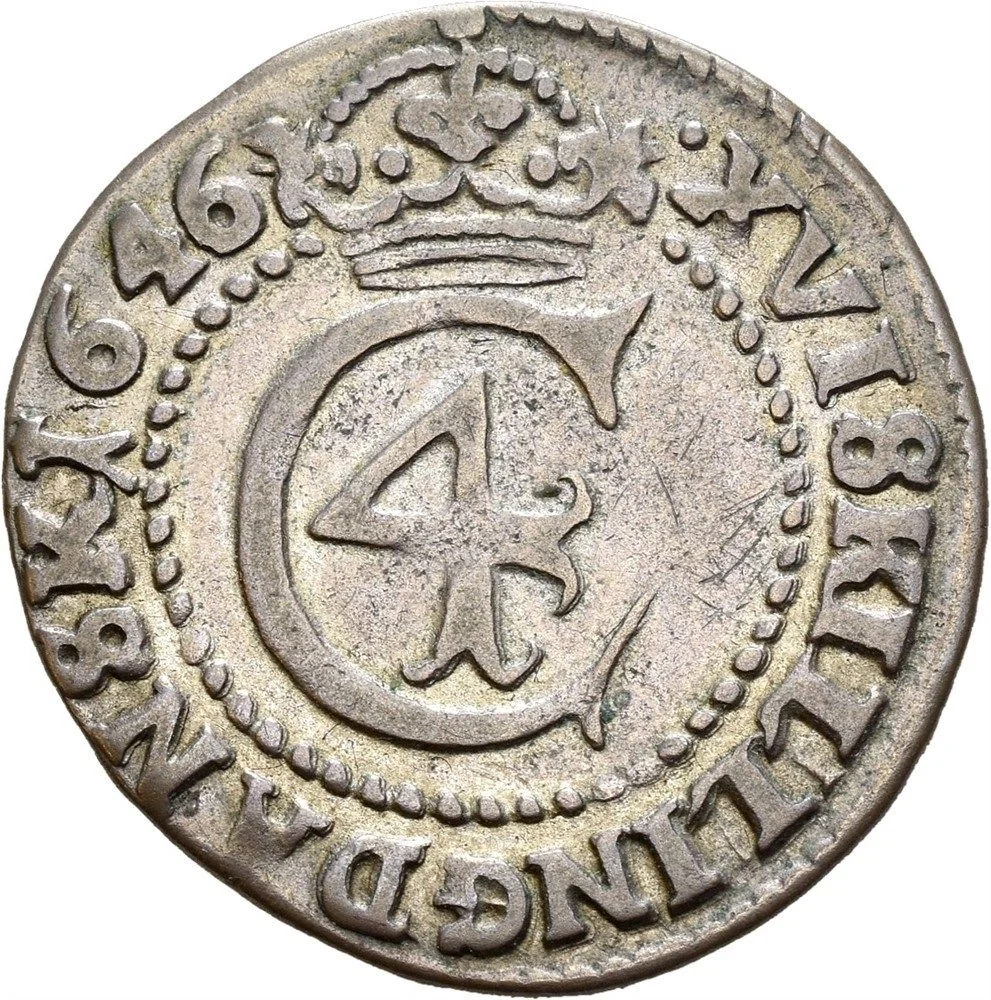
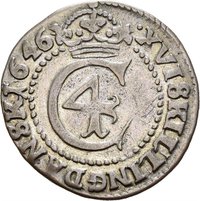
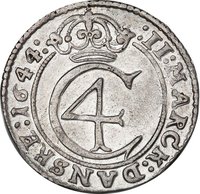
Christian IV's crowned monogram in a beaded ring, surrounded by an inscription. The rim also has a beaded ring.
Inscription:
C 4
·XVI SKILLING DANSK 1646
·XVI SKILLING DANSK 1646
Script: Latin
Reverse
Edge
Mints
| Name | Mark |
|---|---|
| Christiania | — |
Mintings
| Year | Mint Mark | Mintage | Quality | Collection |
|---|---|---|---|---|
| 1644 | — | — | ||
| 1645 | — | 48,000 | ||
| 1646 | — | 9,475 | ||
| 1647 | — | 7,707 |
Historical background
In 1644, Norway was part of the dual monarchy of Denmark-Norway, and its currency system was fundamentally governed from Copenhagen. The primary circulating coin was the Danish rigsdaler, a large silver coin, alongside a complex system of subsidiary skilling and mark denominations. However, the mid-17th century was a period of significant monetary strain across Europe, and Denmark-Norway was no exception. The state, perpetually in need of funds, particularly due to its involvement in the Thirty Years' War and the looming conflict with Sweden (the Torstenson War, 1643-1645), repeatedly resorted to debasement—reducing the silver content in coins while maintaining their face value.
This practice led to severe inflation and a chaotic monetary environment. Older, purer coins were often hoarded or melted down for their intrinsic metal value (Gresham's Law in action), leaving the public to trade with increasingly inferior currency. The situation was exacerbated by a chronic shortage of small change, which crippled everyday market transactions. In response, local merchants and towns sometimes issued emergency tokens or klippe coins (cut or stamped pieces of metal), but these were unreliable and further undermined confidence in the monetary system.
Consequently, by 1644, Norway's economy suffered from a dual crisis: a devalued and unstable national currency from the crown, and a dysfunctional local circulation that hampered commerce. This financial weakness directly impacted the Norwegian war effort against Sweden, as it strained the ability to pay and supply troops. The currency troubles of this period highlighted Norway's dependent economic position within the union and the destabilizing effects of Danish fiscal policy driven by wartime exigencies.
This practice led to severe inflation and a chaotic monetary environment. Older, purer coins were often hoarded or melted down for their intrinsic metal value (Gresham's Law in action), leaving the public to trade with increasingly inferior currency. The situation was exacerbated by a chronic shortage of small change, which crippled everyday market transactions. In response, local merchants and towns sometimes issued emergency tokens or klippe coins (cut or stamped pieces of metal), but these were unreliable and further undermined confidence in the monetary system.
Consequently, by 1644, Norway's economy suffered from a dual crisis: a devalued and unstable national currency from the crown, and a dysfunctional local circulation that hampered commerce. This financial weakness directly impacted the Norwegian war effort against Sweden, as it strained the ability to pay and supply troops. The currency troubles of this period highlighted Norway's dependent economic position within the union and the destabilizing effects of Danish fiscal policy driven by wartime exigencies.
Series: 1644 Norway circulation coins
✨ Legendary