

8 skilling – Norway
Add to wishlist
Norway
Context
Years: 1641–1642
Issuer: Norway
Ruler: Christian IV
Currency:
(1523—1746)
Demonetized: Yes
Total mintage: 19,900
Material
References
KM: #
Numista: #99123
Value
Bullion value: $5.30
Obverse
Description:
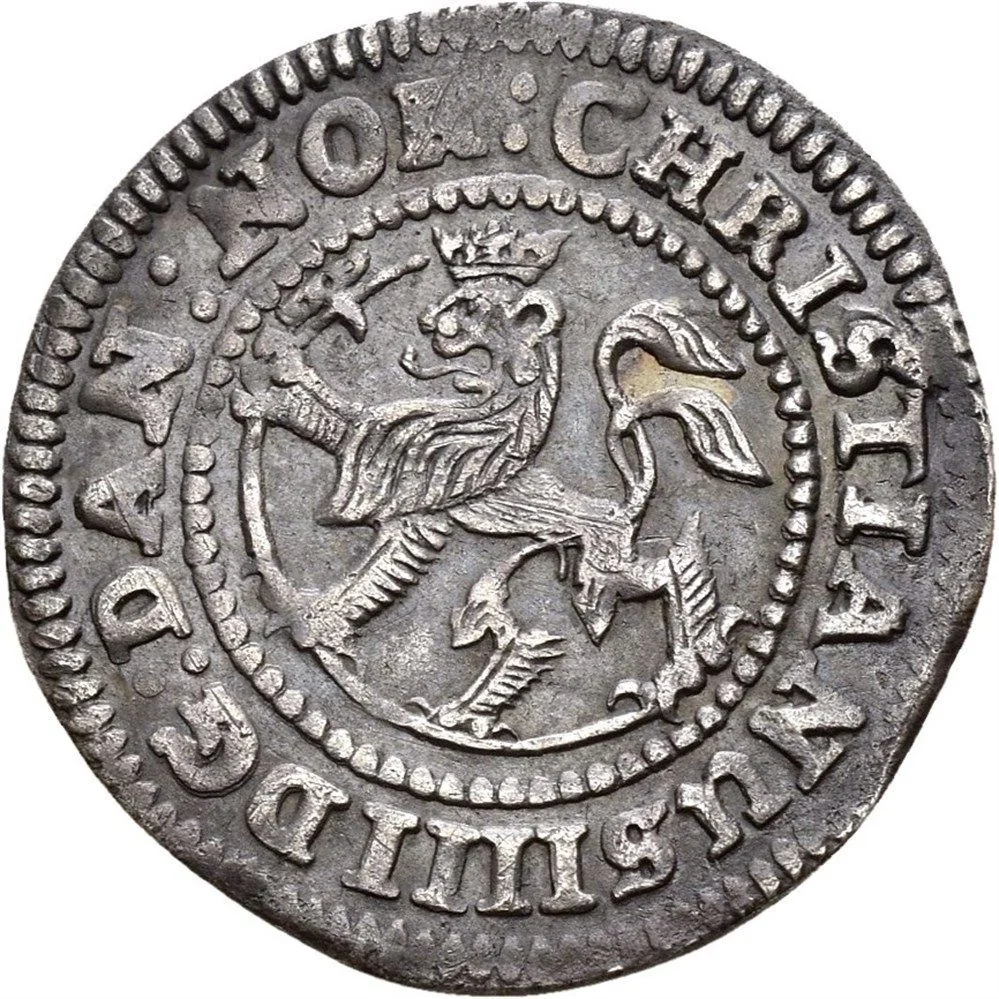
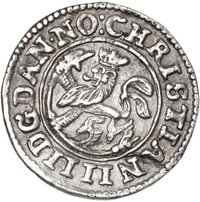
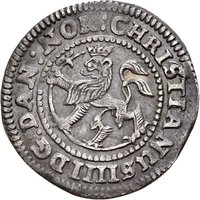
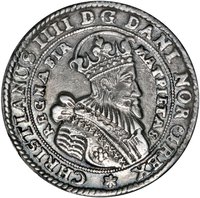
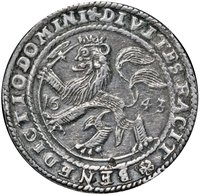
Crowned Norwegian lion with axe, left-facing, within a beaded ring and inscription. Beaded rim.
Inscription:
CHRISTIANUS IIII D G:DAN:NOR:
Script: Latin
Reverse
Description:
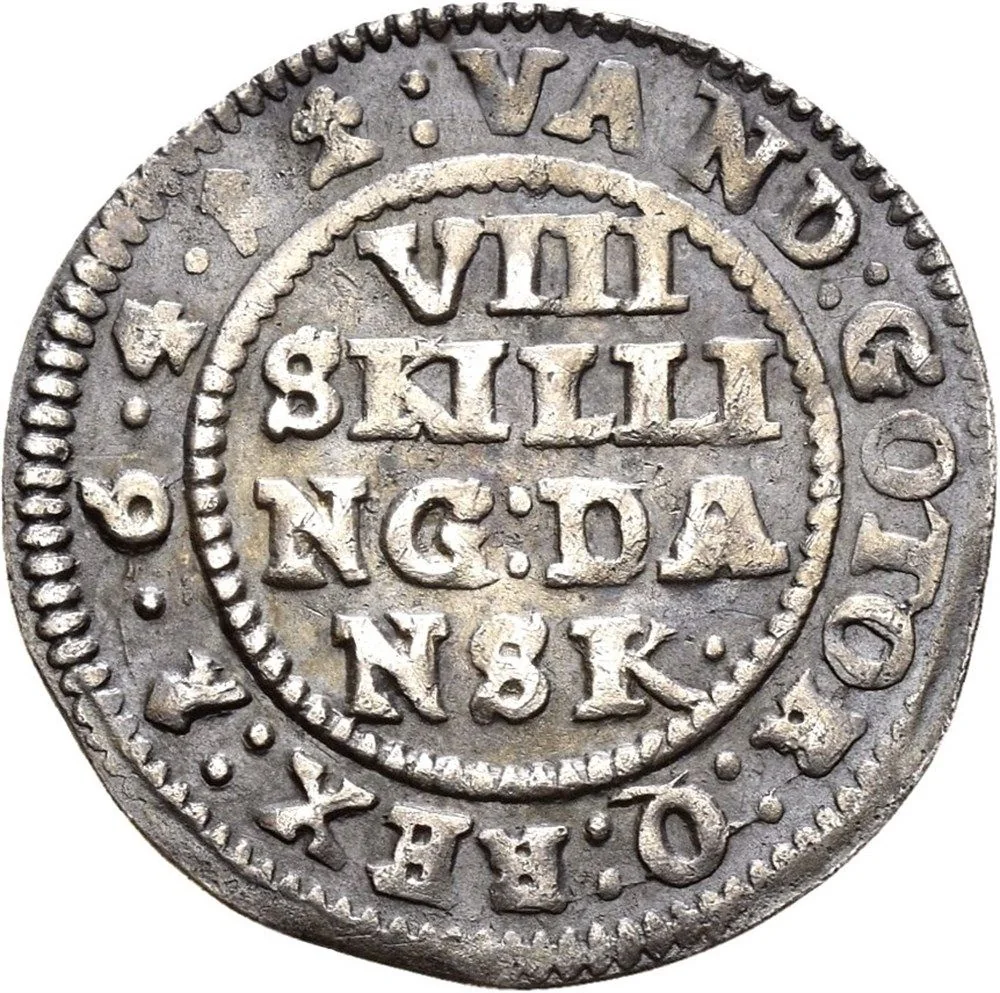
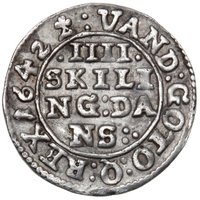
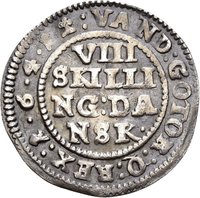
Four-line value in beaded ring, surrounded by inscription. Beaded ring on rim.
Inscription:
VIII
SKILLI
NG:DA
NSK·
:VAND:GOTOR:Q:REX:1·6·4·1 (mm)
SKILLI
NG:DA
NSK·
:VAND:GOTOR:Q:REX:1·6·4·1 (mm)
Script: Latin
Edge
Categories
| Animal |
| Symbols> Coat of Arms |
| Object> Cold weapons |
Mints
| Name | Mark |
|---|---|
| Christiania | — |
Mintings
| Year | Mint Mark | Mintage | Quality | Collection |
|---|---|---|---|---|
| 1641 | — | 3,100 | ||
| 1642 | — | 16,800 |
Historical background
In 1641, Norway was part of the dual monarchy of Denmark-Norway, and its currency system was entirely governed by the Danish crown in Copenhagen. The primary circulating coin was the Danish rigsdaler, a large silver coin that served as the monetary standard. However, the kingdom's currency was in a state of significant strain due to the Thirty Years' War (1618-1648), which placed enormous financial burdens on the state. To fund its military involvement, the government had repeatedly debased the coinage by reducing the silver content, leading to inflation and a loss of public confidence in the currency.
The domestic economy suffered from a chronic shortage of reliable small change for everyday transactions. This gap was often filled by a chaotic mix of older, clipped coins, foreign currencies (especially German and Dutch), and even primitive forms of credit or barter in remote areas. The situation was particularly acute in Norway, where a trade surplus from timber and fish exports meant that good-quality foreign silver coins flowed into the country, but these were often hoarded or exported back out by merchants, leaving the inferior, debased coins in common circulation.
Recognizing the destabilizing effects, the Danish crown had attempted reforms, notably with the Kroneordningen (Crown Regulation) of 1638. This policy aimed to stabilize the rigsdaler by tying its value to a fixed amount of pure silver and introducing new subsidiary coins. By 1641, these measures were still in their early and uncertain stages of implementation. The reform struggled to gain traction, as old habits and the ongoing war's financial demands continued to exert pressure. Thus, the currency situation in Norway in 1641 was characterized by instability, a mix of valued and devalued coins, and a royal administration grappling with the difficult task of restoring monetary order.
The domestic economy suffered from a chronic shortage of reliable small change for everyday transactions. This gap was often filled by a chaotic mix of older, clipped coins, foreign currencies (especially German and Dutch), and even primitive forms of credit or barter in remote areas. The situation was particularly acute in Norway, where a trade surplus from timber and fish exports meant that good-quality foreign silver coins flowed into the country, but these were often hoarded or exported back out by merchants, leaving the inferior, debased coins in common circulation.
Recognizing the destabilizing effects, the Danish crown had attempted reforms, notably with the Kroneordningen (Crown Regulation) of 1638. This policy aimed to stabilize the rigsdaler by tying its value to a fixed amount of pure silver and introducing new subsidiary coins. By 1641, these measures were still in their early and uncertain stages of implementation. The reform struggled to gain traction, as old habits and the ongoing war's financial demands continued to exert pressure. Thus, the currency situation in Norway in 1641 was characterized by instability, a mix of valued and devalued coins, and a royal administration grappling with the difficult task of restoring monetary order.
Series: 1641 Norway circulation coins
✨ Legendary