

2 Skilling – Norway
Norway
Context
Years: 1700–1714
Issuer: Norway 
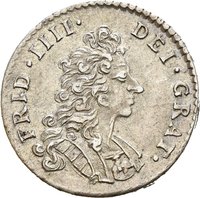
Ruler: Frederick IV
Currency:
(1523—1746)
Demonetized: Yes
Total mintage: 15,107,000
References
KM: #Click to copy to clipboard206
Numista: #99108
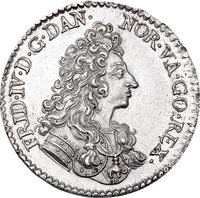
Obverse
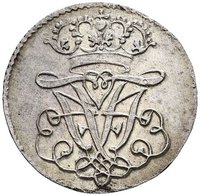
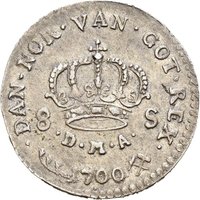
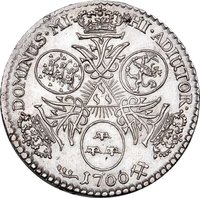
Reverse
Description:
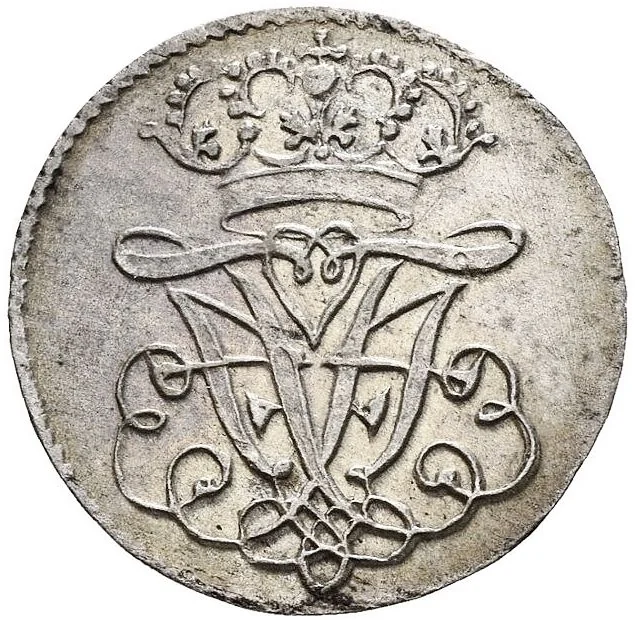
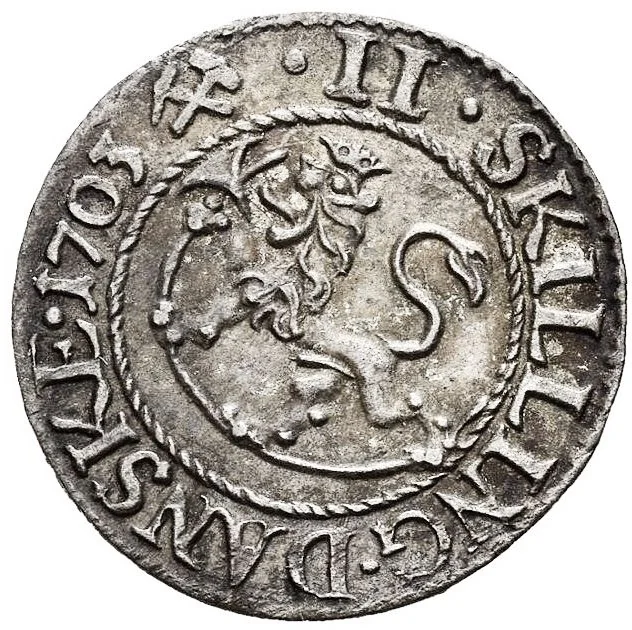
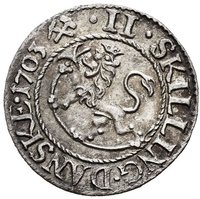
Norwegian lion crowned, holding an axe, left-facing within a braided circle and inscription. Beaded rim.
Inscription:
·II·SKILLING·DANSKE·1703 ⚒
Script: Latin
Edge
Mints
| Name | Mark |
|---|---|
| Norwegian Mint | — |
Mintings
| Year | Mint Mark | Mintage | Quality | Collection |
|---|---|---|---|---|
| 1700 | — | 613,000 | ||
| 1701 | — | 929,000 | ||
| 1702 | — | 833,000 | ||
| 1703 | — | 569,000 | ||
| 1704 | — | — | ||
| 1705 | — | 980,000 | ||
| 1706 | — | 890,000 | ||
| 1707 | — | 1,013,000 | ||
| 1708 | — | 1,307,000 | ||
| 1709 | — | 1,149,000 | ||
| 1710 | — | 1,176,000 | ||
| 1711 | — | 1,663,000 | ||
| 1712 | — | 1,713,000 | ||
| 1713 | — | 1,379,000 | ||
| 1714 | — | 893,000 |
Historical background
In the early 18th century, Norway, then in a union with Denmark under the Danish-Norwegian monarchy, faced a complex and challenging currency situation. The primary circulating coin was the Danish rigsdaler, but the system was plagued by a severe shortage of small change for everyday transactions. This scarcity was exacerbated by the widespread circulation of numerous foreign coins, particularly German and Dutch, which entered through trade. Their variable and often debased values created confusion and hindered commerce, as merchants and the public struggled to assess true worth.
The underlying problem was rooted in the monetary policies set in Copenhagen, which often prioritized the needs of the Danish state over Norwegian conditions. A significant issue was the practice of "forringelse" (debasing), where the state would periodically reduce the silver content in coins to generate seigniorage revenue for the royal treasury. This eroded public trust in the currency, as people hoarded older, purer coins (Gresham's Law in action), further removing sound money from circulation. The result was an unreliable monetary environment that stifled economic growth and created practical difficulties for the common population.
Efforts to reform the system were sporadic and largely ineffective until later in the century. The state attempted to introduce regulated rates for foreign coins and issue new subsidiary coinage, but confidence was low. The situation only began to stabilize after the establishment of the Danish Rigsbank in 1736, which issued paper credit notes, and with more consistent royal ordinances. However, in 1700, Norway's currency remained a fragmented and unstable system, characterized by scarcity, confusion, and a lack of sovereign monetary control, reflecting its subordinate position within the dual monarchy.
The underlying problem was rooted in the monetary policies set in Copenhagen, which often prioritized the needs of the Danish state over Norwegian conditions. A significant issue was the practice of "forringelse" (debasing), where the state would periodically reduce the silver content in coins to generate seigniorage revenue for the royal treasury. This eroded public trust in the currency, as people hoarded older, purer coins (Gresham's Law in action), further removing sound money from circulation. The result was an unreliable monetary environment that stifled economic growth and created practical difficulties for the common population.
Efforts to reform the system were sporadic and largely ineffective until later in the century. The state attempted to introduce regulated rates for foreign coins and issue new subsidiary coinage, but confidence was low. The situation only began to stabilize after the establishment of the Danish Rigsbank in 1736, which issued paper credit notes, and with more consistent royal ordinances. However, in 1700, Norway's currency remained a fragmented and unstable system, characterized by scarcity, confusion, and a lack of sovereign monetary control, reflecting its subordinate position within the dual monarchy.
Series: 1700 Norway circulation coins
⭐ Rare