

2 skilling – Norway
Add to wishlist
Norway
Context
Years: 1675–1683
Issuer: Norway
Ruler: Christian V
Currency:
(1523—1746)
Demonetized: Yes
Total mintage: 2,871,000
References
KM: #
Numista: #99104
Obverse
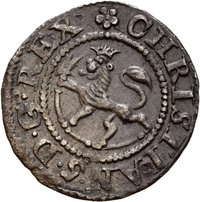
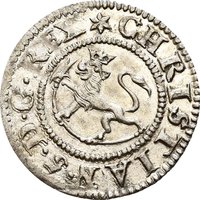
Description:
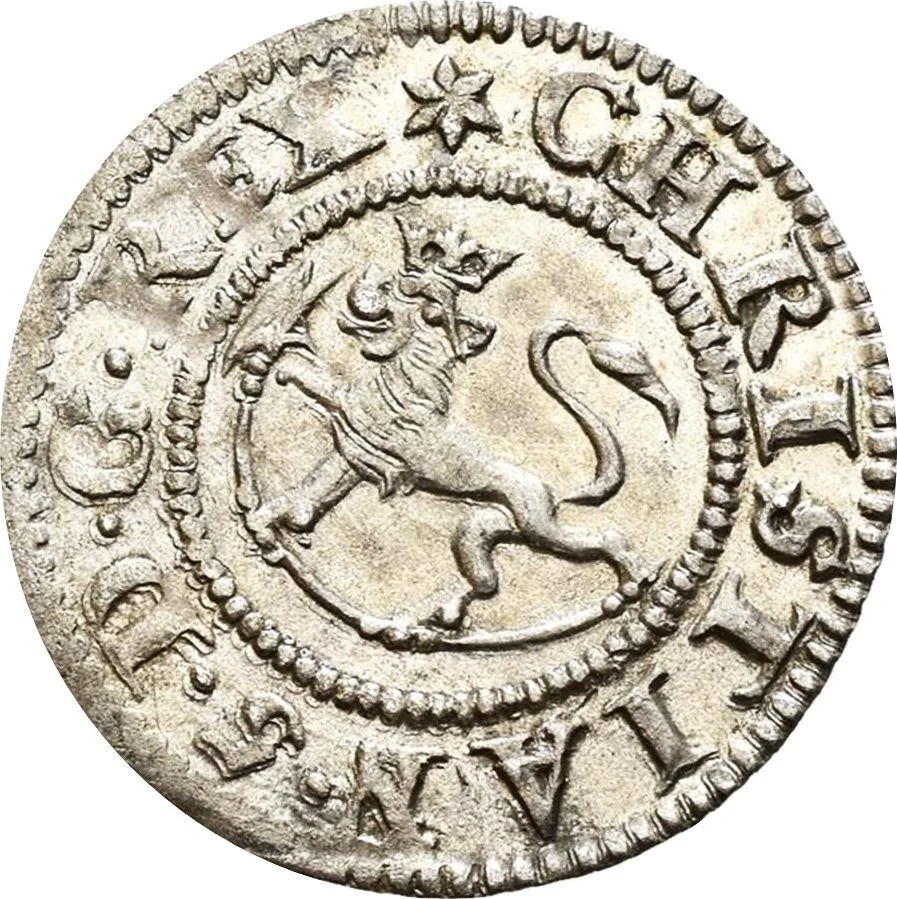
Crowned Norwegian lion with axe, left-facing, within a beaded ring and inscription. Beaded rim.
Inscription:
CHRISTIAN·5·D·G·REX 🟌
Script: Latin
Reverse
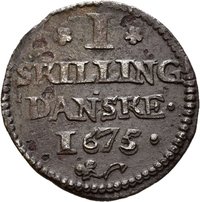
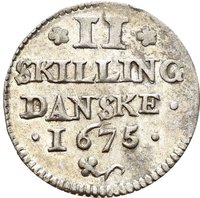
Description:
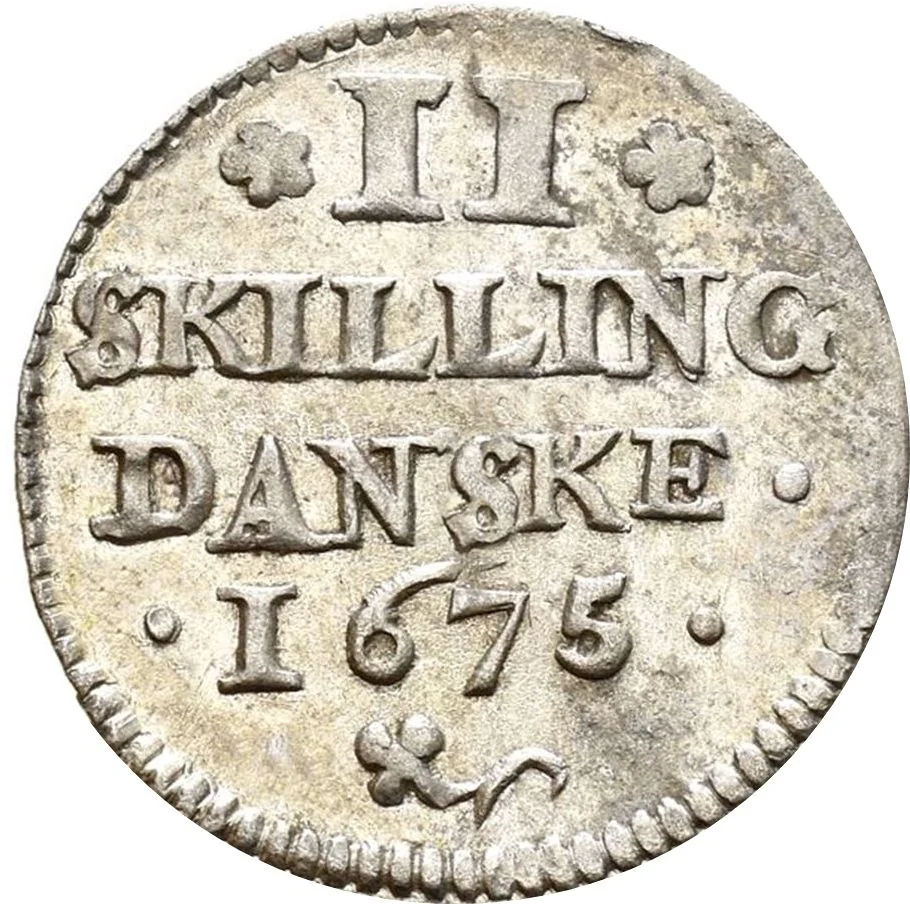
Value and date stacked.
Mintmark under date.
Beaded rim border.
Mintmark under date.
Beaded rim border.
Inscription:
✿ II ✿
SKILLING
DANSKE·
·1675·
SKILLING
DANSKE·
·1675·
Script: Latin
Edge
Plain
Mints
| Name | Mark |
|---|---|
| Christiania | — |
Mintings
| Year | Mint Mark | Mintage | Quality | Collection |
|---|---|---|---|---|
| 1675 | — | 272,000 | ||
| 1676 | — | 95,000 | ||
| 1677 | — | 89,000 | ||
| 1678 | — | 370,000 | ||
| 1679 | — | 499,000 | ||
| 1680 | — | 528,000 | ||
| 1681 | — | 441,000 | ||
| 1682 | — | 331,000 | ||
| 1683 | — | 246,000 |
Historical background
In 1675, Norway was part of the dual monarchy of Denmark-Norway, and its currency system was directly controlled by the royal administration in Copenhagen. The primary circulating coin was the silver riksdaler, but the monetary landscape was chaotic and problematic. A severe shortage of small change crippled everyday commerce, leading to widespread use of fragmented coins, private tokens, and even barter, especially in rural areas. This scarcity was exacerbated by the fact that much of Norway's silver was exported to pay for imports, draining the kingdom of precious metal.
The situation was further complicated by the ongoing Scanian War (1675-1679) against Sweden, which placed enormous financial strain on the state. To fund military operations, the government resorted to debasement—reducing the silver content in coins while maintaining their face value. This practice, combined with the circulation of older, purer coins and foreign currency, led to significant confusion and loss of public trust. Gresham's Law took hold, where "bad" debased money drove "good" full-weight silver out of circulation, either into hoards or abroad.
Consequently, 1675 represents a point of significant monetary stress within the larger 17th-century "Currency Chaos" period in Norway. The twin pressures of wartime finance and a structural shortage of coinage created an unstable and inefficient economy. This crisis would eventually contribute to the establishment of a national bank in Denmark-Norway later in the century, though in 1675, Norwegians contended with a unreliable currency that hampered both trade and daily life.
The situation was further complicated by the ongoing Scanian War (1675-1679) against Sweden, which placed enormous financial strain on the state. To fund military operations, the government resorted to debasement—reducing the silver content in coins while maintaining their face value. This practice, combined with the circulation of older, purer coins and foreign currency, led to significant confusion and loss of public trust. Gresham's Law took hold, where "bad" debased money drove "good" full-weight silver out of circulation, either into hoards or abroad.
Consequently, 1675 represents a point of significant monetary stress within the larger 17th-century "Currency Chaos" period in Norway. The twin pressures of wartime finance and a structural shortage of coinage created an unstable and inefficient economy. This crisis would eventually contribute to the establishment of a national bank in Denmark-Norway later in the century, though in 1675, Norwegians contended with a unreliable currency that hampered both trade and daily life.
Series: 1675 Norway circulation coins
💎 Extremely Rare