

Panama
Context
Material
References
KM: #Click to copy to clipboard15
Numista: #12035
Value
Exchange value: 0.0125 PAB
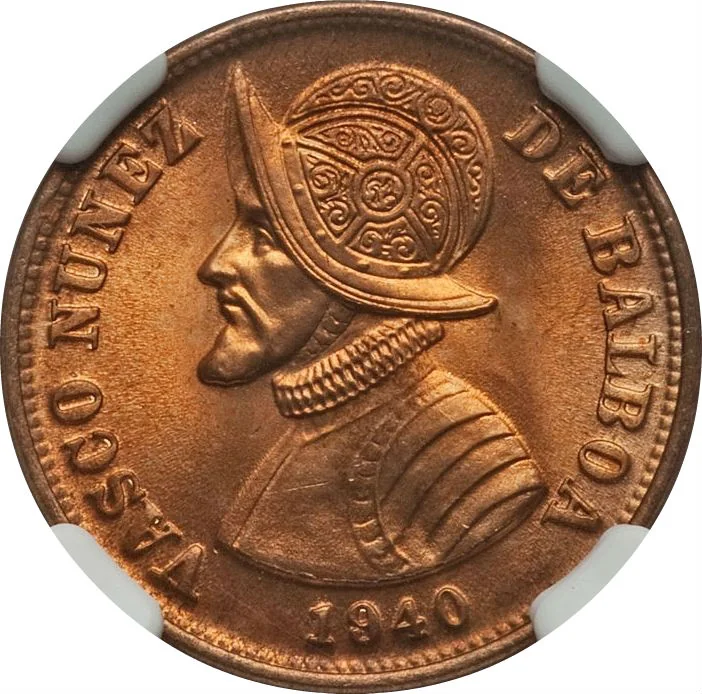
Obverse
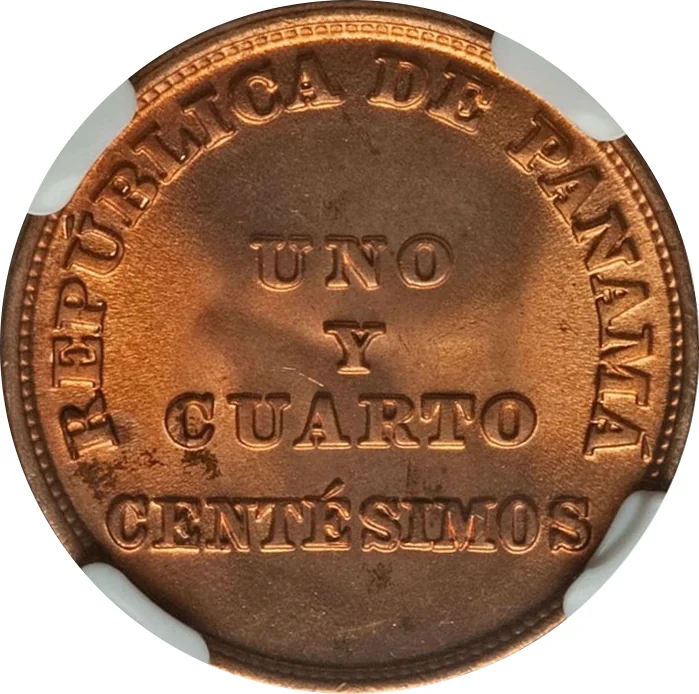
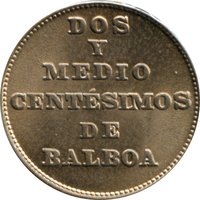
Reverse
Description:
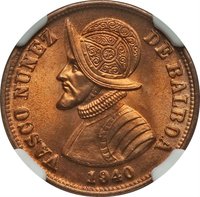
Bust of helmeted Balboa facing left, encircled by legend.
Inscription:
VASCO NUNEZ DE BALBOA
1940
1940
Script: Latin
Edge
Plain
Mints
| Name | Mark |
|---|---|
| United States Mint of Philadelphia | — |
Mintings
| Year | Mint Mark | Mintage | Quality | Collection |
|---|---|---|---|---|
| 1940 | — | 1,600,000 |
Historical background
In 1940, Panama's currency situation was uniquely defined by its relationship with the United States, stemming from its independence in 1903 and the construction of the Panama Canal. Unlike most sovereign nations, Panama did not issue its own paper currency. Instead, the official monetary system was based on the Balboa, which was pegged at par to the United States dollar. U.S. paper dollars circulated freely and were the dominant paper currency in everyday use, while Panama minted its own subsidiary silver coins (centésimos and balboas) that were equivalent in size and value to their U.S. coin counterparts. This arrangement created a de facto dollarized economy, with monetary policy effectively set by the U.S. Federal Reserve.
The outbreak of World War II in 1939 and the pivotal strategic importance of the Panama Canal heightened U.S. economic and security concerns in the region. While Panama's currency peg remained stable, the global conflict caused economic disruptions. The war affected international trade flows through the Canal and created inflationary pressures on imported goods. Furthermore, to safeguard its interests and ensure stability, the United States increased its economic oversight and financial presence in the Canal Zone, reinforcing the dollar's dominance and further intertwining the two economies.
Despite these wartime pressures, the currency system itself did not undergo significant structural change in 1940. The fixed parity with the U.S. dollar provided a crucial anchor of stability, shielding Panama from the currency volatility and devaluations experienced by many other Latin American nations during the period. However, this arrangement also meant Panama had no independent monetary tools to manage its domestic economy, leaving it vulnerable to U.S. economic conditions and policy decisions. Thus, in 1940, Panama's currency landscape was one of imposed stability, characterized by a complete reliance on the U.S. dollar as the bedrock of its financial system amidst a turbulent global backdrop.
The outbreak of World War II in 1939 and the pivotal strategic importance of the Panama Canal heightened U.S. economic and security concerns in the region. While Panama's currency peg remained stable, the global conflict caused economic disruptions. The war affected international trade flows through the Canal and created inflationary pressures on imported goods. Furthermore, to safeguard its interests and ensure stability, the United States increased its economic oversight and financial presence in the Canal Zone, reinforcing the dollar's dominance and further intertwining the two economies.
Despite these wartime pressures, the currency system itself did not undergo significant structural change in 1940. The fixed parity with the U.S. dollar provided a crucial anchor of stability, shielding Panama from the currency volatility and devaluations experienced by many other Latin American nations during the period. However, this arrangement also meant Panama had no independent monetary tools to manage its domestic economy, leaving it vulnerable to U.S. economic conditions and policy decisions. Thus, in 1940, Panama's currency landscape was one of imposed stability, characterized by a complete reliance on the U.S. dollar as the bedrock of its financial system amidst a turbulent global backdrop.
🌱 Common