

6 Mariengroschen – Brunswick-Lüneburg-Calenberg-Hannover
Germany

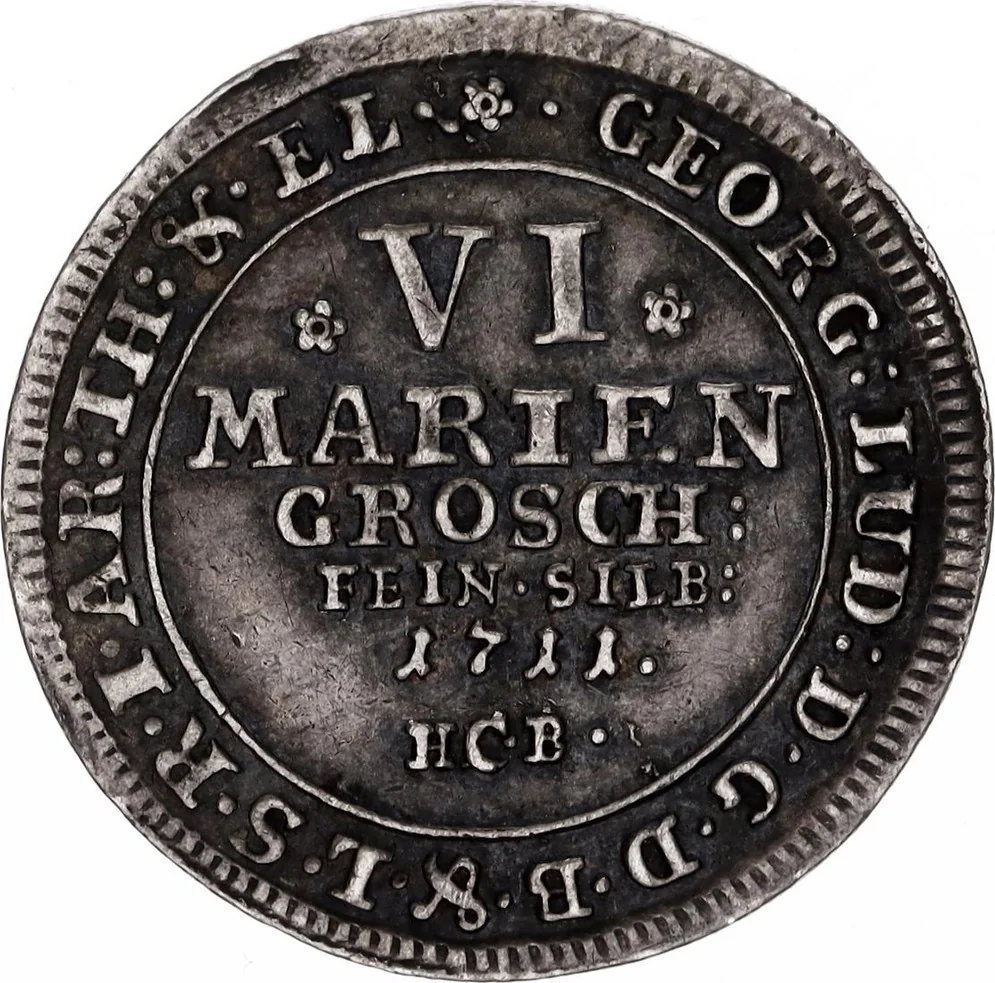
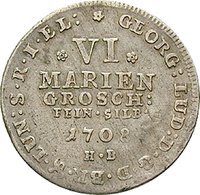
Obverse
Description:
Central inscription in five lines with denomination and mintmaster initials; date ends surrounding legend.
Inscription:
*VI*
MARIEN
GROSCH:
FEIN*SILB:
H*B
GEORG:LUD:D.G.D.BR.&.LUN:S.R.I.EL.1710
MARIEN
GROSCH:
FEIN*SILB:
H*B
GEORG:LUD:D.G.D.BR.&.LUN:S.R.I.EL.1710
Script: Latin
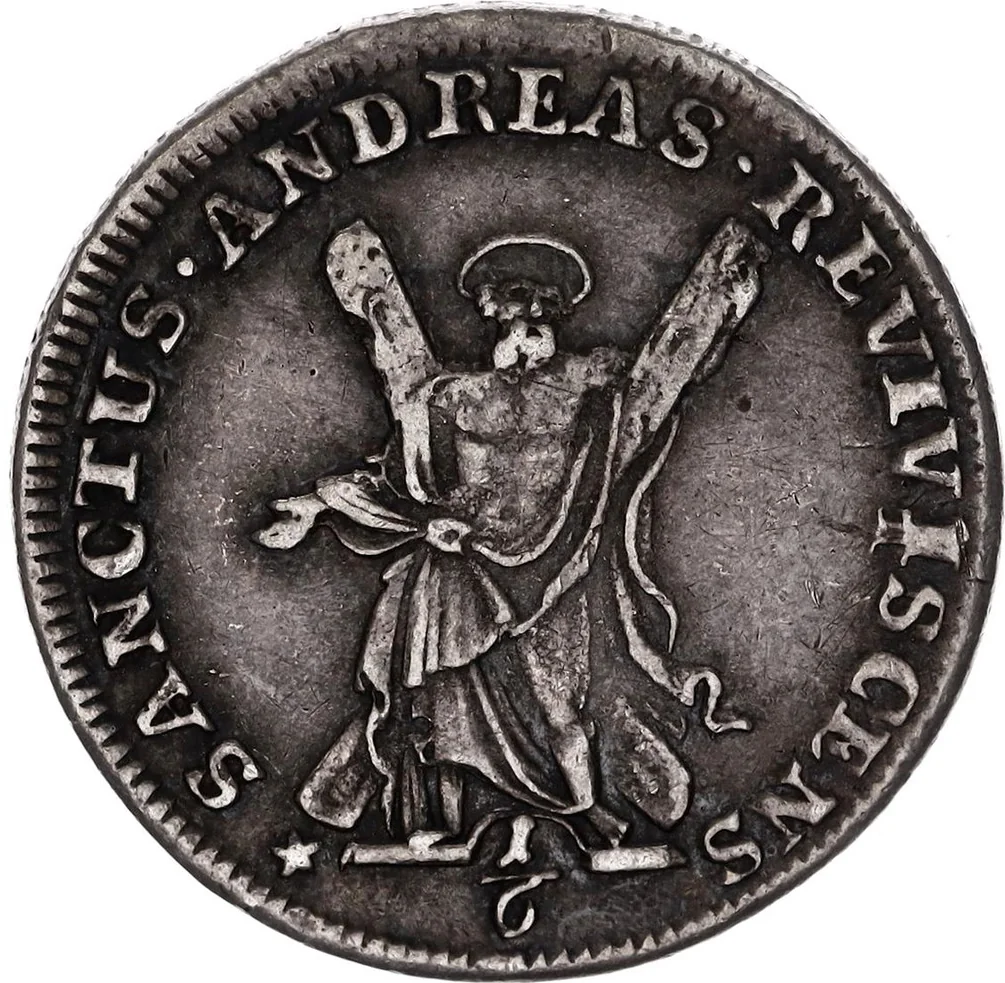
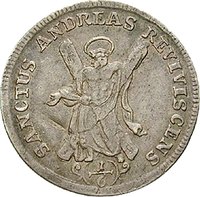
Reverse
Description:
St Andrew, cross, denomination below, legend around.
Inscription:
SANCTUS ANDREAS REVIVISCENS
Script: Latin
Edge
Mints
| Name | Mark |
|---|---|
| Clausthal | — |
Mintings
| Year | Mint Mark | Mintage | Quality | Collection |
|---|---|---|---|---|
| 1710 | — | — | ||
| 1711 | — | — |
Historical background
In 1710, the currency situation in the Duchy of Brunswick-Lüneburg, specifically the Principality of Calenberg (with its capital in Hanover), was characterized by significant complexity and instability. The Holy Roman Empire was a mosaic of over 300 states, each with the right to mint coinage, leading to a chaotic system where numerous foreign and debased coins circulated alongside local issues. The primary accounting unit was the Reichsthaler, but the actual physical coins in circulation—such as Gute Groschen, Mariengroschen, and Pfennige—varied wildly in their intrinsic silver content and value from region to region. This created a perpetual challenge for trade and taxation, as values had to be constantly recalculated.
The root of the problem in Calenberg-Hanover, as elsewhere, was the practice of Kipper- und Wipperzeit debasement from earlier decades, where rulers had reduced the silver content of coins to finance state expenditures, particularly military costs during conflicts like the Thirty Years' War. Although the worst excesses were past, the legacy was a severely compromised monetary system. In 1710, Elector George Louis (who would become King George I of Great Britain in 1714) governed the territory, and his frequent absences and preoccupation with European politics and succession meant that comprehensive monetary reform was likely a secondary concern. The local economy thus operated with a mix of older, better-quality coins hoarded by the public and newer, lighter coins.
Consequently, daily commerce in Hanover in 1710 relied heavily on small-change coins of uncertain value, causing hardship for common people and disrupting market confidence. While attempts at standardization were made through imperial ordinances, enforcement was weak. The situation demanded constant vigilance from merchants and officials, and it underscored the need for the strong, centralized monetary authority that would only emerge later in the century. This monetary fragmentation mirrored the political fragmentation of the Empire itself, hindering economic cohesion within the electorate.
The root of the problem in Calenberg-Hanover, as elsewhere, was the practice of Kipper- und Wipperzeit debasement from earlier decades, where rulers had reduced the silver content of coins to finance state expenditures, particularly military costs during conflicts like the Thirty Years' War. Although the worst excesses were past, the legacy was a severely compromised monetary system. In 1710, Elector George Louis (who would become King George I of Great Britain in 1714) governed the territory, and his frequent absences and preoccupation with European politics and succession meant that comprehensive monetary reform was likely a secondary concern. The local economy thus operated with a mix of older, better-quality coins hoarded by the public and newer, lighter coins.
Consequently, daily commerce in Hanover in 1710 relied heavily on small-change coins of uncertain value, causing hardship for common people and disrupting market confidence. While attempts at standardization were made through imperial ordinances, enforcement was weak. The situation demanded constant vigilance from merchants and officials, and it underscored the need for the strong, centralized monetary authority that would only emerge later in the century. This monetary fragmentation mirrored the political fragmentation of the Empire itself, hindering economic cohesion within the electorate.
💎 Extremely Rare