

¼ moeda – Portugal
Add to wishlist
Portugal
Material
Diameter: 24 mm
Weight: 3.1 g
Gold Weight:: 2.84 g
Shape: Irregular round
Composition: 91.67% Gold
Standard: Gold tenth ounce
Magnetic: No
Technique: Hammered
References
KM: #
Numista: #97963
Value
Bullion value: $436.28
Obverse
Description:
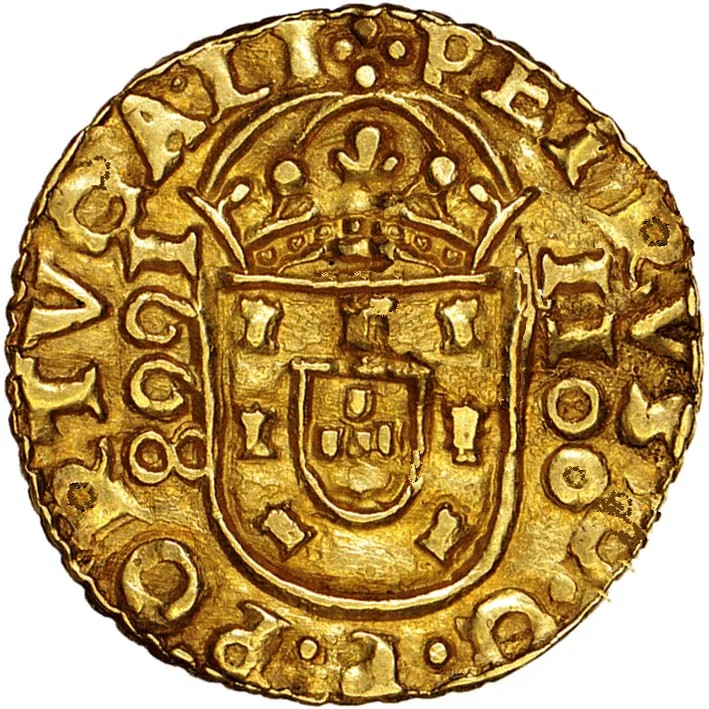
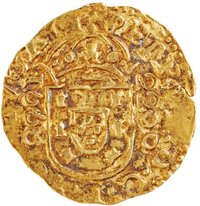
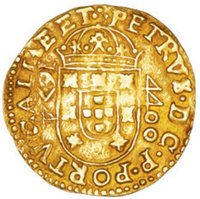
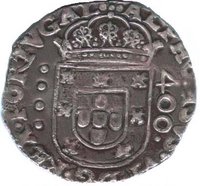
Crowned arms flanked by date and value.
Inscription:
PETRVS D G PORTVGALIÆ
1668 / 1100
1668 / 1100
Script: Latin
Reverse
Edge
Mintings
| Year | Mint Mark | Mintage | Quality | Collection |
|---|---|---|---|---|
| 1668 | — | — | ||
| 1671 | — | — |
Historical background
In 1668, Portugal’s currency situation was complex and challenging, emerging from nearly three decades of war. The signing of the Treaty of Lisbon that year, which ended the War of Restoration against Spain (1640-1668), brought political sovereignty but left the kingdom’s finances in a dire state. Decades of immense military expenditure had been funded through desperate measures, including heavy taxation, borrowing, and—most critically for the currency—the severe debasement of the coinage. Kings John IV and Afonso VI had repeatedly reduced the silver content of coins like the cruzado to mint more money from limited bullion reserves, leading to rampant inflation and a loss of public confidence in the monetary system.
The circulating medium was a chaotic mix of officially minted coins of varying intrinsic values, alongside a flood of foreign currencies, particularly Spanish silver reales and Dutch gold ducats, which often held more stable value. This multiplicity of coins, each with fluctuating exchange rates, crippled domestic trade and complicated tax collection. The Portuguese economy, heavily reliant on colonial trade from Brazil and India, suffered as the degraded coinage failed to provide a reliable unit of account, undermining commercial contracts and state revenues at a time when the crown desperately needed to rebuild.
Recognizing this crisis as a threat to both economic recovery and royal authority, the post-war government under the regent Prince Peter (soon to be King Peter II) initiated a major monetary reform. Beginning in the late 1660s and culminating in the 1688 Padrão decree, this reform systematically recalled old debased coins and introduced a new, stable currency based on the cruzado with a fixed silver content. Therefore, 1668 stands as a pivotal juncture, marking the end of wartime fiscal expediency and the beginning of a concerted, though difficult, effort to restore monetary stability and credibility to the Portuguese kingdom.
The circulating medium was a chaotic mix of officially minted coins of varying intrinsic values, alongside a flood of foreign currencies, particularly Spanish silver reales and Dutch gold ducats, which often held more stable value. This multiplicity of coins, each with fluctuating exchange rates, crippled domestic trade and complicated tax collection. The Portuguese economy, heavily reliant on colonial trade from Brazil and India, suffered as the degraded coinage failed to provide a reliable unit of account, undermining commercial contracts and state revenues at a time when the crown desperately needed to rebuild.
Recognizing this crisis as a threat to both economic recovery and royal authority, the post-war government under the regent Prince Peter (soon to be King Peter II) initiated a major monetary reform. Beginning in the late 1660s and culminating in the 1688 Padrão decree, this reform systematically recalled old debased coins and introduced a new, stable currency based on the cruzado with a fixed silver content. Therefore, 1668 stands as a pivotal juncture, marking the end of wartime fiscal expediency and the beginning of a concerted, though difficult, effort to restore monetary stability and credibility to the Portuguese kingdom.
✨ Legendary