

1 cash – Madras Presidency
Add to wishlist
India
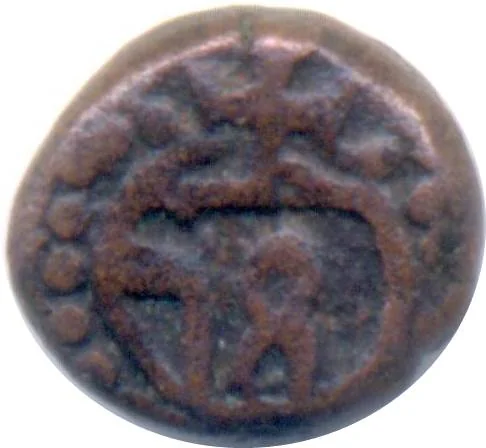
Obverse
Description:
Bale mark: "16"78" in beaded circle.
Inscription:
78
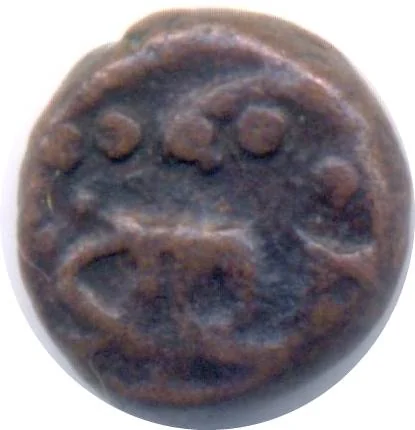
Reverse
Description:
Legend in Telugu,
within an oval.
within an oval.
Inscription:
శ్రీ
రంగ
రంగ
Edge
Plain
Mintings
| Year | Mint Mark | Mintage | Quality | Collection |
|---|---|---|---|---|
| 1678 | — | — |
Historical background
In 1678, the currency situation in the Madras Presidency, administered by the English East India Company, was complex and transitional. The primary circulating medium was a diverse mix of Indian and European coins, reflecting the region's integration into both local and global trade networks. The most important local unit was the gold pagoda, a durable South Indian coin that served as the standard for high-value transactions and Company accounts. Alongside it circulated a plethora of silver rupees (from Mughal mints), copper cash coins for small daily use, and various European silver coins like Spanish Reales and Dutch Ducatoons, which were valued by weight and purity.
This multiplicity created significant challenges for commerce and administration. Exchange rates between gold, silver, and copper coins were highly volatile, influenced by fluctuating bullion supplies, seasonal trade winds, and the varying metallic purity of coins from different issuing authorities. The East India Company, operating from its fortified settlement of Fort St. George, struggled to establish a stable monetary standard for its own trade, revenue collection, and payment of its soldiers and servants. Transactions required expert "shroffs" (money-changers) to assess and convert currencies, leading to inefficiency and potential for fraud.
Recognizing these problems, the Company authorities in Madras were actively moving towards greater monetary control. Just a few years prior, in 1674, they had received the right to mint coins from the local Nayak rulers, and by 1678 they were issuing Madras fanams and gold pagodas stamped with the Company's insignia. This year thus represents a pivotal moment where the Company was transitioning from a passive user of existing currency systems to an active minting authority, laying the foundational economic infrastructure for future colonial rule. The goal was to simplify trade, stabilize revenue, and ultimately project sovereign power through the very coinage of the Presidency.
This multiplicity created significant challenges for commerce and administration. Exchange rates between gold, silver, and copper coins were highly volatile, influenced by fluctuating bullion supplies, seasonal trade winds, and the varying metallic purity of coins from different issuing authorities. The East India Company, operating from its fortified settlement of Fort St. George, struggled to establish a stable monetary standard for its own trade, revenue collection, and payment of its soldiers and servants. Transactions required expert "shroffs" (money-changers) to assess and convert currencies, leading to inefficiency and potential for fraud.
Recognizing these problems, the Company authorities in Madras were actively moving towards greater monetary control. Just a few years prior, in 1674, they had received the right to mint coins from the local Nayak rulers, and by 1678 they were issuing Madras fanams and gold pagodas stamped with the Company's insignia. This year thus represents a pivotal moment where the Company was transitioning from a passive user of existing currency systems to an active minting authority, laying the foundational economic infrastructure for future colonial rule. The goal was to simplify trade, stabilize revenue, and ultimately project sovereign power through the very coinage of the Presidency.
✨ Legendary